

Eternity Band or Anniversary Ring? A Lab Grown Diamond Buying Guide by Milestone Year
Eternity bands and anniversary rings get confused constantly, and it’s easy to see why — from across a room, they can look nearly identical. But the actual difference between them is specific and worth understanding properly before you shop, because it changes comfort, cost, resizing options, and how the piece will actually wear over years of daily use.
This guide covers exactly what separates eternity bands anniversary rings from each other, which setting styles suit each best, and how lab grown diamond pricing has made both genuinely more accessible across a much wider range of milestone years than they used to be. It also covers the traditional gemstone-by-year calendar many buyers use to guide a milestone gift, and how lab grown diamonds fit into that tradition even in years where the “official” stone isn’t a diamond at all.
What’s the Actual Difference Between Eternity Bands and Anniversary Rings?
For eternity bands anniversary rings, the distinction comes down to one specific structural detail: how far the stones go around the band. An eternity band carries a continuous, unbroken line of stones all the way around the full circumference of the ring — there’s no plain metal section anywhere, front or back. An anniversary ring, by contrast, sets stones only across the front or top portion, leaving the underside of the band plain.
This isn’t just a cosmetic difference. A full eternity band worn as a daily-wear piece sits stones directly against the palm side of the finger, which some wearers find less comfortable over time and which also makes future resizing genuinely more difficult, since there’s no plain metal section to work with. An anniversary ring’s plain underside solves both problems while still delivering a very similar look from the front and top — which is exactly why many buyers who love the eternity aesthetic choose an anniversary-style ring instead for genuine daily wear.
Setting Styles for Eternity Bands Anniversary Rings
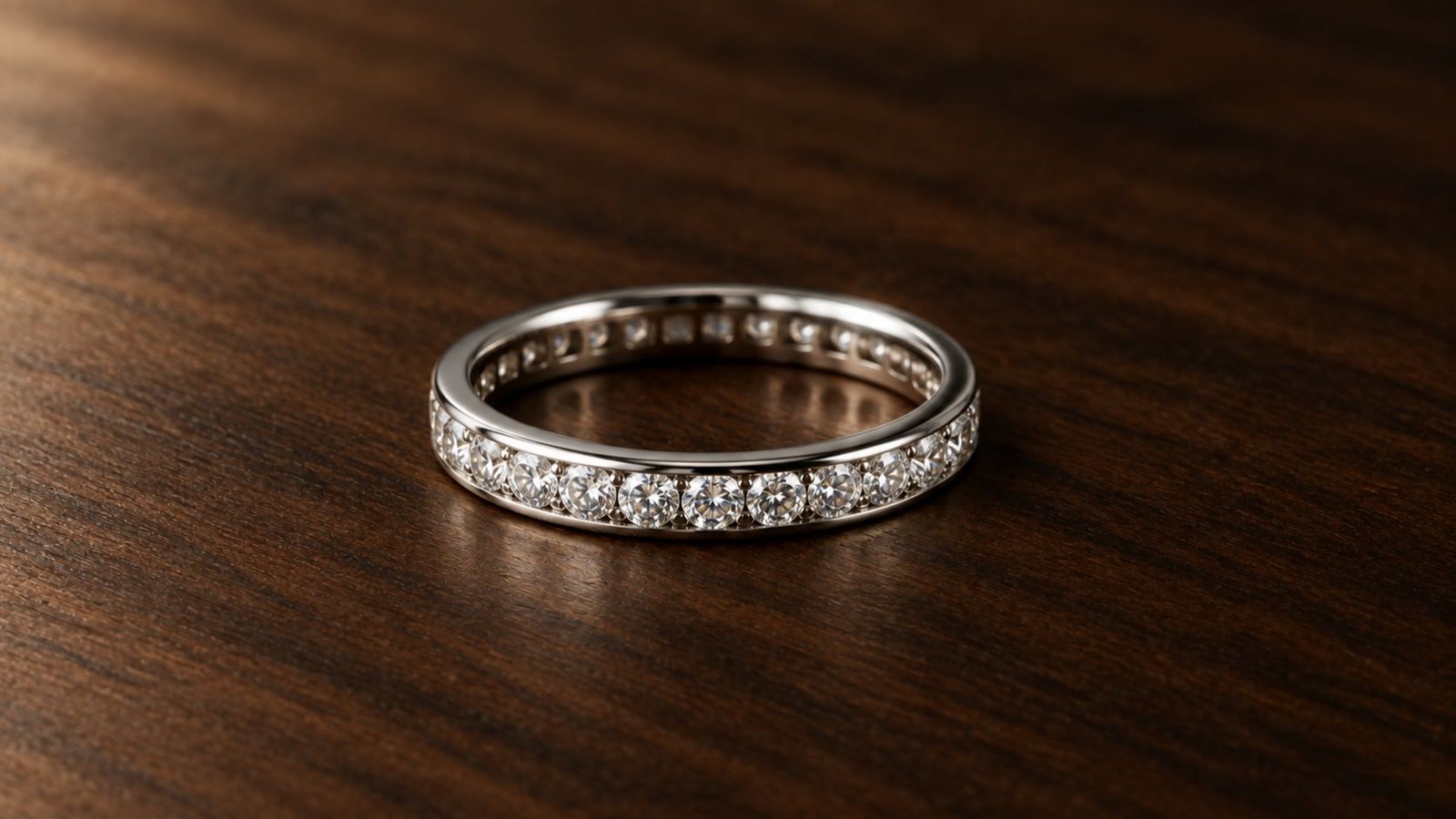
The setting style used along eternity bands anniversary rings changes durability, sparkle, and daily comfort just as much as the eternity-versus-anniversary structural choice does.
Prong settings hold each stone with visible claws, maximising light entry and delivering the strongest sparkle of any eternity band style, though the raised prongs sit slightly proud of the band and can catch on fabric more than flatter styles.
Channel settings secure stones between two parallel metal walls with no visible prongs, creating a smooth, low-profile surface that’s noticeably more comfortable and durable for genuine everyday wear, at a small cost to how much light reaches each stone.
Shared-prong settings let neighbouring stones share a single prong between them, creating a more continuous line of sparkle than channel-set stones while using less metal than a full prong setting on each individual stone.
Bezel settings wrap a thin rim of metal around each stone, offering the most protection of any style covered here — a genuinely practical choice for eternity bands anniversary rings meant to be worn stacked against an engagement ring on the same finger, where extra protection against daily contact matters more than it would for a ring worn alone.
Full Eternity vs Half Eternity: The Real Trade-offs

Full eternity bands deliver the most complete, symbolically “unbroken” look and the maximum total diamond weight for a given stone size, but they’re harder to resize later and can sit less comfortably against the palm during daily wear.
Half eternity rings cover roughly the top half of the band with stones, leaving the underside plain — this genuinely improves comfort and resizing flexibility while barely changing the visible appearance from the front, which is why half eternity has become the more commonly chosen option for rings meant for genuine everyday wear rather than occasional wear.
Three-quarter eternity sits between the two, extending stones further around the band than a half eternity design while still leaving enough plain metal at the back for meaningfully easier resizing than a full eternity band.
If you’re also weighing how this decision interacts with broader setting choices like halo or solitaire styles elsewhere in your jewellery, our comparison of solitaire, halo, and three-stone settings covers similar durability and comfort trade-offs in more depth.
The Traditional Anniversary Gemstone Calendar
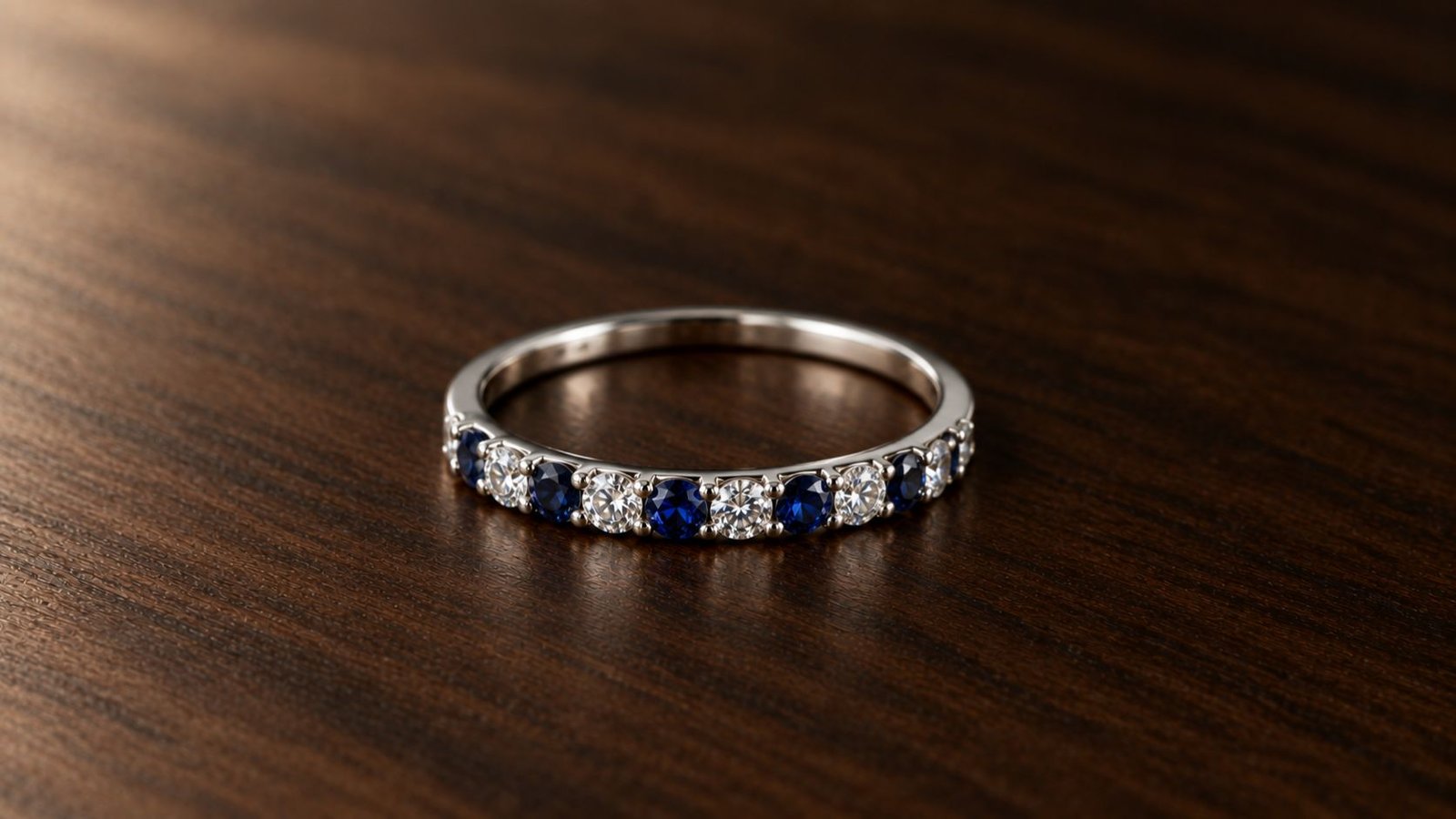
Many buyers shop eternity bands anniversary rings around a specific milestone year, and a long-standing (though not officially standardised) gemstone tradition guides which stone suits which anniversary. According to the International Gem Society’s reference guide, there’s no single governing body behind this list — it grew out of a widely adopted trade tradition rather than any formal standard — but certain milestone-year associations are consistently recognised across most sources:
- 5th anniversary: Sapphire
- 10th anniversary: Diamond
- 15th anniversary: Ruby
- 20th anniversary: Emerald
- 25th anniversary: Silver Jubilee, often paired with diamond
- 30th anniversary: Pearl
- 40th anniversary: Ruby
- 50th anniversary: Golden Jubilee
- 60th anniversary: Diamond Jubilee
Because this tradition isn’t formally standardised, sources sometimes disagree on specific years beyond the most widely recognised milestones above — which means there’s genuine room for personal interpretation rather than a single “correct” answer to follow.
Pairing Milestone Gemstones with Lab Grown Diamonds
Since diamond appears at multiple milestone years, eternity bands anniversary rings built entirely from lab grown diamonds is always a traditionally appropriate choice regardless of which specific year you’re celebrating. For milestone years tied to a coloured gemstone instead — sapphire at the 5th, ruby at the 15th and 40th, emerald at the 20th — pairing that traditional stone with lab grown diamond accents gives a piece that honours the specific milestone while still carrying real sparkle and value.
Getting that pairing right takes real colour-theory thought, particularly for full eternity designs where the coloured stone and diamond accents alternate continuously around the entire band rather than sitting in one isolated setting. Our guide to pairing lab grown diamonds with coloured gemstones covers exactly this kind of combination in more depth, including which colour relationships photograph and wear best together.
Stacking Eternity Bands and Anniversary Rings Over Time

A genuinely popular approach to eternity bands anniversary rings is building a collection over multiple milestone years rather than buying one piece meant to represent everything at once — a slim anniversary band added at the 5th year, another at the 10th, worn stacked together rather than replaced. This approach has grown alongside the broader stacking trend covered in our look at 2026 US jewelry trends, and it solves a real practical problem: a single ring trying to represent an entire multi-decade relationship rarely captures it as meaningfully as a collection that’s genuinely grown alongside it.
Mixed-metal and mixed-setting stacks — a channel-set band from one year next to a prong-set band from another — have become an accepted, even celebrated, part of this approach rather than something buyers feel they need to match perfectly.
Metal Choice for Eternity Bands Anniversary Rings
Metal tone changes how eternity bands anniversary rings read along a continuous line far more than it does in a single-stone setting, simply because there’s so much more metal surface visible across an entire band.
White gold and platinum remain the most requested choice for eternity bands anniversary rings, since these cooler tones let the diamond line read as pure, continuous sparkle without any warm undertone competing with the stones.
Yellow gold has picked up real momentum for both categories recently, particularly for buyers who want their piece to feel warmer and slightly more vintage in character — a full eternity band in yellow gold reads noticeably different in mood than the same design in white metal.
Rose gold works especially well for anniversary rings paired with warmer milestone gemstones like ruby or morganite-adjacent tones, reinforcing rather than competing with the stone’s own warmth.
Mixed-metal collections, where different years’ pieces use different metal tones deliberately, have become an accepted part of the broader stacking approach covered above — there’s no longer a strong expectation that every eternity band or anniversary ring in a collection needs to match exactly.
Budgeting for Eternity Bands Anniversary Rings

Cost for eternity bands anniversary rings scales primarily with two factors: total stone count and individual stone size, both of which climb quickly for a continuous design compared to a single centre-stone piece.
Full eternity bands carry the highest total stone count of any style covered in this guide, since stones run the complete circumference of the ring rather than stopping partway — this makes full eternity consistently the most expensive of the structural options, all else being equal.
Half and three-quarter eternity designs meaningfully reduce total stone count while preserving most of the visible sparkle from the front, making them a genuinely practical way to manage budget without a large visible trade-off.
Lab grown pricing changes this calculation significantly compared to shopping with natural diamonds, since the per-stone cost across dozens of small, consistently matched melee stones adds up fast with natural diamonds in a way it simply doesn’t at lab grown pricing — this is a large part of why full eternity designs, once reserved for buyers with substantial budgets, have become realistically achievable for a much broader range of buyers today.
Setting style also affects total cost, independent of stone count — channel and bezel settings generally use more metal and require more labour per stone than an open prong setting, which can meaningfully affect the final price even when the stone specification is identical.
Common Mistakes When Choosing Between the Two
Choosing a full eternity band without considering resizing. Life circumstances change finger size more often than buyers expect, and a full eternity band’s resizing limitations are worth weighing seriously before committing, particularly for a piece meant to be worn for decades.
Assuming half eternity looks noticeably different from the front. In practice, a well-designed half eternity ring is very difficult to distinguish from a full eternity band when worn and viewed from above — the comfort and resizing benefits rarely come at a real visual cost.
Treating the anniversary gemstone list as a strict rule. Since no official body governs this tradition, choosing a stone based on personal meaning rather than the “correct” year-specific gem is entirely legitimate, and increasingly common.
Picking a setting style based on looks alone. A stunning prong-set eternity band that catches on clothing constantly will get worn less over time than a slightly less dazzling channel-set alternative — daily wearability matters as much as the moment of unboxing.
Caring for Eternity Bands and Anniversary Rings Long-Term

Because eternity bands anniversary rings carry so many individual stones along a continuous line, ongoing care matters more here than for almost any other jewellery category — more settings means more opportunities for a stone to loosen gradually over years of wear.
Schedule periodic professional inspections, ideally once a year for a piece worn daily, so a jeweller can check every prong or channel edge along the full band rather than relying on noticing a problem only after a stone is already missing.
Clean gently and regularly with warm water, mild soap, and a soft brush, paying particular attention to channel-set designs where debris can build up between the metal walls more easily than in an open prong setting.
Store eternity bands anniversary rings separately from other jewellery when not being worn, since the continuous line of stones and metal can scratch or be scratched by other pieces more easily than a single-stone ring with more open space around it.
Remove full eternity bands before activities involving harsh impact or chemical exposure — gardening, heavy cleaning, gym work — since a continuous line of stones has more total surface area at risk than a single centre stone protected by a halo or bezel.
Final Thoughts: A Tradition Worth Making Your Own
Eternity bands anniversary rings carry real symbolic weight, but the practical differences between them — comfort, resizing, durability — matter just as much as the tradition behind them. Understand which structural style actually fits how you plan to wear the piece day to day, choose a setting that balances sparkle against daily durability, and treat the milestone gemstone calendar as inspiration rather than obligation. Lab grown diamond pricing has made it genuinely realistic to build a meaningful collection across many milestone years, rather than compressing an entire relationship into a single piece.
Frequently Asked Questions: Eternity Bands and Anniversary Rings
An eternity band has a continuous, unbroken line of stones going all the way around the ring, while an anniversary ring sets stones only across the front or top portion, leaving the underside plain.
Anniversary rings and half eternity designs are generally more comfortable for daily wear, since the plain underside doesn’t sit stones directly against the palm side of the finger the way a full eternity band does.
It’s possible but genuinely more difficult and limited than resizing a half eternity or anniversary ring, since there’s no plain metal section to work with — this is worth considering seriously before choosing a full eternity design.
It varies by year — sapphire for the 5th, diamond for the 10th, ruby for the 15th and 40th, emerald for the 20th, and pearl for the 30th are among the most widely recognised, though the tradition isn’t governed by any single official body.
Yes, and it’s an increasingly popular choice regardless of the year — diamonds carry universal symbolic weight, and pairing lab grown diamonds with that year’s traditional coloured gemstone is a common way to honour both the tradition and personal preference.
Channel and bezel settings are generally the most durable for eternity bands anniversary rings meant for genuine everyday wear, since they protect stones more fully than an open prong setting.
Yes, and this is one of the most common ways they’re worn — many buyers build a collection of anniversary and eternity pieces over multiple milestone years, stacked alongside an existing engagement ring rather than worn as a standalone piece.
Not usually, at least from the front or top view where the ring is most commonly seen — the visible difference is often minimal, while the comfort and resizing benefits of a half eternity design are meaningful.
Absolutely. Lab grown diamonds carry the same symbolic and emotional weight as natural stones, and their typically lower cost per carat often allows for a more substantial or detailed piece than the same budget would achieve with natural diamonds.
Three-quarter eternity extends the line of stones further around the band than half eternity, offering more visible sparkle while still leaving some plain metal at the back for easier resizing than a full eternity band.
Disclaimer: This article is intended for informational and educational purposes only. Anniversary gemstone traditions vary by source and region and are not governed by a single official standard. Always consult a qualified jeweller for guidance specific to an individual piece.