Designing with Lab Grown Diamonds and Coloured Gemstones: A Complete Pairing Guide for 2026
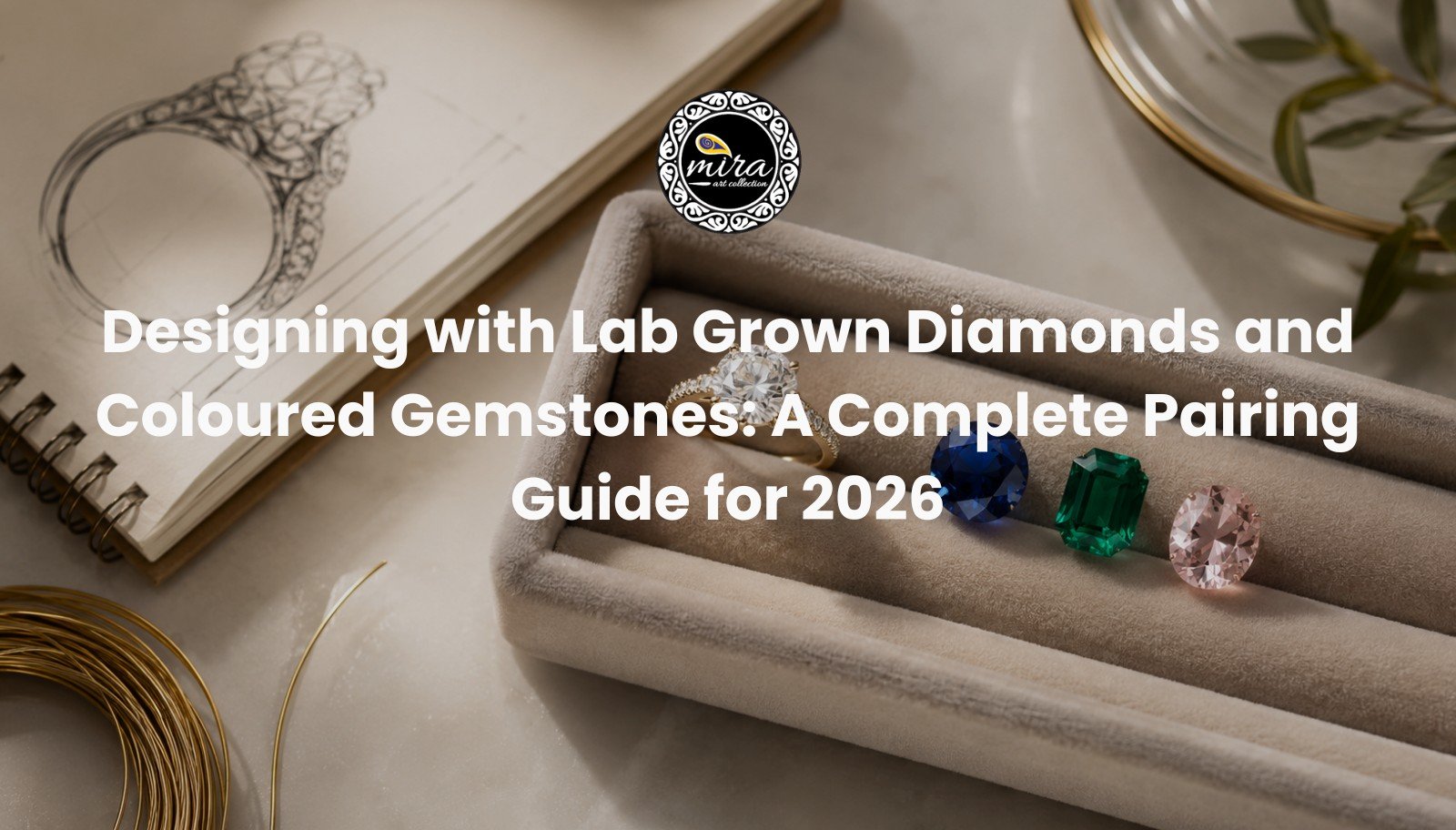
Walk into any serious design studio in 2026 and you’ll notice something that would have looked unusual a decade ago: coloured stones sitting right next to lab grown diamonds on the same tray, being considered for the same piece. Lab grown diamonds and coloured gemstones used to occupy separate conversations — diamonds were the “safe” centrepiece, colour was the accent, and the two rarely got equal billing in a design brief. That’s changed. Buyers now walk in asking for a sapphire halo with a lab grown centre stone, or a three-stone ring that mixes an emerald with two lab grown side diamonds, and they expect their designer to know exactly how to make that combination sing rather than clash.
This guide is written for exactly that moment — the point where you have a lab grown diamond and a coloured gemstone in front of you and need to know whether they belong together, and if so, how to set them so the finished piece looks intentional rather than accidental. We’ll cover colour theory as it actually applies to stone pairing, which cuts and settings work best for different combinations, how metal choice changes everything, and the specific pairings that consistently perform well in finished jewellery.
Whether you’re designing your first piece that combines lab grown diamonds and coloured gemstones or simply refining an approach you’ve used for years, the goal here is a set of principles you can apply confidently to any new combination that lands on your bench.
Why Lab Grown Diamonds and Coloured Gemstones Work So Well Together
For anyone weighing lab grown diamonds and coloured gemstones as a combination, the short answer for why they work is availability and precision. Lab grown diamonds are typically more consistent in colour grade, clarity, and cut quality across a large batch than a comparable natural parcel, which matters enormously when you’re trying to match multiple side stones to a single coloured centre gem. A designer sourcing twenty matched melee stones for a halo doesn’t want subtle variation pulling focus away from the colour stone at the centre — this is exactly the kind of consistency lab grown diamonds and coloured gemstones together make far easier and considerably more affordable to achieve.
There’s also a budget logic at play in how lab grown diamonds and coloured gemstones get combined. Because lab grown diamonds generally cost less per carat than natural stones of comparable quality, designers can allocate more of a project’s budget toward a exceptional coloured gemstone — the piece that often carries the emotional weight of the design — without inflating the total price beyond what a client is willing to spend. That reallocation of budget is quietly reshaping how a lot of custom and fine jewellery gets designed today.
Finally, lab grown diamonds and coloured gemstones simply photograph and wear well together. White diamonds reflect and scatter light in a way that makes surrounding colour read more vividly to the eye — placed correctly, a lab grown diamond doesn’t compete with a coloured stone, it amplifies it.
Colour Theory Basics Every Jewellery Designer Should Apply
You don’t need a fine-art degree to pair stones well, but a working grasp of colour theory saves you from expensive guesswork.
Complementary pairings sit opposite each other on the colour wheel and create the highest visual contrast — think a purple amethyst against a lab grown diamond’s white sparkle, or a warm orange sapphire set beside cooler white stones. These combinations read as bold and modern, and they photograph exceptionally well for social and e-commerce imagery.
Analogous pairings sit next to each other on the wheel — blue and green, or pink and purple — and produce a softer, more harmonious look. A tanzanite paired with blue sapphire melee, for instance, reads as tonal and cohesive rather than contrasted, which suits clients who want colour without a loud statement.
Monochromatic design uses different saturations of a single hue — pale pink morganite with deeper pink sapphire, for example — and lets lab grown diamonds function purely as light and brightness rather than as a competing colour. This approach is particularly forgiving for less experienced designers, since there’s little risk of the palette fighting itself.
The practical rule worth internalising: the coloured gemstone should almost always set the palette, and the lab grown diamonds should be chosen to support that palette — either sharpening the contrast around it or staying quiet enough that the colour does all the talking.
Choosing Coloured Gemstones to Pair with Lab Grown Diamonds
Not every coloured gemstone behaves the same way next to a lab grown diamond, and getting the family right is the first real decision in pairing lab grown diamonds and coloured gemstones successfully. Here’s how the major families tend to perform in real pairings.
Sapphires
Blue sapphire is the most requested pairing partner for lab grown diamonds, and for good reason — the cool blue against crisp white creates a combination that reads as classic and trustworthy to most clients, which is exactly why it’s so common in engagement work. Pink and yellow sapphires pair just as well and tend to appeal to clients looking for something a little less traditional without straying into unfamiliar territory.
Emeralds
Emerald’s deep, saturated green is one of the more dramatic pairings available, but it demands a slightly more careful setting approach, since emeralds are softer and more inclusion-prone than diamond or sapphire. A halo of small lab grown diamonds framing an emerald centre is a dependable, time-tested combination — the white diamonds lift the emerald’s colour without drawing attention to any surface-reaching inclusions.
Rubies
Another dependable option for lab grown diamonds and coloured gemstones, ruby and diamond is a historically loaded pairing, closely tied to bridal and heritage-style design, and it remains one of the most requested combinations for statement rings and anniversary pieces. Because ruby’s red is so saturated, designers often use it sparingly as a centre stone with lab grown diamonds carrying the majority of the surface area, rather than the reverse.
Morganite and Pink Gemstones
Among softer palettes, this pairing of lab grown diamonds and coloured gemstones has become a genuine trend of its own over the past several years, largely because they pair so naturally with rose gold and lab grown diamonds alike. This combination tends to skew toward a romantic, contemporary aesthetic rather than a traditional one.
Tanzanite and Purple Stones
Among lab grown diamonds and coloured gemstones pairings, tanzanite stands out for its blue-violet shift under different lighting, making it one of the more visually interesting gemstones to work with, since the stone itself already provides built-in contrast and movement. It works particularly well in pieces meant to be seen up close, where that colour shift can actually be appreciated.
Fancy Coloured Lab Grown Diamonds
It’s worth noting that lab grown diamonds themselves now come in a genuine range of fancy colours — soft pinks, warm yellows, and cool blues among them. Pairing a fancy-coloured lab grown diamond with a complementary natural gemstone, rather than defaulting to white lab grown stones, is an increasingly popular way to create a piece that’s cohesive in tone from the centre stone outward.
Cut and Shape Considerations for Lab Grown Diamonds and Coloured Gemstones
The cut of your lab grown diamond changes how a coloured gemstone reads next to it just as much as the colour choice itself, which is why experienced designers treat cut selection as part of the same decision as choosing the coloured gemstone, not a separate step that comes afterward.
Round brilliants maximise sparkle and work as a neutral, high-contrast frame around almost any coloured centre stone — this is why round melee dominates halo settings regardless of which gemstone sits in the middle.
Baguettes and emerald cuts bring clean geometric lines that suit art-deco and architectural design briefs. Pairing a step-cut coloured gemstone with baguette lab grown diamonds on either side creates a strong, linear composition that reads as deliberate and modern.
Pear and marquise shapes add movement and elongation, and they’re frequently used as side stones flanking a coloured round or oval centre — the effect draws the eye outward and makes a finger or design element appear longer.
Mixed-cut designs, where round and fancy-shaped lab grown diamonds appear together around a single coloured gemstone, have become increasingly common in 2026 as designers move away from strictly uniform halos toward more textured, layered settings.
How Metal Choice Changes the Pairing
Metal tone is often the deciding factor in whether a lab grown diamond and coloured gemstone pairing feels finished or unresolved.
White gold and platinum keep the visual focus almost entirely on the stones themselves, since the metal essentially disappears against white lab grown diamonds. This is the safest choice for cooler-toned coloured gemstones like sapphire, tanzanite, and emerald.
Yellow gold warms up the entire palette and pairs beautifully with warmer coloured gemstones — citrine, morganite, warm sapphires, and fancy yellow lab grown diamonds all read richer against yellow gold than they do against white metal.
Rose gold has become the default choice for pink and peach-toned gemstone pairings specifically because it reinforces rather than competes with the stone’s own warmth, and it flatters a wider range of skin tones than either white or yellow gold alone.
If you’re pairing lab grown diamonds and coloured gemstones and aren’t sure which metal to recommend, look at the gemstone’s undertone first — cool stones generally want cool metal, warm stones generally want warm metal — and treat exceptions as deliberate design choices rather than defaults.
Matching Lab Grown Diamonds and Coloured Gemstones to Client Personality
Beyond colour theory and metal, a good pairing of lab grown diamonds and coloured gemstones also reflects the person who’s going to wear it every day, and experienced designers tend to build a short client profile before finalising a stone combination.
Classic and understated clients generally respond best to restrained pairings — a single well-chosen coloured gemstone with a modest lab grown diamond halo, in white gold or platinum, is almost always a safe recommendation here. The goal is longevity: a piece that still looks appropriate a decade from now, not one built around a passing trend.
Bold, statement-driven clients tend to want more contrast and more surface area of colour, which opens the door to larger coloured centre stones, dramatic cuts like pear or marquise, and mixed-metal settings that lab grown diamonds and coloured gemstones both support well. These clients are usually the ones most open to fancy-shaped stones and asymmetrical designs.
Sentimental or heritage-focused clients often arrive with a specific gemstone already in mind — sometimes inherited, sometimes tied to a birthstone or family tradition — and the designer’s job shifts from choosing the coloured gemstone to choosing lab grown diamonds and a setting that honour it appropriately. In these cases, letting the existing stone dictate metal tone and diamond shape usually produces the most emotionally resonant result.
Reading which category a client falls into early in the design conversation makes every subsequent decision about lab grown diamonds and coloured gemstones faster and more confident, since you’re no longer choosing in the abstract — you’re choosing for a specific person.
Designer’s Corner: Combinations That Consistently Work
For designers who want a shortlist rather than a full framework, these lab grown diamonds and coloured gemstones combinations have a strong track record across finished jewellery:
- Blue sapphire centre with round lab grown diamond halo — the most requested engagement combination, reliably elegant across nearly any budget tier.
- Emerald centre with baguette lab grown diamond side stones — a clean, art-deco-leaning composition that suits statement rings and cocktail pieces.
- Ruby centre with a pavé lab grown diamond band — keeps the red stone as the clear focal point while letting the band add continuous sparkle.
- Morganite centre with rose gold and pear-shaped lab grown diamond accents — a soft, contemporary look that’s especially popular for right-hand rings.
- Tanzanite centre with mixed round and marquise lab grown diamonds — leans into the stone’s natural colour shift with added movement from the diamond shapes.
A Word on Sourcing: Why Stone Quality Still Comes First
None of these pairings hold up if the underlying stones aren’t sourced carefully, and this is where a lot of designers new to combining lab grown diamonds and coloured gemstones run into avoidable trouble. Sourcing well-matched lab grown diamonds is a different exercise from sourcing a single striking coloured gemstone, and treating them as a single combined sourcing decision — rather than two separate purchases that happen to end up in the same piece — tends to produce noticeably better finished work.
Colour grade, cut quality, and certification matter just as much in a supporting role as they do when a lab grown diamond is the centre stone — a poorly cut side stone will visibly underperform next to a well-cut coloured gemstone, even if it’s technically the same carat weight.
If you’re still building out your own knowledge of how lab grown diamonds are graded and sourced, a few pieces on our site cover ground that’s directly useful here. Our guide to diamond fluorescence is worth a read before you finalise side-stone selection, since fluorescence can subtly shift how a white lab grown diamond reads next to a strongly coloured gemstone.
If you’re sourcing melee in bulk for halos or pavé work, our breakdown of calibrated lab grown diamonds and why they matter for professional manufacturing explains why size and cut consistency across a batch makes such a visible difference in the finished piece. And if fancy-coloured lab grown diamonds are part of your palette, our piece on pink, blue, and yellow lab diamonds goes deeper into how those coloured stones are graded and sourced compared to colourless ones.
Common Mistakes to Avoid When Pairing Lab Grown Diamonds and Coloured Gemstones
Letting the diamonds outcompete the gemstone. A halo that’s too large or too bright can pull attention away from the coloured centre stone rather than framing it. As a rule of thumb, the coloured gemstone should still be the first thing a viewer’s eye lands on.
Ignoring undertone. Pairing a cool-toned sapphire with warm yellow gold, or a warm morganite with stark white gold, isn’t necessarily wrong, but it requires a deliberate design reason — done accidentally, it tends to make a piece look unresolved.
Overlooking durability. Softer gemstones like emerald and morganite need protective settings, especially when placed next to harder lab grown diamonds in everyday-wear pieces. A bezel or protective halo setting goes a long way toward preventing chips in daily wear — GIA’s guide to gemstone durability is a useful reference if you want to check a specific stone’s hardness and toughness before finalising a setting.
Mismatched cut quality between stones. A beautifully cut coloured gemstone next to poorly cut lab grown diamonds creates an obvious visual imbalance, and vice versa. Both stones need to earn their place in the piece.
Final Thoughts: Designing With Intention
Pairing lab grown diamonds and coloured gemstones successfully isn’t about memorising a fixed set of rules — and the more pieces you design combining lab grown diamonds and coloured gemstones, the more that instinct develops on its own — it’s about understanding why certain combinations work, so you can make confident, intentional choices even outside the shortlist. Let the coloured gemstone set the palette, choose your lab grown diamond cut and metal to support rather than compete with it, and pay attention to undertone and durability throughout. Do that consistently, and the specific combination matters far less than the care with which it’s put together.
Frequently Asked Questions: Pairing Lab Grown Diamonds with Coloured Gemstones
Yes. Visually and optically, lab grown diamonds are identical to natural diamonds, so they pair with coloured gemstones exactly the same way. The main practical advantage is that lab grown diamonds are often easier to source in consistent matched batches for side stones and halos.
There’s no single best pairing — it depends on the look you’re going for. Blue sapphire is the most requested for classic, timeless designs, while morganite and tanzanite tend to suit clients looking for something softer or more contemporary.
In most successful designs, the coloured gemstone is the centre stone and lab grown diamonds play a supporting role in the halo, band, or side stones. This keeps the palette clear and lets the colour do the visual work it’s meant to do.
Significantly. White metal keeps focus on the stones themselves and suits cool-toned gemstones, yellow gold warms up the palette for warmer stones, and rose gold is particularly flattering for pink and peach tones. Metal choice can make or break how resolved a pairing looks.
They can be, particularly for clients who want a fully diamond-based piece with colour built in rather than mixing gemstone types. Fancy-coloured lab grown diamonds are available in pink, yellow, and blue among other hues, and they can be paired with complementary natural gemstones for an especially cohesive palette.
Blue sapphire with a round lab grown diamond halo is generally considered the safest, most broadly appealing combination — durable, classic, and rarely polarising, which makes it a dependable recommendation for clients who aren’t sure what they want.
Often, yes. Diamonds are extremely hard and resistant to everyday wear, while gemstones like emerald and opal are softer and more prone to chipping or scratching. Pieces combining the two should be designed with the softer stone’s protection in mind, and cleaned according to that stone’s specific care requirements.
A quick way to check is to look at where the two stones sit on the colour wheel — complementary or analogous relationships tend to work, while clashing usually comes from mismatched undertones (a very cool stone next to a very warm one) rather than the hues themselves.
Yes, lab grown diamonds used as side stones or in a halo carry the same GIA or IGI certification standards as a centre stone, though very small melee stones are sometimes sold with batch reports rather than individual certificates.
It varies, but many designers find it a cost-effective way to add visual impact, since a well-chosen coloured gemstone can carry as much visual weight as a much larger, more expensive diamond centre stone would.
Disclaimer: This article is intended for informational and educational purposes only. Design trends, sourcing practices, and gemstone characteristics referenced here reflect information available as of 2026. Always consult a qualified jeweller or gemologist for guidance specific to an individual piece or gemstone.
Emerald
4.29 ct Emerald PINK VS2 IGI Certified Lab Grown Diamond
Emerald
4.07 ct Emerald PINK VS2 IGI Certified Lab Grown Diamond
Radiant
9.07 ct Radiant E VVS1 IGI Certified Lab Grown Diamond
Emerald
2.81 ct Emerald PINK VS1 IGI Certified Lab Grown Diamond