

Violet and Purple Lab Grown Diamonds Explained: How They’re Made, Graded, and Set
Purple diamonds are among the rarest colours nature produces, and that rarity has always made them close to impossible to source consistently at natural-diamond prices. Purple lab grown diamonds solve that access problem — but understanding exactly how the colour is achieved, and what a certificate should honestly disclose about that process, matters more here than for almost any other fancy colour on the market.
This guide covers precisely how purple lab grown diamonds get their colour, why that process is worth understanding rather than glossing over, how grading and certification handle the disclosure, and how to design well around a stone in this colour family once you’ve sourced one properly.
How Purple and Violet Lab Grown Diamonds Actually Get Their Colour
Here’s the honest, technical answer, and it’s worth being direct about it rather than leaving it vague: purple and violet colour in lab grown diamonds is achieved through post-growth treatment, not through the growth process itself. A diamond is first grown with nitrogen present in its structure — what gemologists call a type Ib diamond — then exposed to high-dose electron irradiation, followed by controlled annealing (a precise heating and cooling process) at temperatures around 750°C. This sequence creates what’s called nitrogen-vacancy, or NV, colour centres within the crystal structure, and when NV– centres dominate over NV0 centres, the result is an intense, saturated purple.
This isn’t a shortcut or a lesser process — it’s a well-documented, controlled laboratory technique, and GIA’s own research laboratories study and confirm it regularly. A Spring 2026 Gems & Gemology lab note from GIA’s Dubai laboratory examined a 3.93-carat purple diamond rough and confirmed exactly this mechanism — type Ib nitrogen structure, high-dose irradiation, and low-temperature annealing producing dominant NV– centres — using infrared and visible-light spectroscopy to verify it conclusively.
Natural purple diamonds, by contrast, have a genuinely murkier scientific story. Researchers haven’t reached firm consensus on what causes purple colour in natural stones — some point to hydrogen and boron interaction, others to pressure-related lattice deformation during formation deep in the Earth’s mantle — and even GIA hasn’t published a definitive explanation for the natural version of this colour.
Is a Treated Purple Diamond “Less Real”? Addressing a Common Misconception
Some marketing content circulating online claims purple lab grown diamonds are somehow “untreated” or more naturally purple than they actually are. Based on GIA’s own published research and multiple independent gemological sources, this isn’t accurate — colour treatment through irradiation and annealing is the standard, well-established method for producing purple, violet, pink, and red colour in lab grown diamonds specifically. Pink lab grown diamonds follow the same fundamental process, and red and violet stones are produced through closely related variations of it.
None of this makes a treated purple diamond a lesser stone. It’s still a genuine diamond, physically and chemically identical to any other, with a colour achieved through a controlled, well-understood, and fully disclosed laboratory process. The only thing that matters is honest disclosure — a properly graded purple lab grown diamond will state its treatment plainly on the certificate, and any supplier unwilling to confirm this directly is a bigger concern than the treatment itself.
Grading Purple Lab Grown Diamonds: What the Certificate Should Say

A properly issued certificate for purple lab grown diamonds should explicitly state the treatment method — typically noted as “irradiated” or “HPHT treated,” sometimes both in combination — alongside the standard fancy colour grading terminology.
Colour intensity follows the same general framework used for other fancy colours: Fancy Light, Fancy, Fancy Intense, and Fancy Vivid, moving from the most subtle to the most saturated versions of the hue. Purple lab grown diamonds are available across this full intensity range, giving buyers real choice between a soft lavender-leaning stone and a deep, saturated violet.
Secondary hue modifiers matter here more than in colourless diamonds — a stone might be graded as “purplish pink,” “pinkish purple,” or “violetish purple,” depending on which secondary colour is present alongside the dominant hue, and this modifier genuinely changes how the stone reads in different lighting.
Fluorescence deserves specific attention for treated colour stones. Orange fluorescence, in particular, is viewed unfavourably in the trade for treated pink and purple diamonds, in much the same way strong blue fluorescence carries a reputation in colourless stones — our full guide to diamond fluorescence covers the broader mechanics of how fluorescence is graded and when it actually affects appearance, which applies just as much to fancy colour stones as to colourless ones.
Purple vs Violet: Is There Actually a Difference?

In casual conversation, “purple” and “violet” often get used interchangeably, but there’s a real trade distinction worth knowing. Violet generally leans more toward blue in its secondary hue, while purple sits closer to a balanced mix of red and blue, sometimes leaning slightly pink. On a certificate, this distinction shows up in the specific hue modifier used rather than in the primary colour name alone, and it’s worth asking your supplier directly which specific hue combination a given stone actually falls into, rather than assuming “purple” and “violet” describe the same thing.
Sourcing Purple Lab Grown Diamonds: What to Ask Your Supplier
Ask for explicit written confirmation of the treatment method — irradiation and annealing, specifically — rather than accepting a vague answer about how the colour was achieved.
Ask whether the certificate is from GIA or IGI, since both institutions have established, credible protocols for identifying and disclosing colour treatment in fancy coloured diamonds, unlike smaller or less established labs.
Ask about colour stability. Treated colour stones are generally stable under normal wear, but it’s worth confirming with your supplier that a specific stone hasn’t shown any documented colour-shift behaviour, since gemological research has occasionally noted unusual, temporary colour changes in certain lab grown diamonds under specific lighting conditions during grading.
Ask how fluorescence was graded and disclosed, particularly given the orange-fluorescence consideration covered above, since this detail is sometimes omitted from a basic listing even when it appears on the full certificate.
Designing with Purple and Violet Lab Grown Diamonds

Metal choice changes the mood significantly. White gold and platinum let a purple stone read as cool and contemporary, while rose gold warms the overall palette and can bring out any pinkish secondary hue in the stone. Yellow gold, less commonly paired with purple, creates a bold, jewel-toned contrast for buyers wanting a more dramatic statement.
Complementary stone pairings work well when approached with real colour theory rather than guesswork — a purple centre stone paired with colourless lab grown diamond accents keeps the coloured stone as the clear focal point, while pairing with a secondary coloured gemstone requires more careful planning. Our guide to pairing lab grown diamonds with coloured gemstones covers exactly this kind of multi-colour composition in more depth.
Setting style matters for showcasing saturation. A bezel or low-profile setting can mute a lighter purple stone’s visible colour slightly, while an open prong setting lets more light — and more visible colour saturation — through, which is worth factoring in for lighter-intensity stones specifically.
For buyers exploring the full range of fancy coloured lab grown diamonds beyond purple specifically, our guide to pink, blue, and yellow lab grown diamonds covers how those other colours compare in sourcing, grading, and design considerations.
How Purple Compares to Other Treated Fancy Colours
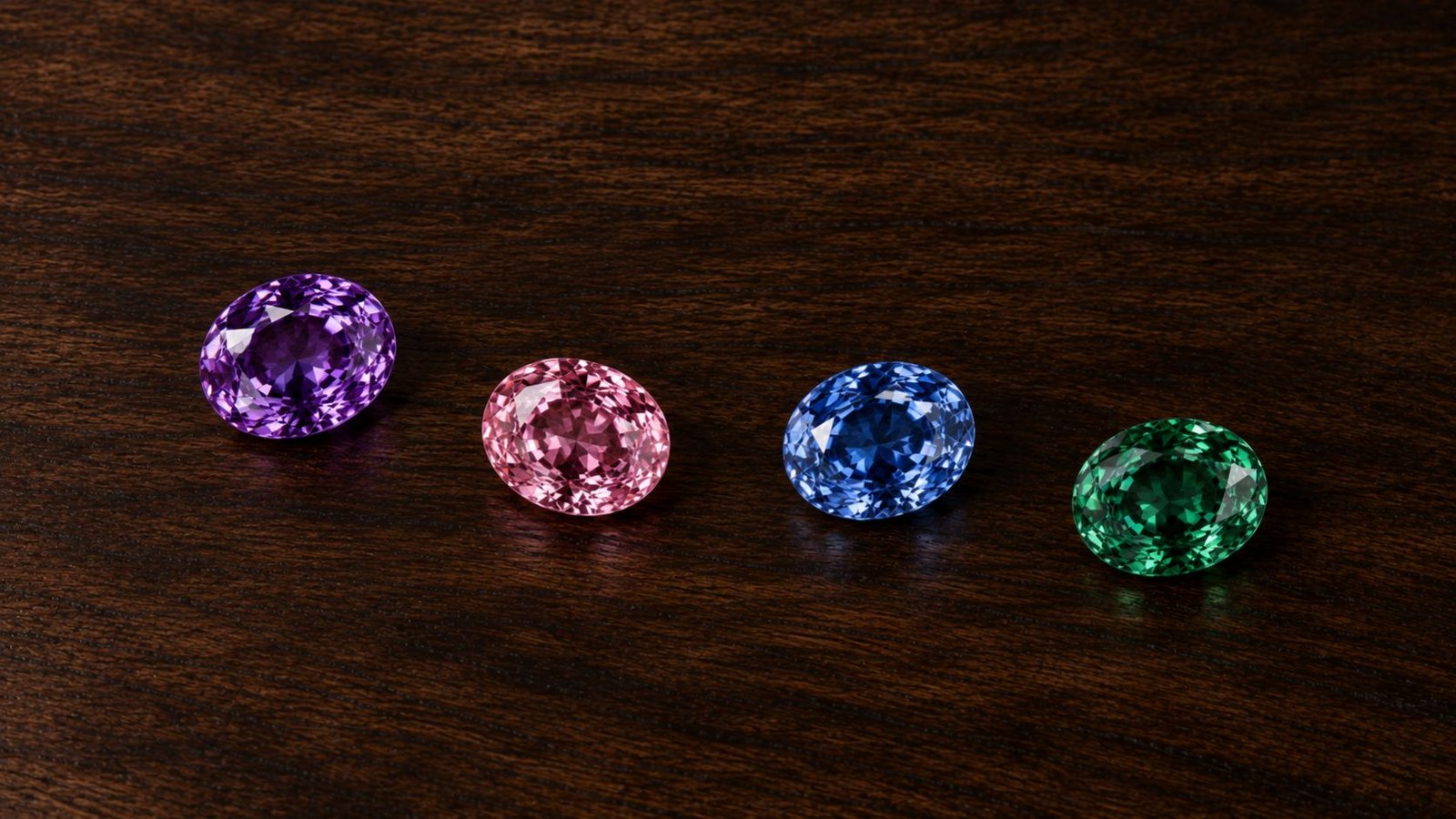
Understanding where purple lab grown diamonds sit relative to other fancy colours in the market helps put both sourcing difficulty and price in context.
Pink lab grown diamonds follow a closely related treatment path — irradiation and annealing applied to nitrogen-containing type Ib stones — and have become considerably more mainstream than purple, with a wider range of suppliers offering consistent stock across various intensities.
Blue lab grown diamonds are produced through a genuinely different mechanism, typically involving boron introduced during the growth process itself rather than post-growth irradiation, which is part of why blue behaves differently from purple in terms of both sourcing and typical price positioning.
Green lab grown diamonds rely on radiation exposure without the same annealing step used for purple and pink, producing a distinct colour mechanism of their own, and tend to be treated with similar caution around fluorescence and colour-stability questions.
Purple’s relative rarity within the treated-colour category comes down largely to how precisely the irradiation and annealing parameters need to be controlled to land on a clean, well-saturated purple rather than drifting toward pink, brown, or an uneven, patchy result — which is part of why well-executed purple stones command genuine attention from buyers specifically seeking this colour.
What Affects the Price of a Purple Lab Grown Diamond
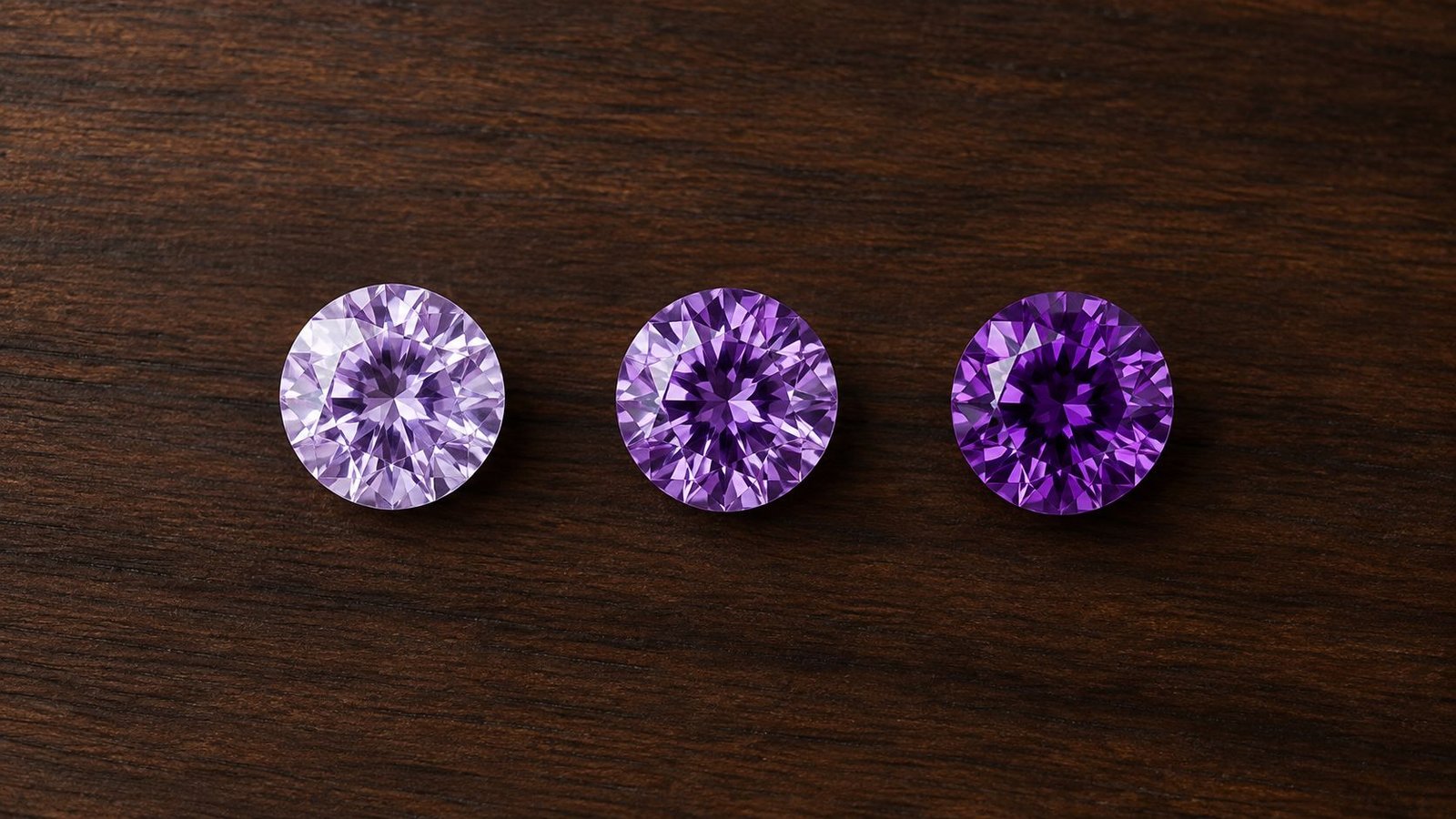
Several factors move the price of purple lab grown diamonds beyond the standard carat weight consideration that applies to any diamond.
Colour intensity and evenness matter enormously — a Fancy Vivid stone with uniform, saturated colour throughout commands meaningfully more than a Fancy Light stone or one with visible colour zoning, where the purple appears stronger in some areas of the stone than others.
Secondary hue desirability plays a real role too, with certain hue combinations — a clean, well-balanced purple without a muddy brown undertone, for instance — generally preferred over combinations that read as less pure or less vibrant.
Certification and treatment disclosure quality affects the price of purple lab grown diamonds indirectly but meaningfully, since a stone with a clear, detailed GIA or IGI report documenting exactly how the colour was achieved is a more confident purchase, and confident purchases command better pricing in the trade than stones with vague or incomplete paperwork.
Size remains a real factor, as with any diamond, though the relationship between size and price isn’t perfectly linear for treated fancy colours the way it more predictably is for colourless stones, since larger rough stones capable of taking a clean, even purple treatment are themselves less common.
Common Misconceptions About Purple Lab Grown Diamonds
“Treated means fake.” Treatment refers to how colour was achieved in a genuine diamond, not a claim about the stone’s authenticity. A treated purple lab grown diamond is chemically and physically a real diamond in every sense.
“Purple and violet diamonds are the same thing.” They’re related but distinct trade terms, differentiated by which secondary hue — blue-leaning for violet, more balanced red-blue for purple — dominates the stone’s specific colour profile.
“Untreated purple lab grown diamonds are the norm.” Based on current gemological research, irradiation and annealing treatment is the standard, well-documented method for producing purple in lab grown diamonds — claims suggesting otherwise aren’t well supported by the published science.
“Fluorescence doesn’t matter for coloured stones.” It can matter meaningfully for treated pink and purple diamonds specifically, where orange fluorescence carries a real reputation in the trade, distinct from how fluorescence is treated in colourless stones.
Caring for Purple Lab Grown Diamonds
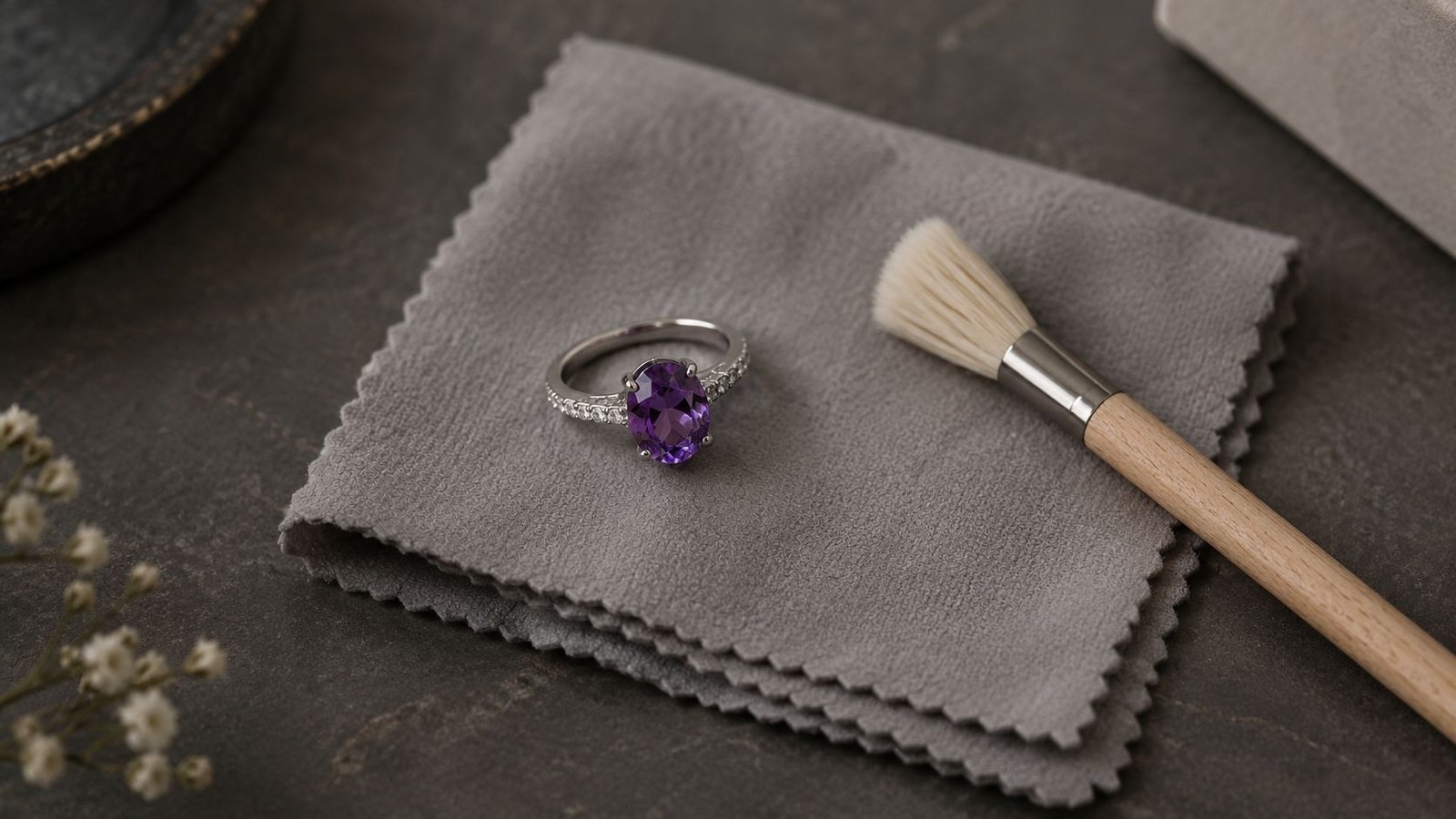
Treated colour stones generally need the same durability-focused care as any diamond, with one added consideration worth keeping in mind.
Standard cleaning — warm water, mild soap, a soft brush — works fine for purple lab grown diamonds, and there’s no special chemical sensitivity introduced by the irradiation and annealing treatment itself once it’s complete and stable.
Avoid prolonged direct exposure to strong UV light sources where possible, such as tanning beds or extended time under intense display lighting, since treated colour centres can theoretically be more sensitive to further light-induced change than an untreated stone, even though documented real-world colour shift in properly treated, stable stones is rare.
Store separately from harder abrasive materials as with any fine jewellery, and have the setting checked periodically by a jeweller, since the diamond itself is exceptionally durable but the mount holding it is not immune to ordinary wear.
Final Thoughts: Buy Purple Lab Grown Diamonds With Full Information
Purple lab grown diamonds offer genuine access to one of nature’s rarest diamond colours, achieved through a legitimate, well-documented treatment process rather than anything that should be hidden or downplayed. The only real risk in this category comes from suppliers unwilling to disclose that process honestly, not from the treatment itself. Ask direct questions about treatment method, certification source, and fluorescence, and you’ll be buying with the same confidence you’d bring to any other diamond purchase — just with a considerably rarer colour in hand.
Frequently Asked Questions: Purple Lab Grown Diamonds
Through post-growth treatment — a diamond grown with nitrogen present (type Ib) is exposed to high-dose electron irradiation, then annealed at controlled temperatures around 750°C, producing nitrogen-vacancy colour centres that create the purple hue.
Treated. Based on current gemological research, including GIA’s own published lab studies, purple, violet, pink, and red colour in lab grown diamonds is achieved through irradiation and annealing after the diamond has already grown, not through the growth process itself.
No. It’s still a genuine, chemically identical diamond — treatment describes how the colour was achieved, not the stone’s authenticity. Honest disclosure on the certificate is what matters, not the presence of treatment itself.
Violet diamonds generally lean more toward blue in their secondary hue, while purple sits closer to a balanced red-blue mix, sometimes leaning pink. The distinction shows up in the certificate’s specific hue modifier.
It’s worth checking specifically. Orange fluorescence is viewed unfavourably for treated pink and purple diamonds in the trade, so ask your supplier how fluorescence was graded and disclosed on the certificate.
GIA or IGI, both of which have established, credible protocols for identifying and disclosing colour treatment in fancy coloured diamonds. A certificate from a smaller, less established lab is a weaker basis for confirming treatment history.
Under normal wear, treated colour is generally stable. Gemological research has occasionally documented unusual, temporary colour shifts in certain lab grown diamonds under specific lighting during grading, which is worth asking your supplier about directly for peace of mind.
It depends on the effect you want — white gold or platinum keeps the look cool and contemporary, rose gold warms the palette and can enhance a pinkish secondary hue, and yellow gold creates a bold, jewel-toned contrast.
Purple remains one of the rarer fancy colours even in the lab grown market, since achieving a clean, well-saturated purple through the irradiation and annealing process requires precise control over treatment conditions.
Yes, though it takes real colour-theory planning to avoid the piece looking chaotic — pairing with colourless diamond accents is the simpler, safer default, while a secondary coloured gemstone requires more deliberate design consideration.
Disclaimer: This article is intended for informational and educational purposes only. Gemological and treatment information referenced here reflects published research, including GIA’s Gems & Gemology findings, available as of 2026. Always request full written disclosure of treatment and certification from your supplier before purchasing.