Beyond Colorless: The Fascinating World of Pink, Blue, and Yellow Lab Diamonds
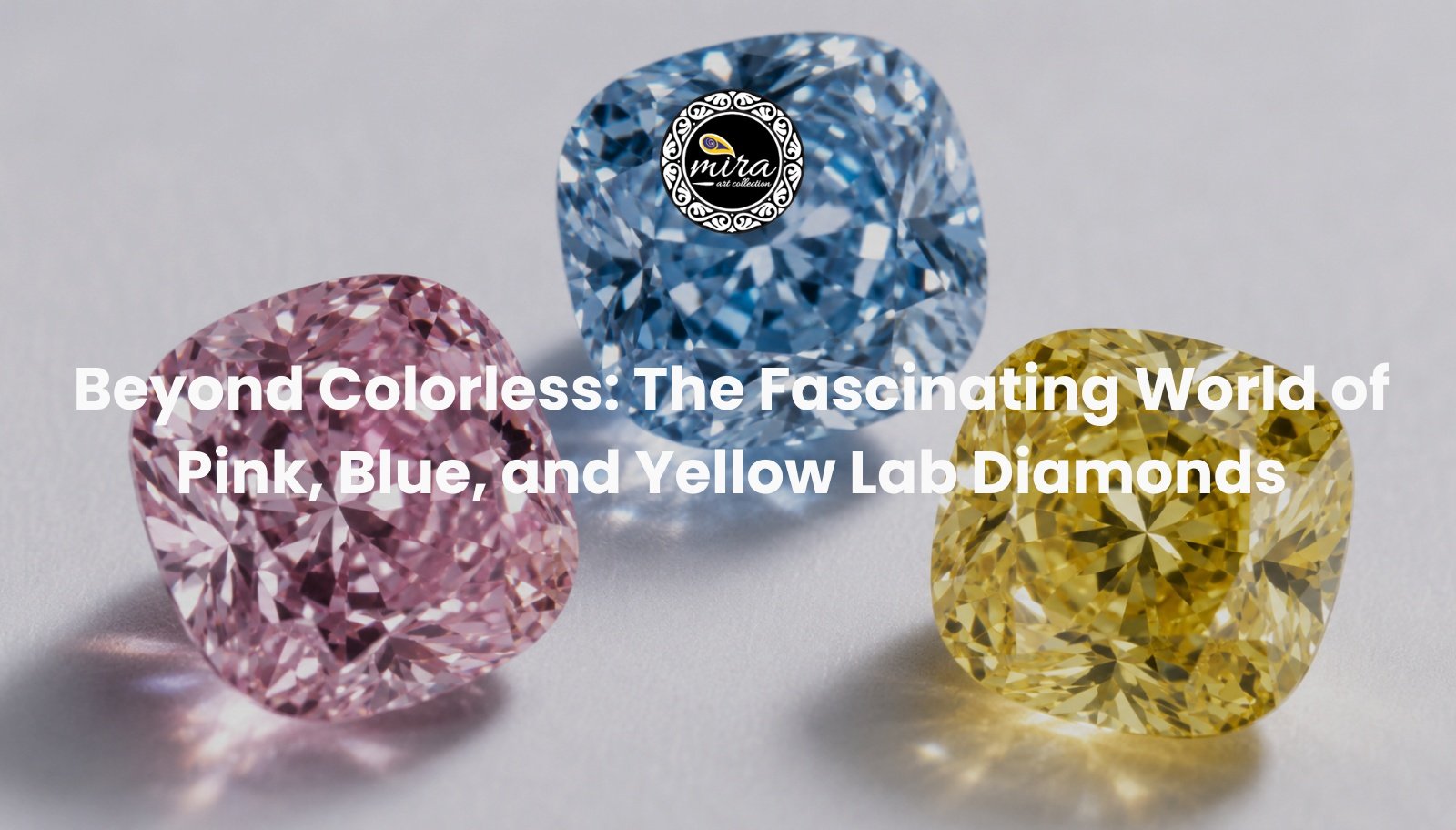
Beyond Colorless: The Fascinating World of Pink, Blue, and Yellow Lab Diamonds
Most people picture a diamond as clear, colorless, and sparkling white. That image has dominated the jewellery counter for so long that many shoppers don’t realise an entire universe of color exists just beneath the surface of the diamond world. Natural fancy color diamonds — pink, blue, yellow, green, and beyond — are among the rarest gemstones on the planet, historically priced far out of reach for the average buyer. A single natural pink diamond weighing just a few carats has sold at auction for tens of millions of dollars.
Colored lab diamonds have quietly changed that equation. Using the same core science that made colorless lab grown diamonds mainstream, producers can now introduce specific trace elements or structural conditions during the growth process to create stones in brilliant, saturated hues — at a fraction of what a natural fancy color diamond would cost. What was once an exclusive privilege of royalty, celebrities, and elite collectors is becoming an accessible category within reach of everyday jewellery buyers.
This guide walks through how colored lab diamonds are actually made, why pink, blue, and yellow have become the three most recognisable categories, what other rare hues exist, how these stones are graded and certified, and what buyers genuinely need to know before choosing one. If you’re still weighing lab grown against mined stones more broadly, our lab grown vs natural diamonds engagement ring guide is a useful companion read.
Why Colored Diamonds Are Naturally So Rare
To appreciate why colored lab diamonds matter, it helps to understand why natural colored diamonds are so scarce in the first place. A diamond forms deep within the Earth’s mantle under intense heat and pressure over the course of a billion years or more. For a diamond to develop a distinct hue, something unusual has to happen during that process — a trace element has to be present in the carbon source, a structural distortion has to occur within the crystal lattice, or the diamond has to be exposed to natural radiation over geological time.
These conditions are essentially a matter of chance. Nature does not consistently deliver the ingredients needed for color, which is precisely why fewer than one in ten thousand natural diamonds mined today display a fancy color at all. Blue tones only appear when boron gets incorporated into the crystal during that formation window. Yellow diamonds require nitrogen. Pink diamonds — among the rarest of all — result from a structural distortion in the crystal lattice rather than a chemical impurity, a phenomenon scientists still don’t fully understand even after decades of study.
Because natural colored diamonds depend on random geological accidents, supply has always been vanishingly small. The famous Argyle mine in Australia, once responsible for the majority of the world’s natural pink diamonds, closed permanently in 2020, tightening an already limited supply even further. This scarcity is the foundation of the extraordinary prices natural fancy color diamonds command.
How Colored Lab Diamonds Are Grown
Colored lab diamonds are produced using the same two core methods that created the lab grown diamond industry as a whole: High-Pressure High-Temperature (HPHT) synthesis and Chemical Vapor Deposition (CVD). The difference lies in what growers introduce into the process, and in some cases, what happens to the stone after growth is complete.
Controlled trace element introduction. During HPHT or CVD growth, producers can deliberately introduce specific elements into the growth chamber. Adding trace amounts of boron produces a blue diamond. Adding nitrogen produces a yellow diamond. Because growers control the exact quantity and timing of these additions, the resulting color can be far more predictable and consistent than anything nature typically produces.
Irradiation and annealing. Some colored lab diamonds — particularly certain pink, green, and unusual fancy hues — are created by exposing an already-grown diamond to controlled irradiation, followed by a heat treatment process called annealing. This alters the crystal lattice in ways that produce color centers, essentially replicating in a controlled laboratory setting the same lattice distortions that occur naturally over eons.
Post-growth HPHT treatment. As with colorless lab diamonds, a secondary HPHT treatment can be applied after initial growth to intensify, stabilise, or shift a stone’s color. This step is particularly common in the production of pink and certain yellow diamonds, where the as-grown color needs refinement to reach a commercially desirable saturation.
Reputable producers and gemological laboratories disclose exactly which of these methods were used to achieve a stone’s final color, and any certified colored lab diamond will carry documentation explaining its treatment history. This transparency is one of the defining differences between the colored lab diamond market and the far murkier history of treated natural colored diamonds, where undisclosed treatments have periodically caused controversy.
Pink Lab Diamonds: Romance Without the Rarity Price Tag
Of every diamond hue on the market, pink carries the strongest emotional pull, tied so closely to love, softness, and milestone moments that collectors have historically paid extraordinary sums to own it. A single carat of a natural fancy vivid pink diamond can cost well over a million dollars, placing it entirely outside the realm of practical jewellery buying for almost anyone.
Pink lab diamonds change that story dramatically. Depending on the intensity and clarity grade, a one-carat pink lab diamond can be purchased for a small fraction of what an equivalent natural stone would cost — often in the low thousands of dollars rather than the millions. This price gap has made pink lab diamonds one of the fastest-growing segments within the broader colored lab diamond category, particularly for engagement rings, anniversary jewellery, and statement pieces aimed at buyers who want the emotional symbolism of pink without an impossible budget.
Pink lab diamonds are graded using the same fancy color intensity scale applied to natural stones — ranging from faint and light pink through fancy, fancy intense, and fancy vivid. As with natural pink diamonds, the more saturated and pure the hue, the higher the value, though even the most intensely saturated pink lab diamonds remain dramatically more affordable than their natural counterparts.
Blue Lab Diamonds: Boron’s Signature Color
Blue diamonds occupy a special place in diamond history, largely thanks to famous natural stones like the Hope Diamond. In nature, blue coloration results from trace amounts of boron becoming incorporated into the crystal structure during formation — an occurrence so rare that natural blue diamonds represent a minuscule fraction of overall diamond production.
Blue lab diamonds replicate this exact mechanism under controlled conditions. By introducing precise, measured amounts of boron during the HPHT or CVD growth process, producers can consistently generate stones ranging from faint blue through vivid, saturated blue tones that rival the finest natural specimens in visual impact. Because the amount of boron can be carefully controlled, blue lab diamonds tend to display remarkably even, consistent coloration throughout the stone — something that is far harder to guarantee in nature, where boron distribution during formation is essentially random.
Blue lab diamonds have found particular popularity in men’s jewellery, statement rings, and designer collections seeking a striking alternative to traditional colorless stones. Their cost compared to natural blue diamonds follows the same pattern seen across the colored lab diamond category — typically a fraction of the price for a visually comparable stone, with full gemological certification confirming both origin and color grade.
Yellow Lab Diamonds: The Most Accessible Fancy Color
Of the three colors most commonly associated with colored lab diamonds, yellow is both the easiest to produce and the most widely available. Nitrogen, the element responsible for yellow coloration, is actually the most common trace impurity found in diamond formation generally — which is why even some natural, otherwise near-colorless diamonds carry a faint yellowish tint that graders work to distinguish from truly “fancy” yellow specimens.
Because nitrogen incorporation is relatively straightforward to control during laboratory growth, yellow lab diamonds are produced in larger volumes and at lower price points than pink or blue lab diamonds. This accessibility has made yellow one of the most popular entry points into colored lab diamond jewellery, appealing to buyers who want a distinctive, vibrant stone without stretching into premium pricing territory.
Yellow lab diamonds span a wide range, from soft, pale champagne tones through rich, saturated canary yellow. The canary yellow shade in particular has become a signature look in modern engagement rings and cocktail jewellery, prized for its warmth and its striking contrast when set against white gold or platinum bands.
Beyond the Big Three: Green, Violet, Red, and Black
While pink, blue, and yellow dominate the colored lab diamond conversation, they are far from the only hues available. Green lab diamonds, produced through controlled irradiation, offer a rare and unusual look that appeals to buyers seeking something outside conventional jewellery norms. Violet and purple lab diamonds, among the rarest and most technically difficult colors to produce consistently, appear occasionally from specialist producers and command premium pricing even within the lab grown category.
Red remains the most elusive diamond color of all, whether natural or lab grown — a color so difficult to reliably produce that only a small number of laboratories worldwide have successfully created gem-quality red lab diamonds. Black lab diamonds, by contrast, are comparatively easier to produce and have become a popular choice for bold, modern men’s jewellery and alternative engagement rings, valued for their opaque, graphite-like depth rather than brilliance and fire.
Each of these rarer colors within the colored lab diamond category tends to carry its own pricing logic, generally tracking how difficult the specific hue is to produce consistently and at scale, rather than following the same cost curve as colorless lab diamonds.
How Colored Lab Diamonds Are Graded and Certified
Certification is just as important for colored lab diamonds as it is for colorless ones — arguably more so, given how central color intensity is to a stone’s value. The two most widely recognised gemological laboratories issuing fancy color grading reports for lab grown stones are GIA and IGI, both of which apply a specialised color grading framework distinct from the standard D-to-Z scale used for colorless diamonds. Buyers who want certified stones can browse Mira Art Collection’s GIA Certified Lab Diamonds and IGI Certified Lab Diamonds collections directly.
Fancy color grading assesses three separate qualities: hue (the actual color, such as pink, blue, or yellow), tone (how light or dark the color appears), and saturation (how intense or muted the color is). These combine into an overall intensity classification, ranging through categories such as faint, very light, light, fancy light, fancy, fancy intense, fancy deep, and fancy vivid.
Every reputable colored lab diamond will arrive with a certification report explicitly stating its laboratory origin, the growth method used (HPHT or CVD), any post-growth treatments applied, and the full color and clarity grading. Buyers should treat this documentation as non-negotiable — a colored lab diamond sold without transparent certification is a stone whose actual quality and treatment history cannot be verified.
Colored Lab Diamonds vs. Natural Fancy Color Diamonds: The Price Reality
The single biggest driver behind the growing popularity of colored lab diamonds is price. Natural fancy color diamonds, particularly in vivid pink, blue, and certain rare shades, exist among the most expensive gemstones in the world on a per-carat basis, frequently outpricing even the finest colorless diamonds many times over. For a broader look at how lab grown pricing compares across shapes and currencies, see our guide to lab grown diamond prices in USD, EUR, and INR and the real math behind diamond markup.
Colored lab diamonds offer a visually comparable stone — often indistinguishable to the naked eye and verifiable only through specialised laboratory equipment — at a cost that can be anywhere from a fraction to a small percentage of the natural equivalent, depending on the specific color, intensity, and carat weight involved. This price gap tends to be even more pronounced for colored stones than it is for colorless lab diamonds, precisely because natural fancy colors carry such an extreme rarity premium to begin with.
For buyers, this means a colored lab diamond makes it possible to own a genuinely striking, saturated fancy color stone — the kind that would have been financially unreachable as a natural diamond — while still receiving full gemological certification and complete transparency about the stone’s laboratory origin.
Choosing a Colored Lab Diamond: What Buyers Should Look For
Selecting a colored lab diamond involves a slightly different set of priorities than choosing a colorless one. Color intensity and evenness typically matter more than the clarity grade, since a well-saturated, evenly distributed hue often makes a bigger visual impact than minor internal characteristics that are largely invisible to the naked eye anyway.
Buyers should request full certification from a recognised laboratory, confirm exactly which growth method and any post-growth treatments were used, and, where possible, view the stone in multiple lighting conditions before purchase, since color intensity can appear to shift under different light sources. Setting choice also plays a meaningful role — white gold and platinum tend to make blue and pink hues appear more vivid by contrast, while yellow gold settings can either complement or compete with yellow diamonds depending on the specific shade chosen.
Finally, buyers should work with retailers who are willing to explain exactly how a given stone’s color was achieved. The colored lab diamond market rewards transparency, and any seller reluctant to discuss growth method or treatment history should be treated with appropriate caution.
The Growing Market for Colored Lab Diamonds
As the broader lab grown diamond industry has matured and production costs have fallen, colored lab diamonds have moved from a niche specialty offering into a genuine growth category within fine jewellery. Producers in India, the United States, and parts of Europe have increasingly dedicated production capacity specifically to fancy color output, recognising that colored lab diamonds carry stronger margins than standard colorless production even as overall lab grown diamond prices have compressed.
Retailers report that pink and blue lab diamonds in particular have become popular choices for engagement rings among buyers seeking something distinctive that still carries the emotional and symbolic weight traditionally associated with diamond jewellery. Yellow lab diamonds, meanwhile, continue to serve as an accessible entry point for buyers curious about colored stones but working within a more modest budget.
As certification standards continue to mature and consumer awareness of colored lab diamonds grows, industry analysts expect this category to continue expanding at a faster rate than the colorless lab diamond segment, driven by the simple economic reality that colored lab diamonds offer buyers access to a category of gemstone that would otherwise remain entirely out of reach.
Final Thoughts
Colored lab diamonds represent one of the more quietly remarkable developments within the modern diamond industry — taking a category of gemstone once reserved almost exclusively for the ultra-wealthy and making it accessible to a far broader range of buyers. Whether it’s the romantic appeal of pink, the striking rarity of blue, or the warm accessibility of yellow, colored lab diamonds now offer a genuine alternative for anyone drawn to color rather than the traditional colorless standard.
As with any diamond purchase, informed buyers should insist on proper certification, understand exactly how a stone’s color was achieved, and choose a retailer willing to be transparent about origin and treatment. Approached that way, colored lab diamonds offer something increasingly rare in the luxury jewellery world: genuine beauty and rarity of appearance, without the once-impossible price tag.
To see how a trusted wholesale supplier sources and certifies its inventory, read Inside Mira Art Collection: What Sets This Lab Grown Diamond Wholesaler Apart, or explore more buying guides on our lab grown diamond blog.
Pear
10.03 ct Pear E VS1 IGI Certified Lab Grown Diamond
Emerald
7.08 ct Emerald D VS2 IGI Certified Lab Grown Diamond
Emerald
10.01 ct Emerald E VS1 IGI Certified Lab Grown Diamond
Emerald
10.04 ct Emerald E VS1 IGI Certified Lab Grown Diamond