Why Calibrated Lab Grown Diamonds Are the Backbone of Professional Jewellery Manufacturing in 2026
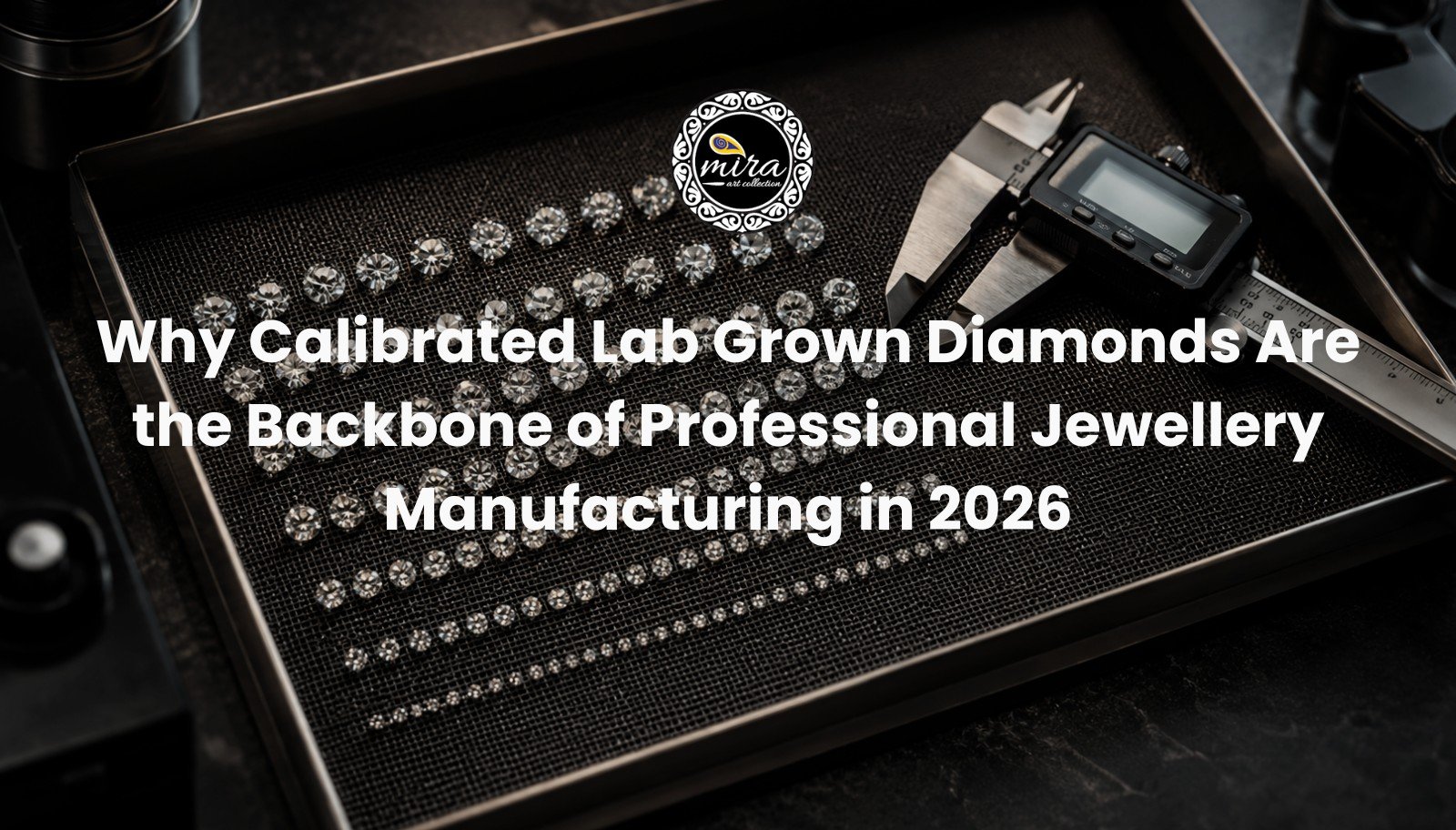
There is a category of diamond specification that most retail buyers never encounter and most trade professionals could not operate without. It is not about carat weight, colour grade, or clarity tier. It is about millimetres — precise, consistent, repeatable millimetres that determine whether a stone seats correctly in a pre-manufactured setting, whether a parcel of fifty stones produces a finished eternity band that looks like it was made by a single pair of hands, and whether a production run of a hundred identical rings ships on schedule or gets held up at the bench because the stones do not fit.
Calibrated lab grown diamonds are the answer to that operational challenge — and understanding exactly what calibration means, why it matters so much more than most buyers initially expect, and how calibrated lab grown diamonds compare to non-calibrated alternatives is essential knowledge for any jewellery manufacturer, studio owner, or wholesale buyer sourcing at production scale in 2026.
This guide covers the complete picture: what calibration actually is, how it is achieved in lab grown diamond production, the specific manufacturing applications where calibrated lab grown diamonds are non-negotiable, what to look for when specifying a calibrated parcel, and why the lab grown production environment is particularly well suited to delivering the precision this application demands.
What Calibration Actually Means — and What It Does Not
The word “calibrated” is used frequently enough in the diamond trade that its precise meaning sometimes gets lost in general usage. For manufacturing applications, calibration has a specific, technical definition that is worth establishing clearly before anything else.
Calibrated lab grown diamonds are stones that have been cut and sorted to meet precise millimetre dimension specifications within a defined tolerance range. The critical distinction from standard diamond sourcing is that calibration is a physical size specification — measured in millimetres of diameter or length and width — rather than a carat weight specification.
This distinction matters enormously in practice. Carat weight measures a stone’s mass. Millimetre dimensions measure its face-up footprint and girdle diameter. Two diamonds of identical carat weight can have meaningfully different face-up diameters depending on how their depth is proportioned. A 0.05-carat round brilliant with a shallow cut might measure 2.5mm in diameter; a deeper stone of the same carat weight might measure only 2.3mm. In a pavé setting designed for 2.4mm stones, neither fits correctly — one sits too high and rocks, the other drops into the collet and cannot be secured.
Calibrated lab grown diamonds solve this problem by specifying the millimetre dimension directly and sorting stones to meet it within a tolerance that manufacturing applications can reliably accommodate. Industry standard calibration tolerances typically run ±0.05mm to ±0.10mm for round stones, meaning a parcel specified as 1.5mm rounds will contain stones measuring between 1.45mm and 1.55mm — tight enough to fit pre-manufactured settings without individual adjustment, but achievable in volume production.
Why Millimetre Precision Matters More Than Carat Weight at Production Scale
The practical consequences of working with non-calibrated stones in a production environment are something that every experienced bench jeweller has encountered — and most have stories about the delays and losses it creates. Understanding why calibrated lab grown diamonds avoid these problems requires understanding how modern jewellery manufacturing actually works.
Most production jewellery — from eternity bands and pavé engagement rings to halo settings and tennis bracelets — is designed in CAD software and produced from CNC-machined metal castings or wax models that contain precisely sized seat openings for each stone. A halo ring designed around a 2.0mm pavé surround, for example, will have seat openings machined to accept 2.0mm stones — not 1.9mm stones, not 2.1mm stones, but 2.0mm stones within the tolerances the setting can accommodate.
When non-calibrated stones arrive at the bench, setters face two choices, both of which add cost and time. They can sort through the parcel themselves to find stones that fit each seat — a process that can add hours to a production run and generates significant waste in the form of usable stones that simply do not match the setting dimensions needed. Or they can adjust the seats to accommodate whatever stones arrived — a process that requires skilled benchwork, adds further time, and introduces inconsistency across pieces in the same production run.
Calibrated lab grown diamonds eliminate both of these problems. When a parcel arrives to specification, stones seat directly without individual sorting or seat adjustment. The production run moves at the pace it was planned for. Waste drops because every stone in the parcel is usable for the intended application. Quality consistency improves because all seats contain stones of the same face-up dimension rather than a mixture of slightly different sizes that create visible variation across the finished piece.
For high-volume manufacturers producing hundreds or thousands of identical pieces, the financial and operational value of calibrated lab grown diamonds over non-calibrated alternatives is not marginal — it is structural. The difference between a calibrated supply chain and an uncalibrated one is often the difference between a production model that scales and one that does not.
The Lab Grown Production Advantage for Calibration
Here is the detail that makes calibrated lab grown diamonds particularly well suited to the precision manufacturing market: the controlled production environment of CVD and HPHT growth is fundamentally more compatible with tight calibration specifications than geological diamond formation.
Natural diamonds form under chaotic geological conditions over billions of years. The rough crystals that emerge are shaped by the specific pressures, temperatures, and chemical conditions of the particular environment in which each formed — producing inherently variable rough that cutting houses must work around rather than specify in advance. Getting consistently calibrated stones from natural rough requires extensive sorting after cutting, which adds time, cost, and produces more offcut waste.
Calibrated lab grown diamonds are produced in controlled reactor environments where the growth parameters — temperature, pressure, gas composition, growth duration — are set deliberately by engineers targeting specific rough crystal dimensions. CVD growth in particular produces tabular rough that cuts predictably and allows manufacturers to target specific finished stone dimensions with considerably more consistency than natural rough allows.
The result is that calibrated production is structurally more achievable and more reliable with lab grown rough than with natural rough at equivalent specification tightness. This does not mean every lab grown stone arrives perfectly sized — careful post-cutting sorting and measurement is still essential. But it does mean that the yield of on-specification stones per production run is meaningfully higher, reducing cost and increasing the proportion of each parcel that meets manufacturing requirements without further adjustment.
Robotic planning and cutting technology — now widely deployed in Surat’s lab grown diamond manufacturing sector — has advanced this further. AI-driven cutting systems can scan rough crystals and plan cuts that target specific finished dimensions with a precision that manual planning cannot consistently achieve. This has made calibrated lab grown diamonds in sizes below 1.5mm significantly more uniform than was achievable even three years ago, opening up a tier of micro-pavé and invisible setting applications that previously required painstaking manual stone selection.
If you want the fuller technical background behind the growth methods referenced throughout this guide, our CVD vs HPHT comparison guide breaks down exactly how these two growth methods differ at the production stage, and our deep dive into the diamond polishing process covers how cutters translate rough crystal into a finished, calibration-ready stone — useful context for buyers who want to understand not just how to specify a calibrated parcel, but how the stones inside it actually came to be.
Standard Calibration Sizes and Their Applications
Calibrated lab grown diamonds are available across a wide range of sizes, with certain size ranges dominant in specific manufacturing applications. Understanding which calibrations matter for which applications is essential for building an efficient ordering specification.
Sub-1.5mm Calibrations: Micro-Pavé and Luxury Watch Applications
Stones in the 0.8mm to 1.4mm range are the finest calibrations in regular production use. These serve micro-pavé engagement ring halos, luxury watch dial decoration, and the finest pavé lines in high-end fashion jewellery. At these sizes, calibration tolerance is critical — a 0.1mm size variation that would be barely noticeable in a 2.5mm stone becomes highly visible in a 1.2mm stone where it represents nearly 10 percent of the total diameter.
Calibrated lab grown diamonds in this sub-1.5mm range are overwhelmingly produced using HPHT technology, which offers the tight size control and consistent quality characteristics — particularly DEF colour and VVS clarity — that luxury manufacturing applications demand. The smallest commercially produced calibrated rounds for jewellery applications currently go down to approximately 0.8mm, below which setting by hand becomes impractical for most production environments.
1.5mm to 2.0mm: Standard Pavé and Halo
This is the highest-volume calibration range for calibrated lab grown diamonds in production jewellery. Stones in the 1.5mm to 2.0mm range serve the majority of standard pavé engagement ring designs, most halo settings at mid-market price points, and eternity bands at the most commonly ordered sizes.
The 1.7mm and 1.8mm calibrations are particularly dominant — corresponding to approximately 0.02 to 0.025 carats per stone at standard depths — and represent the sweet spot between visible individual sparkle and practical mass-production tolerances. Most engagement ring manufacturers in the mid-market segment build their CAD library around 1.7mm or 1.8mm pavé specifications as their standard halo and pavé size.
For calibrated lab grown diamonds at this range, colour specification typically targets DEF with VS clarity as the production standard, though GH with VS2 is increasingly common for value-positioned collections where the small stone size makes the colour differential invisible in the finished piece.
2.0mm to 3.0mm: Larger Accent Stones and Tennis Bracelets
Above 2.0mm, calibrated lab grown diamonds transition into accent stone and statement jewellery territory. Stones in this range serve as the graduated sizes in three-stone engagement rings, the accent stones in shoulder-set designs, the stones in tennis bracelets and tennis necklaces, and the side stones in bezel-set fashion rings.
At 2.5mm and above, individual stone appearance becomes more scrutinised by end consumers — a 2.5mm stone is visible enough that colour and clarity start to matter more noticeably than they do at 1.5mm. Calibration specifications for this range typically tighten to ±0.05mm rather than ±0.10mm, and colour and clarity specifications move upward accordingly to match the increased visibility.
3.0mm and Above: Calibrated Semi-Mount Sizes
Beyond 3.0mm, calibrated lab grown diamonds cross into sizes where individual stone character begins to matter as much as batch consistency. These sizes serve semi-mount settings, three-stone ring shoulders, and certain eternity band designs where a larger stone size creates a more statement-oriented piece.
At 3.5mm and above, the calibration specification often bridges between a production melee parcel and individually selected stones — buyers at this size frequently specify both a millimetre range and a quality grade floor, treating each stone with slightly more individual attention than is practical for sub-2.0mm production volumes.
Sieving, Measurement, and Quality Control in Calibrated Lab Grown Diamond Production
The process that turns lab grown rough output into accurately calibrated lab grown diamonds for manufacturing is more precise than most buyers realise, and understanding it helps set realistic expectations for what calibration can and cannot guarantee.
Sieving
The first stage of calibration is mechanical sieving, where a mixed parcel of cut stones is passed through a series of screens with precisely sized apertures. Stones that pass through one screen but are retained by the next fall within the size window that aperture pair defines.
For round brilliant calibrated lab grown diamonds, the sieve aperture directly measures the stone’s girdle diameter — the most relevant dimension for setting compatibility. A stone that passes through a 1.6mm screen but is retained by a 1.5mm screen is a 1.5mm-to-1.6mm calibrated stone.
Sieving establishes the broad size range but does not catch every out-of-specification stone. Stones that are irregular in shape — slightly oval rather than truly round — can pass through sieve apertures that a perfectly round stone of the same nominal diameter would not, creating calibration inconsistencies that mechanical sieving alone cannot eliminate.
Individual Measurement
High-quality calibrated lab grown diamonds production involves individual measurement of every stone in the parcel using calibrated measurement tools — either manual gauges or automated machine vision systems that capture diameter measurements to 0.01mm precision and flag stones outside the specified tolerance range.
This individual measurement stage is what separates a genuinely calibrated parcel from a simply sieved one. Machine vision systems — increasingly standard in Surat’s lab grown manufacturing sector — can measure and sort thousands of stones per hour to tolerances that manual sorting could not match in any reasonable production timeframe.
Shape Verification
For non-round calibrated lab grown diamonds — ovals, pears, marquise, princess, and emerald-cut accent stones — calibration requires measurement in two dimensions: length and width. A 4.0mm x 3.0mm oval calibration specification requires that every stone in the parcel falls within acceptable tolerances on both dimensions simultaneously.
This two-dimension requirement makes non-round calibration considerably more challenging to achieve at tight tolerances than round calibration, which is why calibrated fancy shape melee has historically been harder to source reliably than calibrated rounds. Recent investment in automated measurement technology has improved this, and suppliers specialising in calibrated lab grown diamonds for fancy shape applications are now able to deliver consistency that was not commercially achievable even three years ago.
Specifying a Calibrated Lab Grown Diamond Order: What to Include
A professional purchase specification for calibrated lab grown diamonds goes well beyond what most retail diamond orders require. Here is the complete specification framework that protects your production operation:
Size specification: State the calibration target and tolerance explicitly — for example, “1.80mm ±0.05mm round” rather than “approximately 0.025ct rounds.” Millimetre specifications are always more operationally precise than carat weight specifications for production applications.
Shape: Specify round, princess, oval, emerald, or whatever fancy shape your setting requires. For non-round shapes, specify both dimensions and acceptable length-to-width ratio range.
Colour range: DEF for high-visibility applications; GH for pavé lines where the setting metal obscures body colour; FG as a common middle ground that balances quality and supply availability.
Clarity floor: VS2 minimum for step-cut calibrations where open facets reveal inclusions; SI1 acceptable for round brilliant pavé where brilliant faceting obscures minor inclusions; VVS territory for luxury watch and micro-pavé applications. These grades follow the same clarity scale GIA uses to assess laboratory-grown diamonds, so specifying against it gives suppliers an unambiguous, internationally recognised reference point.
Cut standard: Full cut (57 facets) for rounds above 1.2mm; single cut for smaller stones where full faceting is impractical to execute at commercial scale.
Growth method: CVD or HPHT — specify if your quality standards or client requirements distinguish between the two. Most professional calibrated lab grown diamonds specifications accept either.
Quantity and delivery tolerance: State the exact quantity required and an acceptable delivery tolerance (±5 to ±10 percent is standard for calibrated melee parcels).
Parcel testing: Specify whether you require a test parcel before committing to full volume, and what your quality acceptance criteria are.
How Calibrated Lab Grown Diamonds Are Transforming Production Economics
The shift from natural to calibrated lab grown diamonds as the production standard for melee and accent stone applications has had direct and measurable effects on manufacturing economics across the jewellery industry.
Cost reduction is the most immediately visible impact. A calibrated parcel of 1.8mm DEF/VS lab grown rounds costs approximately 75 to 85 percent less than a comparable natural melee parcel at the same specifications. For a manufacturer using 200 stones per ring in a pavé-intensive design, this per-parcel saving compounds to significant per-piece margin improvement — without any change to the visible quality of the finished piece.
Production speed has also improved. When calibrated lab grown diamonds arrive to specification, setters move through production runs at the rate the design was planned for rather than the rate that stone sorting allows. This throughput improvement translates directly into capacity that can be allocated to additional orders rather than absorbed into compensating for supply inconsistency.
The ethical supply chain dimension has also become commercially relevant in ways it was not five years ago. Jewellery brands marketing to sustainability-conscious consumers can now specify their melee supply as fully traceable lab grown origin — something that melee-size natural diamonds, which are not individually certified and typically arrive through multi-stage supply chains with limited traceability, cannot readily provide.
For the studio or brand building a production jewellery line in 2026, calibrated lab grown diamonds are no longer the alternative to natural melee. They are the production standard, and the question is simply which supplier relationship to build rather than whether to make the switch.
The Manufacturing Standard Has Shifted — and It Will Not Shift Back
The adoption of calibrated lab grown diamonds as the production standard for professional jewellery manufacturing reflects something deeper than a simple cost optimisation. It reflects a broader shift in how the industry thinks about the relationship between stone supply and manufacturing process design.
When melee supply was unpredictable — in size, quality, availability, and price — manufacturers built their processes around accommodating that unpredictability. Setters were skilled in sorting and adjusting. CAD designs built in extra seat tolerance. Production schedules carried buffer time for the stone issues that inevitably occurred.
Calibrated lab grown diamonds change that operating assumption. When the supply is consistent, the process can be designed around consistency. CAD models can be tighter. Automated setting becomes viable where it was not before. Production schedules can be planned rather than estimated. Quality can be designed in rather than inspected out.
For any jewellery manufacturer, studio, or wholesale buyer who has not yet evaluated calibrated lab grown diamonds as a systematic production input rather than an occasional supplement to natural melee sourcing, 2026 is the year that evaluation is overdue.
Frequently Asked Questions: Calibrated Lab Grown Diamonds
Calibrated lab grown diamonds are cut and sorted to meet specific millimetre dimension tolerances — typically ±0.05mm to ±0.10mm — so every stone in a parcel fits a pre-designed setting without individual adjustment. Non-calibrated stones are sorted by approximate weight range and may vary enough in actual face-up diameter to require setter adjustment or additional sorting before use.
Settings are machined to accept stones of a specific physical diameter, not a specific weight. Two diamonds of the same carat weight can have different face-up diameters depending on their depth proportions. Millimetre calibration specifies the dimension that actually determines setting fit, making it the operationally correct specification for any production application.
Standard tolerances for calibrated lab grown diamonds in round brilliant sizes are ±0.05mm to ±0.10mm. Luxury watch and micro-pavé applications sometimes specify tighter tolerances of ±0.03mm, which requires more intensive individual measurement and produces lower yield per production run, reflected in a higher per-stone cost.
Yes, though availability and tolerance consistency vary by shape. Round is by far the most widely available in tight calibrations. Princess, oval, pear, and marquise calibrations are available from specialist suppliers and have improved significantly with machine vision sorting technology. Step-cut shapes like emerald and Asscher are available in calibrations but require higher clarity specifications due to the open facets of step-cut designs.
DEF colour with VS clarity is the most common specification for calibrated lab grown diamonds in high-visibility applications. GH colour with VS2 clarity is standard for pavé lines where the metal setting obscures body colour. VVS clarity is specified for micro-pavé and luxury watch applications where the small stone size demands flawless face-up appearance even under magnification.
Both growth methods produce calibrated stones, but HPHT is dominant for very small calibrations below 1.5mm where its tight growth control produces consistent rough dimensions. CVD is dominant for calibrations above 1.5mm where its tabular growth shape suits the cutting geometry of standard round and fancy shapes. Most professional specifications for calibrated lab grown diamonds accept either method.
Request a pre-shipment sample of 20 to 50 stones and measure each one with a calibrated digital gauge before approving the full parcel. Machine-measured parcels should include a measurement certificate from the supplier. Check not just diameter but also girdle thickness consistency, since an excessively thick girdle on an otherwise correctly sized stone can prevent proper seating in the setting.
Yes, and this is one of the most significant production advantages of tight calibration. Automated pavé and invisible setting machines require stones within extremely tight dimensional tolerances to function reliably. Calibrated lab grown diamonds with tolerances of ±0.03mm to ±0.05mm are compatible with most commercially available automated setting equipment.
Minimum quantities vary by supplier. Most wholesale producers of calibrated lab grown diamonds work with minimum parcel sizes of 50 to 100 stones for standard round calibrations, with larger minimums for fancy shapes or very tight tolerance specifications. Specialist suppliers serving luxury watch and automated setting applications typically require larger commitments in exchange for the tightest calibration tolerances.
Replace carat weight references with millimetre dimension specifications and explicit tolerance ranges. A complete professional specification reads: shape, millimetre target, tolerance, colour range, clarity floor, cut standard, growth method preference, and quantity. This level of specification eliminates ambiguity that creates supplier disputes and production delays, and ensures that every parcel of calibrated lab grown diamonds you receive meets the operational requirements of your manufacturing process.
Disclaimer: This article is intended for informational and educational purposes only. Calibration specifications, pricing, and supplier capabilities vary by manufacturer and market conditions. Always verify specifications with your supplier and conduct sample testing before committing to volume production orders.
Pear
10.03 ct Pear E VS1 IGI Certified Lab Grown Diamond
Emerald
7.08 ct Emerald D VS2 IGI Certified Lab Grown Diamond
Emerald
10.01 ct Emerald E VS1 IGI Certified Lab Grown Diamond
Emerald
10.04 ct Emerald E VS1 IGI Certified Lab Grown Diamond