

Lab Grown Diamond Fraud: The Warning Signs Too Many Buyers Miss
Most lab grown diamond sellers are exactly what they claim to be. But a fast-growing market has always attracted a small number of people looking to exploit buyers who don’t yet know what to check, and lab grown diamond fraud has genuinely evolved alongside the category’s popularity — moving well beyond obvious scams into tactics specific enough that even careful buyers can miss them. This guide covers the lab grown diamond fraud warning signs that actually matter, grounded in real, documented fraud patterns rather than vague anxiety, along with exactly how to verify a stone and certificate yourself before you hand over any money.
Red Flag 1: A Certificate Image Instead of a Verifiable Report Number

This is the single most important lab grown diamond fraud red flag on this entire list, and it’s also the easiest to check. A photo of a certificate is not proof of anything — images can be edited, reused, or simply lifted from a listing for an entirely different stone. What actually matters is the report number, which you can independently verify directly on the issuing lab’s own website, completely separate from anything the seller shows you.
If a seller won’t provide the report number before purchase, or if that number returns no result — or a result describing a different stone than the one you’re being sold — treat that as an immediate, purchase-stopping problem, not a detail to overlook.
Red Flag 2: Undisclosed Simulants Sold as “Lab Grown Diamonds”
A genuine lab grown diamond is pure carbon in a cubic crystal structure, identical to a mined diamond in every measurable way — a 10 on the Mohs hardness scale, a refractive index around 2.417 to 2.419, and a specific gravity near 3.52. Cubic zirconia, moissanite, white sapphire, and even ordinary glass are sometimes marketed as “lab grown diamonds” to buyers who don’t know the difference, despite having entirely different physical and optical properties.
This is a different problem from a seller honestly selling CZ or moissanite as what it actually is, which is perfectly legitimate. The fraud specifically involves labelling a simulant as diamond. If you want to check a stone yourself, our guide to spotting cubic zirconia at home covers the practical tests worth running before you trust any seller’s word alone.
Red Flag 3: Removed or Altered Laser Inscriptions

Many certified diamonds carry a microscopic laser inscription on the girdle matching their certificate’s report number — a detail invisible to the naked eye but confirmable under magnification. Some fraud schemes specifically involve removing or altering this inscription to obscure a stone’s true origin or make it harder to match against its actual grading history. If a seller can’t explain a missing inscription on a stone that should have one, or seems evasive about letting you examine the girdle under magnification, that evasiveness itself is worth treating seriously.
Red Flag 4: Mixed Parcels Blending Lab Grown and Natural Stones
A particularly sophisticated form of lab grown diamond fraud involves deliberately combining lab grown and natural stones within the same parcel, relying on outdated or inadequate screening tools that can’t reliably separate the two, to pass lab grown stones off at natural-diamond prices. This tactic specifically targets buyers or businesses using older detection equipment, which is exactly why sourcing from suppliers who provide individual, verifiable certification for every stone — rather than a general parcel description — matters so much for any meaningful purchase.
Red Flag 5: Pricing Manipulation Tactics

Lab grown diamond fraud frequently shows up in pricing psychology rather than the stone itself. Common tactics include inflating a fictional “original price” to make a discount look more dramatic than it is, creating false urgency with countdown timers or “limited-time” claims that reset the moment they expire, and promising unrealistic resale or investment returns that no legitimate diamond — lab grown or natural — can actually deliver.
An extremely low price relative to comparable stones deserves real scrutiny too. Lab grown diamonds are genuinely more affordable than natural stones of similar quality, but they still cost real money to grow, cut, and certify — a price dramatically below what multiple other reputable sellers are quoting for equivalent specifications is a signal worth investigating before you buy, not after.
Red Flag 6: Payment Methods That Avoid Buyer Protection
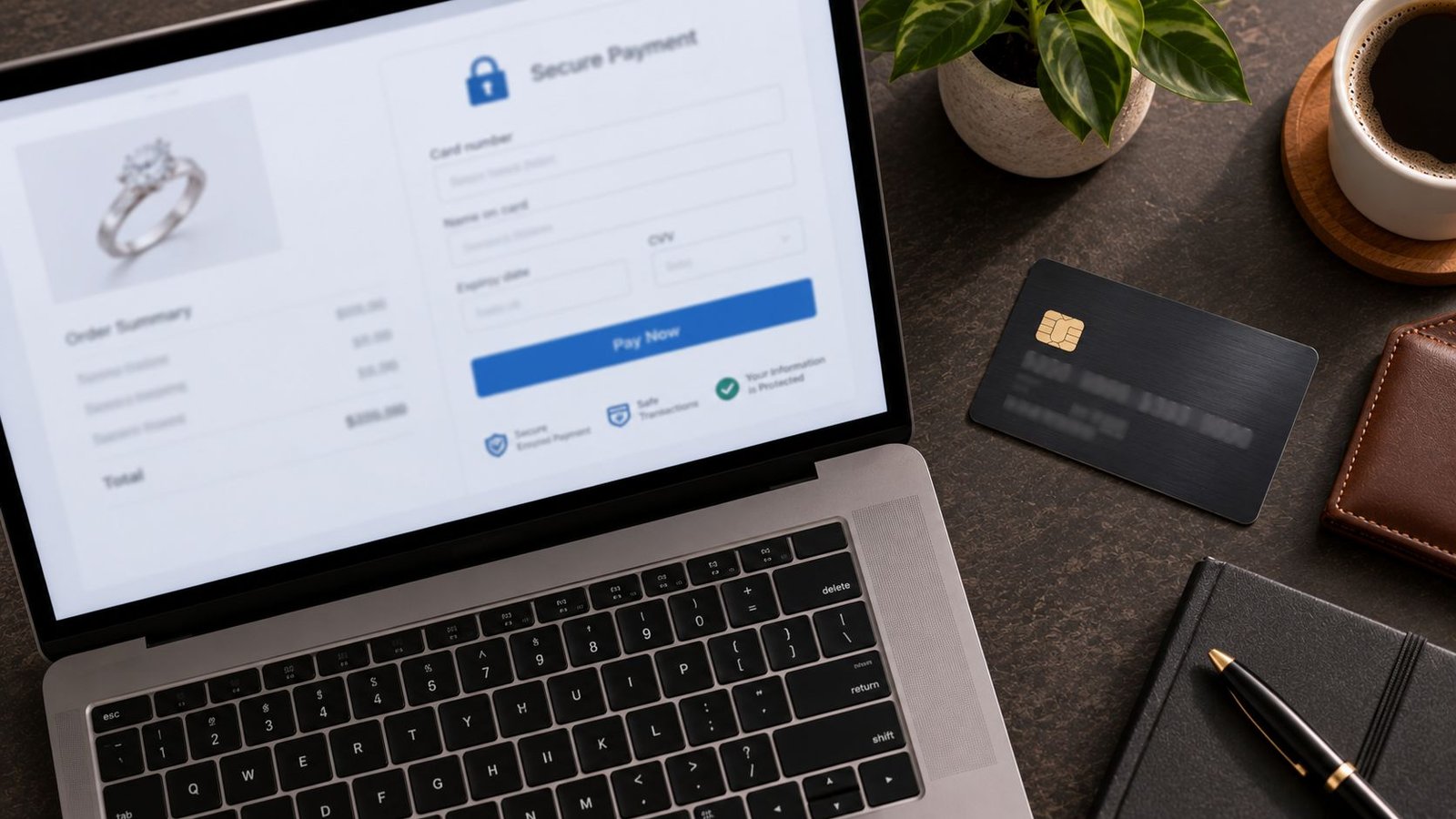
Legitimate sellers accept payment methods that offer real buyer protection and a genuine paper trail — credit cards and established secure payment processors among them. Requests to pay via wire transfer, direct bank transfer, cryptocurrency, or peer-to-peer payment apps like Venmo, particularly when framed as the only option or pushed with urgency, are a significant warning sign, since these methods are difficult or impossible to reverse once funds have moved and offer little to no recourse if something goes wrong.
Red Flag 7: Signs of an Illegitimate or Newly Formed Seller
A trustworthy seller typically has a genuine digital footprint — a professional website, clear and verifiable contact information, and a review history that reads as consistent and specific rather than generic or suspiciously uniform. Be cautious of sellers who appear to have launched very recently with no track record, who lack verifiable contact details, or whose reviews focus heavily on price with little specific detail about actual delivery, product quality, or certification experience.
How to Actually Verify a Certificate Yourself

Every major grading lab provides a free, public verification tool, and using it takes only a couple of minutes. Search the report number directly on the issuing lab’s own official verification page — not a link the seller provides, which could point anywhere — and confirm that the shape, carat weight, colour, and clarity listed match exactly what you’re being shown. Any mismatch, however small, is worth raising directly with the seller before proceeding, and a seller who becomes evasive or defensive when asked to support that verification is telling you something important in itself.
What to Do If You Suspect Lab Grown Diamond Fraud
Act quickly rather than waiting. If you paid by credit card, contact your card issuer about a chargeback as soon as you suspect a problem, since most protection windows are time-limited. In the US, report suspected fraud directly to the FTC, which tracks patterns across complaints and can pursue enforcement action against repeat offenders. Keep every piece of documentation — listings, receipts, correspondence, and certificate images — since this evidence matters for both a payment dispute and any formal complaint.
Protecting Yourself Before You Buy
Our warning guide on choosing a lab grown diamond wholesaler covers broader due-diligence questions worth asking any supplier, well beyond the specific fraud patterns covered here. And because legitimate disclosure requirements are a genuine legal matter in markets like the US, our guide to who actually regulates lab grown diamonds explains the difference between a seller simply having a certificate and a seller actually meeting their legal disclosure obligations — both matter, and they’re not automatically the same thing.
How Lab Grown Diamond Fraud Differs From Traditional Diamond Fraud
While plenty of overlap exists between lab grown diamond fraud and patterns that have targeted natural diamond buyers for decades, a few tactics are genuinely specific to how the lab grown category works.
Origin-blurring is a newer tactic entirely. Traditional diamond fraud rarely needed to obscure “how” a stone came to exist — a mined diamond is a mined diamond. Lab grown diamond fraud, by contrast, sometimes specifically involves removing growth-related indicators or altering documentation to make a lab grown stone appear natural, exploiting the price gap between the two categories in the opposite direction from what most buyers expect.
Price-based deception cuts both ways. Some fraud pushes a simulant or lower-grade stone at inflated lab grown prices; other schemes push an actual lab grown stone while implying natural origin to justify a higher price than the stone would otherwise command. Both rely on the same underlying weakness — a buyer who doesn’t independently verify origin and grade rather than taking a seller’s framing at face value.
The verification tools themselves are newer and less universally adopted. Because lab grown-specific detection equipment is a relatively recent addition to many jewellers’ toolkits, fraud schemes exploiting outdated screening — like the mixed-parcel tactic covered above — have a genuine window of opportunity that didn’t exist in quite the same way before lab grown diamonds reached significant market volume.
Building a Personal Verification Habit
Rather than treating fraud prevention as a one-time checklist, the buyers who avoid lab grown diamond fraud most consistently tend to build a few habits into every purchase, regardless of how trustworthy a seller initially seems.
Verify before you fall in love with a specific stone. It’s genuinely harder to walk away from a purchase once you’ve mentally committed to a particular piece, which is exactly why report-number verification belongs at the start of the process, not as an afterthought once you’re already emotionally invested.
Get a second opinion for significant purchases. An independent local jeweller can often confirm a stone’s basic characteristics in a few minutes, providing a useful cross-check against what an online seller claims, particularly for larger or more expensive pieces.
Trust specific, verifiable claims over general reassurance. A seller who readily provides a report number, welcomes independent verification, and answers detailed questions directly is behaving very differently from one who offers vague assurances and gets defensive when pressed for specifics — and that difference in behaviour is often more informative than anything else on this list.
Common Misconceptions About Lab Grown Diamond Fraud
“A certificate photo is proof enough.” It isn’t — only an independently verified report number, checked directly on the issuing lab’s own site, actually confirms anything.
“Lab grown diamond fraud only happens with unknown online sellers.” While less common, established-seeming sellers and showrooms aren’t automatically exempt — the verification habits covered in this guide are worth applying regardless of how polished a seller’s presentation looks.
“If the price is low, it must just be a good deal on a lab grown stone.” Lab grown diamonds are genuinely more affordable than natural ones, but a price dramatically below multiple other reputable quotes for the same specifications deserves real scrutiny, not automatic trust.
“Simulants like moissanite and CZ are inherently fraudulent.” They aren’t — selling a simulant honestly, clearly labelled as what it is, is entirely legitimate. The fraud is specifically in mislabelling a simulant as a genuine diamond.
A Quick Pre-Purchase Checklist

Pulling the red flags above into a short, practical sequence makes lab grown diamond fraud prevention genuinely fast rather than overwhelming.
Before you pay anything: get the report number and verify it directly on the issuing lab’s own site, confirm the listed specifications match exactly, and check that the seller has a genuine, verifiable business presence.
During the transaction: insist on a traceable payment method with real buyer protection, and treat any pressure toward wire transfer, crypto, or an unusual payment app as a reason to pause rather than proceed.
After you receive the piece: if a physical inspection is possible, check for a laser inscription matching the certificate where one should exist, and don’t hesitate to get an independent second opinion for anything above a modest price point.
Running through this sequence takes only a few extra minutes compared to a purchase made purely on trust, and it closes off nearly every tactic covered in this guide at once.
Final Thoughts: Verification Takes Minutes, Regret Lasts Longer
Lab grown diamond fraud relies overwhelmingly on buyers skipping a handful of simple checks that take only a few minutes to complete. Verify the report number independently rather than trusting a certificate image, understand what a genuine diamond’s physical properties actually are, use traceable payment methods, and treat pricing psychology and seller legitimacy with the same scrutiny you’d apply to any major purchase. None of this requires expertise — it requires knowing which two or three checks actually matter and being willing to walk away when a seller can’t satisfy them.