

Grown in Two Ways: What CVD vs HPHT Really Means for Diamond Quality and Value
Walk into almost any conversation about lab grown diamonds and sooner or later someone asks whether one growth method beats the other. The honest starting point is that CVD vs HPHT is not a contest between a real diamond and an imitation. Both processes produce genuine diamond: carbon atoms locked into the same cubic crystal lattice that forms deep underground, with the same hardness, the same brilliance and the same durability. What differs is the journey the carbon takes to get there, and that journey leaves subtle fingerprints on colour, crystal shape, finishing needs and production economics.
What follows unpacks the subject step by step, with no lab-coat jargon required. You will see how each machine works, where the two methods genuinely diverge, where the differences stop mattering to a buyer, and how to judge a finished stone on its own merits. Whether you buy for a retail counter, a wholesale portfolio or a ring of your own, understanding CVD vs HPHT helps you ask sharper questions and choose with confidence rather than guesswork.
CVD vs HPHT at a Glance: Two Roads to One Crystal
Think of two builders assigned to make an identical brick wall. One works under crushing force, squeezing raw material into place the way a sculptor packs clay. The other works in near stillness, laying material down one thin sheet at a time. The finished walls look alike, yet the process behind each is completely different. That is the simplest picture of the two growth methods.
HPHT stands for high pressure, high temperature. It recreates, inside a heavy industrial press, an environment of extreme force and heat. CVD stands for chemical vapour deposition. It works in a sealed chamber at far lower pressure, where a carbon-bearing gas is broken apart so that carbon can settle onto a diamond seed.
Historically, HPHT arrived first in gem-quality production, while CVD matured more gradually and then advanced quickly over recent years. Today both feed the jewellery trade at scale, and gemmological laboratories grade stones from both routes using the very same 4Cs framework. Neither is a shortcut or a lesser cousin. They are two engineering answers to the same question: how do you persuade carbon to become a diamond?
How the HPHT Method Grows a Diamond

Picture a heavy press built to squeeze a tiny chamber with almost unimaginable force. Inside that chamber sit a small diamond seed, a supply of carbon in the form of graphite, and a molten metal mixture that acts as a solvent, typically built around iron, nickel or cobalt. Once the press reaches pressures in the region of five to six gigapascals, roughly fifty to sixty thousand times normal air pressure, and temperatures of around 1,300 to 1,600°C, the graphite dissolves into the liquid metal and slowly travels toward the cooler seed. There it settles, atom by atom, extending the seed’s crystal pattern outward.
The result is a chunky, multi-faceted rough crystal rather than a flat plate. Growth speed depends on the target size, and large, clean crystals need patience, since rushing the process invites flaws.
HPHT growth has one recurring challenge: nitrogen. Trace nitrogen from the surrounding materials slips into the crystal and tints it yellow, so producers add nitrogen-absorbing materials, known as getters, to keep the stone colourless. Another quirk is that tiny specks of the metal solvent can occasionally become trapped inside, leaving small dark metallic inclusions. Careful producers manage both issues well, and in recent years the large majority of HPHT stones submitted to major laboratories have been colourless, which shows how far the process has matured.
How the CVD Method Builds a Diamond Layer by Layer

CVD takes the opposite philosophy. Instead of force, it relies on precision and patience. A thin, flat slice of diamond, known as the substrate, is placed inside a sealed chamber from which the air has been removed. The chamber is then filled with a carefully measured gas mixture, mostly hydrogen with a small share of a carbon source such as methane. Microwaves energise the gas into a glowing plasma, which breaks the molecules apart and frees carbon atoms to drift down and attach to the substrate, copying its crystal structure as they go.
Hydrogen plays a quiet but crucial role here. It makes up the overwhelming bulk of the gas and works to strip away any carbon that tries to form graphite or other non-diamond material, leaving only proper diamond to build up. Temperatures generally sit between about 700 and 1,300°C, far gentler than HPHT conditions, and pressure stays low. The trade-off is time: crystals build up in thin layers over a period of weeks, and growth is sometimes paused so that the surface can be cleaned or polished before deposition resumes.
CVD crystals grow as flat, tablet-like plates rather than chunky blocks, and a single reactor can hold several substrates at once. Because the chemistry is tightly controlled, the process tends to produce stones with very little nitrogen, which is one reason CVD has become so popular for colourless gems. Its main quirk is a brownish tint that can appear in freshly grown rough, and we will come to how that is handled shortly.
CVD vs HPHT: Does the Growth Method Change Diamond Quality?
Here is the reassuring answer: not in the way most people fear. Diamond is diamond regardless of how it formed. Both methods yield carbon arranged in the same cubic lattice, scoring 10 on the Mohs scale, with the same thermal conductivity, refractive index and fire. A skilled cutter working on a well-grown stone from either route can deliver top colour and high clarity, and a poorly made stone from either route will disappoint.
What separates one finished diamond from another is the quality of the specific growth run, the care taken during cutting, and the honesty of the grading report. That is why GIA’s overview of laboratory-grown diamonds presents both processes within a single grading framework, and why the final certificate matters far more than the label describing the route.
Differences do exist at the microscopic level. Growth leaves behind internal patterns, much as tree rings reveal a tree’s history. The two methods differ in how they take up nitrogen, how strain is distributed inside the crystal and which tiny inclusions they tend to carry. CVD stones are usually type IIa, meaning almost free of nitrogen, while HPHT producers reach colourless results through careful nitrogen control. These distinctions help gemmologists identify a stone’s origin, but they rarely change how the diamond looks to a buyer holding it under ordinary light.
For anyone weighing the two purely on quality, the practical takeaway is simple: shop the diamond in front of you, not the acronym behind it.
Colour, Clarity and Post-Growth Treatment

Colour is where the CVD vs HPHT story turns most visible in the rough. Freshly grown CVD rough often carries a brownish cast, particularly when producers favour fast growth recipes. Rather than slowing everything down, many manufacturers grow quickly and then anneal the stone at high temperature to lighten or remove that brown tone. Laboratories describe two variants: an HPHT treatment run at temperatures above those used for HPHT growth, which adds no new diamond material, and low-pressure, high-temperature annealing under vacuum or inert gas. Natural brown diamonds are enhanced in a comparable way, so the practice is long established in the trade.
Treatment is not a mark against a stone. It is a finishing step, and what matters is disclosure. Major laboratories flag post-growth treatment on their reports, which lets buyers see exactly what has happened to a stone. The improved colour is considered stable in ordinary wear, and a treated stone graded in the colourless range looks the same as an untreated one of the same grade. HPHT stones can also be treated to shift their colour, which is why the phrase “post-growth treatment” appears on reports for both families.
Fancy colours are possible from either route. Deliberate additions of elements such as boron can produce blue stones, while nitrogen contributes yellow, and both methods are used to make coloured diamonds for jewellery. On clarity, CVD stones may show pinpoints, faint clouds or internal graining, while HPHT stones may show the small metallic inclusions mentioned earlier. Both types of feature are graded by the same clarity scale used for every other diamond, as GIA’s 2024 review of laboratory-grown diamond trends makes clear.
How Laboratories Tell the Two Methods Apart
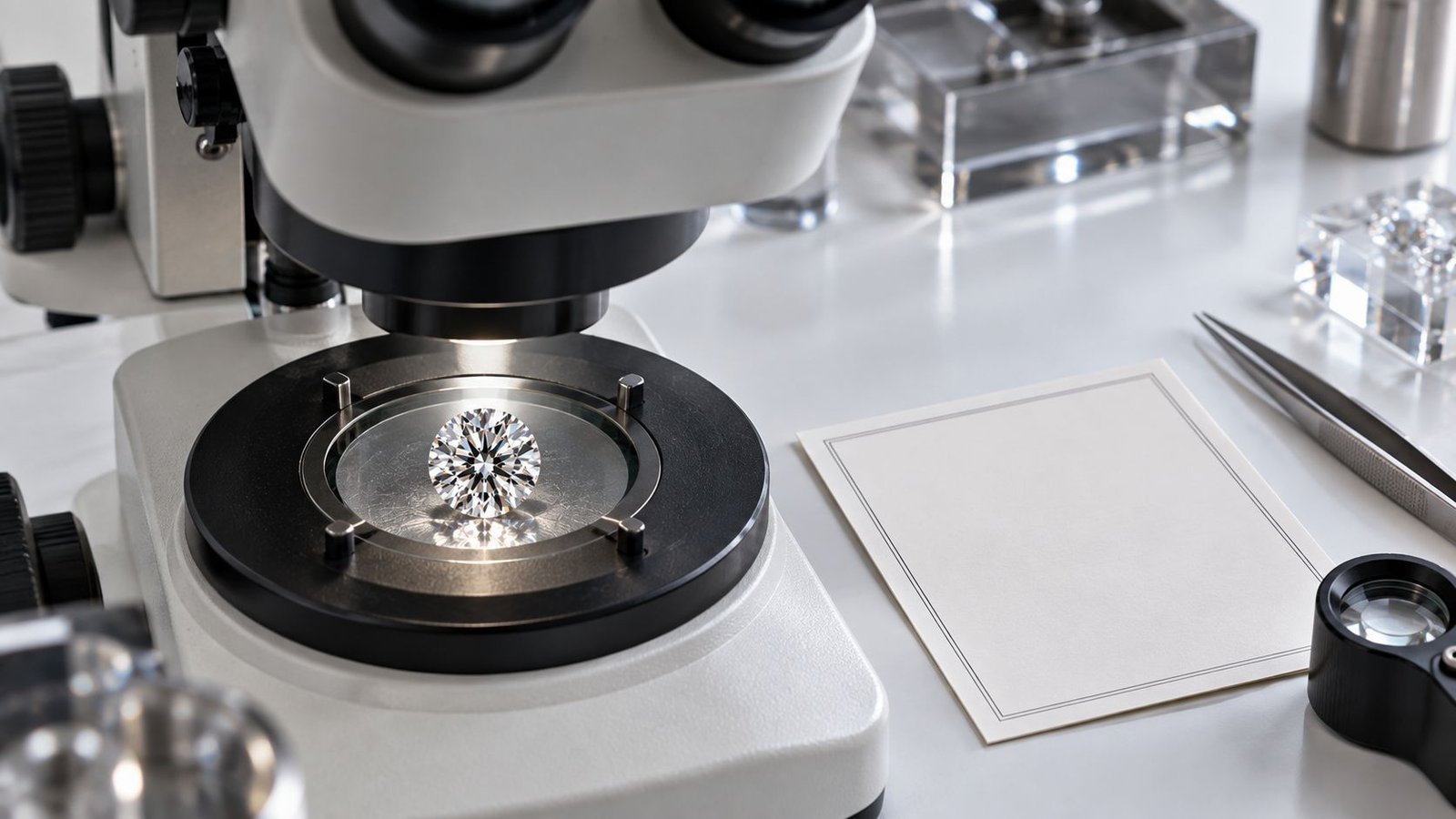
You do not need specialist equipment to buy well, but it helps to know how experts settle the CVD vs HPHT question for any given stone. Gemmologists rely on instruments that reveal what the naked eye cannot. Fluorescence imaging exposes internal growth structure: HPHT stones often display a cross-shaped or geometric pattern, while CVD stones tend to reveal fine layered striations that echo the way they were built up sheet by sheet. Spectroscopy adds another layer of evidence by recording how the crystal absorbs and emits light, which reflects its nitrogen content and treatment history.
Because of these tools, a reputable laboratory can confirm that a stone is lab grown, describe the growth process and note whether post-growth treatment was detected. Many reports carry this information directly, so the practical step for any buyer is to read the specific certificate rather than rely on a seller’s summary. If a supplier cannot show you a report for a stone, that is the moment to slow down.
CVD vs HPHT for Size, Shape and Cutting
Crystal shape drives strategy, and it is one of the practical places where CVD vs HPHT differences reach the cutting room. A flat CVD plate and a chunkier HPHT crystal invite different cutting plans, and experienced cutters tune their approach to squeeze the best finished stone from each type of rough. Neither shape is superior; each simply asks a different question of the person holding the polishing wheel.
On size, both methods now deliver stones well beyond the small melee once associated with early production. Growth time, crystal stability and machine capacity all influence how large a single stone can become, and those limits keep moving as equipment improves. For a buyer the useful lesson is that size availability changes over time, so it pays to ask a supplier what is currently in stock rather than assuming an old rule of thumb still applies.
Cut quality, of course, matters more than either growth route. A superbly cut stone from any method will outshine a sloppy one, because proportions, symmetry and polish govern how light travels through the diamond. That is worth remembering whenever a comparison starts to focus on process rather than performance.
What CVD vs HPHT Means for Price
Retail price is driven mainly by carat weight, colour, clarity, cut, certification and the supplier’s margin, not by whether the stone came from a reactor or a press. Two similar stones with comparable reports will usually sit close together in price regardless of route, and any large gap deserves a question about grade, treatment or certification rather than an assumption that the method explains it.
Behind the scenes, producers do weigh the economics differently. Press-based HPHT operations demand heavy, robust equipment. CVD reactors run several substrates in parallel and depend on stable plasma conditions and reliable power. Each approach has strengths in efficiency, and both have grown cheaper to run as technology has improved. Broadly speaking, much of India’s gem-quality growth capacity has leaned toward CVD, while other major producing regions built large HPHT operations, so the supply mix you encounter can vary with the market you buy from.
The encouraging news for buyers is that competition between the two methods has helped make lab grown diamonds more accessible. Our lab grown diamond price guide shows how prices look across USD, EUR and INR markets, and the same 4Cs logic applies to stones from either route.
CVD vs HPHT Side-by-Side: The 7 Key Differences
The table below pulls the seven most useful differences into one place so you can scan them quickly.
| Feature | HPHT | CVD |
| Growth environment | Heavy press with molten metal solvent | Sealed vacuum chamber with carbon-rich gas plasma |
| Pressure | Around 5–6 GPa | Low pressure, far below HPHT levels |
| Temperature | Roughly 1,300–1,600°C | Roughly 700–1,300°C |
| Carbon source | Graphite dissolved in metal | Methane gas mixed with hydrogen |
| Typical crystal shape | Chunky, multi-faceted | Flat, tablet-like plate |
| Post-growth colour work | Possible if a colour change is wanted | Common, to lighten brownish tones |
| Typical lab clues | Metallic inclusions, cross-shaped fluorescence | Layered growth striations, internal graining |
Read the table as a map of differences in process, not a ranking of quality. Every row describes how the diamond was made or how it can be identified; none of them says one stone is a better gem than the other.
Beyond Jewellery: Where Each Method Shines
Diamond’s talents reach far beyond the ring finger, and the CVD vs HPHT split shows up in industry too, where the two methods have found different homes. HPHT has long served the abrasives and cutting-tool world, where tough, durable grit is prized. CVD, with its controlled chemistry and thin-layer growth, has opened doors in optics, heat management and electronics research, where purity and precision count for more than carat weight.
This wider picture matters because it shows both methods are mature, well-understood technologies with decades of engineering behind them. When a jewellery stone comes from either route, it draws on the same deep pool of scientific knowledge that supports advanced manufacturing. That is a comforting thought for anyone who worried a lab grown stone might be an experimental product.
CVD vs HPHT: Which Method Should You Choose?

For most buyers the best answer is to choose the stone, not the method. Here is a simple approach that works for retail shoppers and wholesale buyers alike.
Start with the report. Read the laboratory report for grade, growth process and any post-growth treatment. Our look at AI’s role in lab grown diamond production and grading adds useful background on how grading standards keep evolving.
Compare on the 4Cs. Two stones with identical carat, colour, clarity and cut should be judged on how they look and how they are priced, whatever their route.
Ask about treatment. Confirm whether any post-growth treatment was applied and that it is disclosed. Transparent suppliers answer this without hesitation.
Look at the stone itself. Where possible, view the diamond in person or on a detailed video. Sparkle, symmetry and colour appearance settle most questions.
Think about consistency. If you are buying matched pairs or parcels, ask whether the stones share the same growth process and treatment history, because consistency helps a uniform look. Our warning guide on choosing a lab grown diamond wholesaler covers the wider questions worth asking.
Common Misconceptions About CVD vs HPHT
Because CVD vs HPHT is a fairly new topic for many buyers, a few myths circulate widely. Here are the most common ones, with the facts behind them.
“HPHT diamonds are more real because they use pressure like nature.” Both methods create real diamond. Nature uses pressure, but what defines a diamond is its crystal structure and chemistry, and both routes deliver exactly that.
“CVD diamonds are fake because they grow from gas.” The carbon that lands on the seed becomes true diamond, identical in structure to any other. The source of the carbon does not change what the finished crystal is.
“Post-growth treatment means a lower-quality stone.” Treatment is a finishing step used to refine colour and is disclosed on reports. Judge the finished stone on its grade, not on the existence of a treatment line.
“One method is always cheaper.” Price depends on the 4Cs, certification and the supplier, not the label. Similar stones tend to sit at similar prices regardless of route.
“The growth method decides the grade.” The grade is decided by examining the finished diamond. A great stone can come from either route, and so can a mediocre one.
Questions Worth Asking a Supplier
When CVD vs HPHT details matter to your purchase, a handful of direct questions quickly shows whether a supplier understands the products they sell.
Ask which growth process the stone came from and whether any post-growth treatment was applied. A knowledgeable supplier will answer plainly and point you to the report.
Ask whether a parcel or matched set shares the same growth process. This is especially useful for wholesale buyers who care about a consistent appearance across many stones.
Ask how the supplier verifies what they receive. Clear checking procedures and independent certification are signs of a business that takes accuracy seriously.
Final Thoughts: Two Methods, One Remarkable Material
The debate around CVD vs HPHT tends to sound like a fight, yet the reality is closer to a friendly partnership. One method uses immense pressure and molten metal, the other uses gentle vacuum and glowing plasma, and both deliver genuine diamond that can be graded, cut and treasured in exactly the same way. The differences that matter most sit in the details of the individual stone: its colour, clarity, cut, certificate and honest disclosure of any post-growth treatment.
For buyers, that is genuinely good news. You can stop worrying about which acronym is “better” and focus on choosing a beautiful, well-documented stone from a supplier you trust. For sellers, it means explaining both methods with pride and clarity, since informed customers are confident customers. Understanding CVD vs HPHT is less about picking a winner and more about appreciating how human ingenuity found two remarkable paths to the same extraordinary gem.