

Inside the AI Shift Reshaping Lab Grown Diamond Production and Grading
Every year brings a fresh wave of headlines claiming artificial intelligence has “revolutionised” diamond production, and separating what’s genuinely changed from what’s marketing polish takes real digging. Some of it is real and well documented. Some of it is a vague claim repeated across enough blogs that it starts to sound established even without a verifiable source behind it. This guide sticks to what’s actually confirmed — named technologies, real companies, documented capabilities — and is honest about where AI’s role in producing and grading AI lab grown diamonds still has genuine limits.
AI in the Growth Chamber: Real-Time Process Control

Both CVD and HPHT growth of AI lab grown diamonds depend on holding temperature, pressure, and gas composition within tight tolerances for hours or days at a stretch, and this is the area where automation’s role is most solidly established. Sensor-based systems that continuously monitor chamber conditions and make real-time adjustments — rather than relying on periodic manual checks — have become standard practice across a growing share of production facilities, reducing the batch-to-batch variability that used to be a much bigger factor in yield and quality consistency.
Specific efficiency claims circulating in industry coverage — faster growth cycles, particular percentage improvements in defect rates — vary considerably by source and aren’t independently verified across the board, so it’s worth treating any single specific number with some scepticism rather than repeating it as settled fact. What is consistently corroborated across multiple sources is the underlying shift itself: growth conditions are increasingly monitored and adjusted algorithmically rather than purely by human operators checking gauges on a schedule.
Catching Defects During Growth, Not After
A related and well-documented shift for AI lab grown diamonds is the move toward detecting structural issues while a diamond is still growing, rather than only discovering problems once growth is complete. Sensor and computer-vision systems integrated into modern reactors can flag irregularities in real time, allowing adjustments mid-process rather than writing off a finished stone after the fact. This matters more for yield and cost efficiency than it does for the finished stone’s own qualities — a diamond that reaches a buyer has already passed both growth and grading regardless of how the defect was caught, but catching problems earlier in the process genuinely does affect production economics and, over time, price.
AI-Assisted Cut Planning: A Genuinely Established Technology
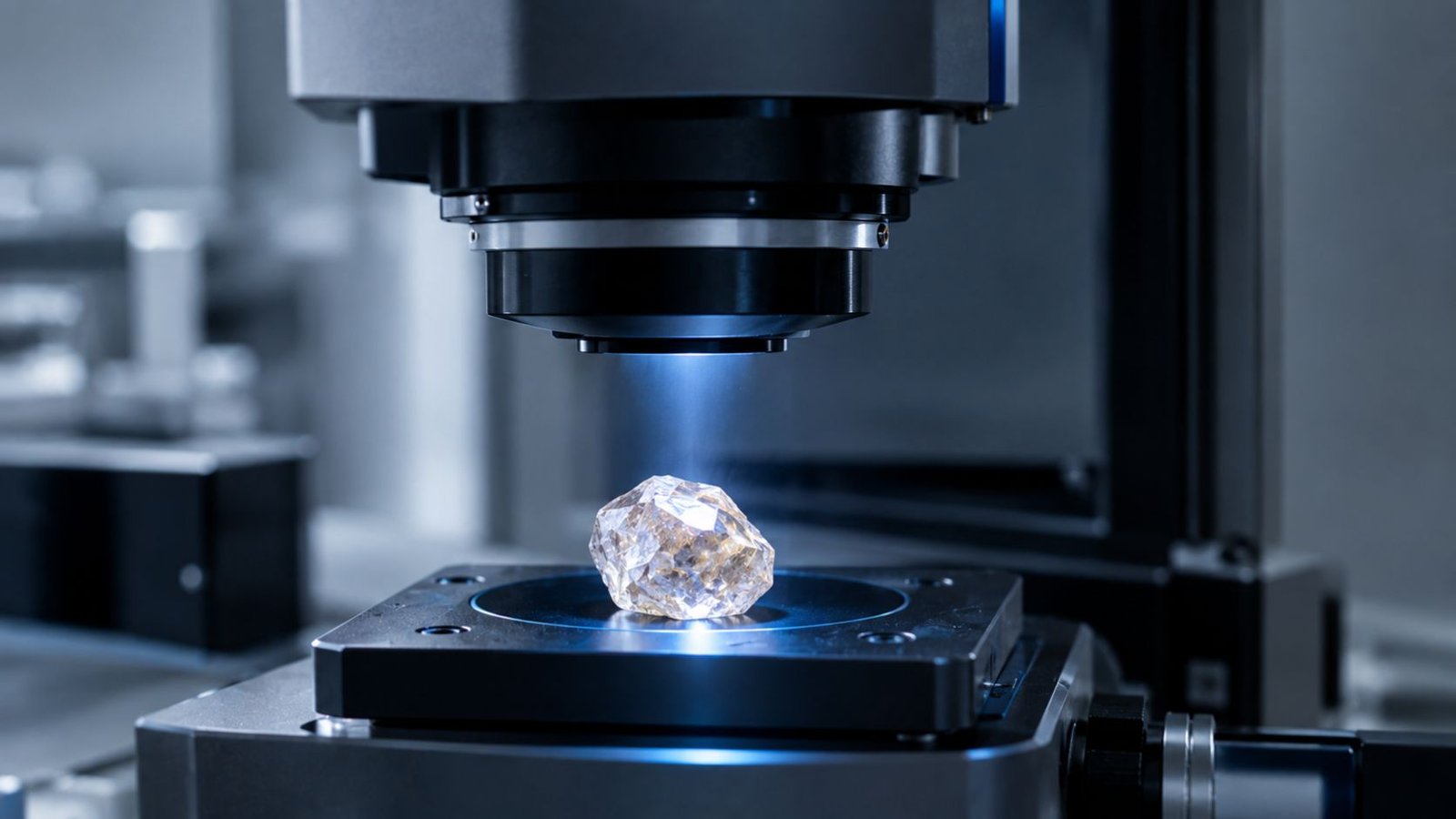
This is where the “AI in diamonds” story has the deepest, most verifiable track record. Sarine Technologies, a publicly traded diamond technology company, introduced DiaMension — the first software for computerised diamond planning — back in 1992, decades before “AI” became the industry buzzword it is today. Sarine’s Galaxy system now scans rough diamonds to map internal inclusions before cutting begins, letting manufacturers plan a polished outcome that maximises value from a given piece of rough rather than cutting largely on instinct and experience alone.
This planning technology applies to AI lab grown diamonds’ rough material exactly as it does to natural rough, and it’s one of the more concretely valuable applications of automation in the entire production chain — reducing wasted material and inconsistent yield in a way that’s measurable rather than merely claimed.
Grading Gets Automated Too: eGrading and Where Its Limits Actually Sit

Sarine leads this category as well. The company launched the diamond industry’s first AI-based grading technology in 2017, then followed up with a second-generation system, Sarine Clarity-II and an updated Sarine Color system, in 2022 — extending automated grading across a broader range of clarity grades and adding parameters like fluorescence and tinge assessment that earlier automated systems couldn’t reliably handle.
Here’s the honest, important nuance worth stating plainly: automated grading hasn’t replaced human gemologists, and industry coverage through 2026 consistently describes a hybrid model rather than full automation. AI systems excel at consistency — removing the fatigue, mood, and subjective variation that affects even well-trained human graders — but subjective judgment calls in colour and clarity grading, particularly for borderline or unusual stones, still benefit from an experienced human eye working alongside the automated data. A formatted grading certificate compiled from AI-collected data is typically still reviewed and signed off by a certified gemologist before release, not issued on the machine’s assessment alone.
GIA Made Its Own Move Too: The New Premium and Standard Grades
Independent of any single company’s AI product, GIA overhauled its own approach to grading lab grown diamonds, dropping the familiar D-to-Z colour scale for these stones as of October 2025 and replacing it with a simpler Premium and Standard split. It wasn’t billed as an AI initiative on GIA’s part, but it points the same direction as everything else here — grading for AI lab grown diamonds moving toward quicker, more standardised assessment as output keeps climbing.
Machine Learning for Origin Verification
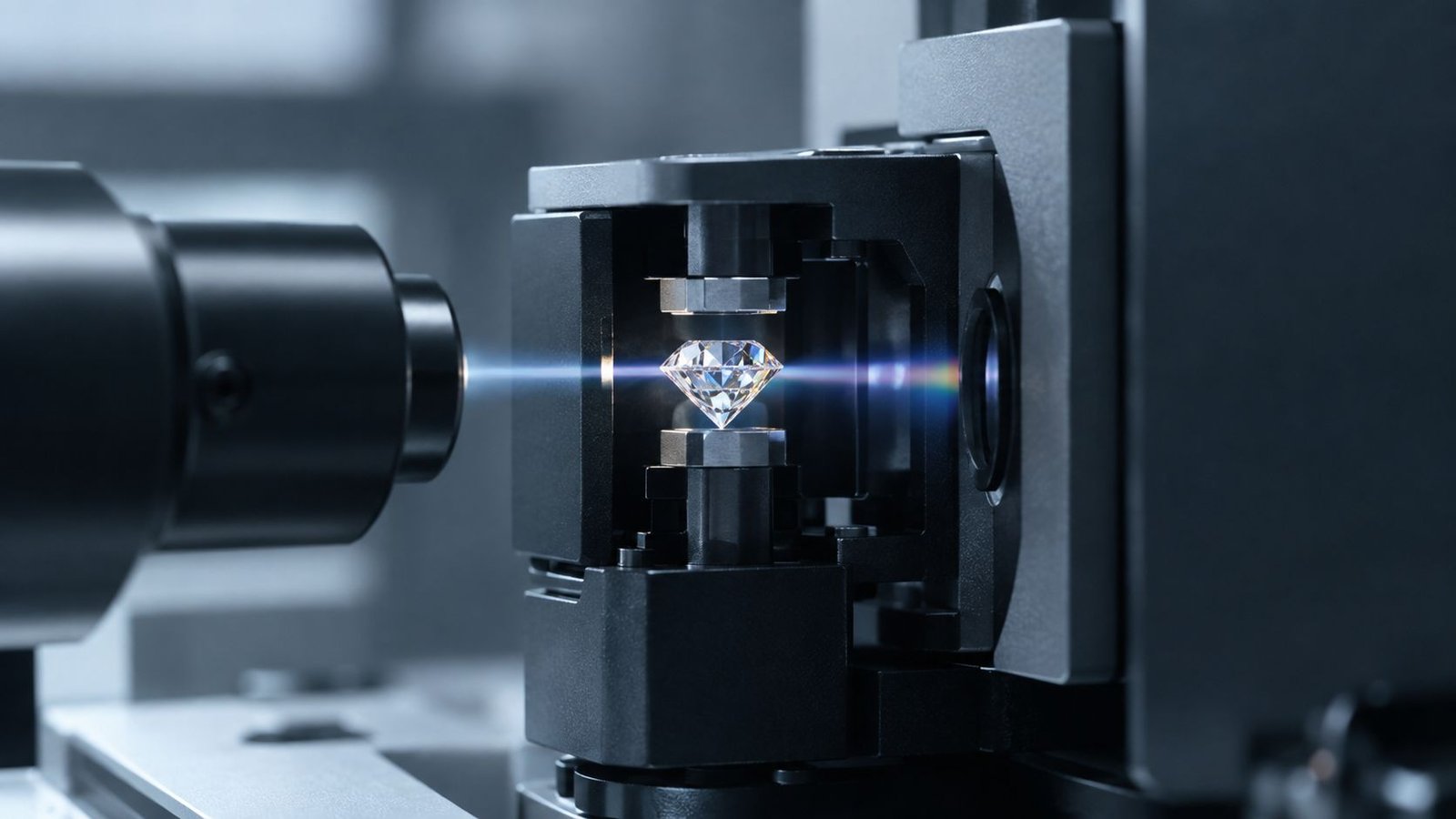
A genuinely important machine learning application for AI lab grown diamonds involves distinguishing natural diamonds from lab grown material, and increasingly separating CVD origin from HPHT origin — models trained on spectroscopic data can identify growth-related characteristics far more consistently than manual inspection alone. This matters directly for certification accuracy, since correctly identifying a stone’s origin is foundational to everything else a grading report states about it.
What This Means for Wholesale Buyers
For buyers sourcing AI lab grown diamonds, these production and grading changes translate into a few practical, tangible benefits. Automated cut planning generally means better yield and more consistent proportions across a batch of rough sourced from the same production run. Automated grading generally means faster turnaround on certification, which matters for restocking speed on popular shapes — and faster restocking has knock-on effects for pricing stability too, an area our shape-by-shape price guide tracks in more detail.
Real-time growth monitoring generally means more consistent quality across large parcels, which is exactly the kind of consistency that matters most when sourcing calibrated melee for halo or eternity band work, as covered in our guide to why calibrated lab grown diamonds matter for professional manufacturing.
None of this changes the fundamentals of good sourcing practice, though — a certificate is still the thing that actually matters, regardless of how much automation went into producing it. Our warning guide on choosing a lab grown diamond wholesaler covers the due diligence worth doing regardless of how advanced a supplier’s production technology claims to be.
Where AI Still Falls Short
Being honest about AI lab grown diamonds’ limitations matters as much as covering what’s genuinely working. Subjective clarity nuance — distinguishing between two very close grades on a borderline stone — and colour judgment calls involving unusual secondary hues remain areas where experienced human gemologists consistently outperform automated systems, according to industry coverage through 2026. Fully autonomous, end-to-end diamond production and grading with zero human oversight isn’t where the industry actually stands today, despite how some marketing content frames it. The more accurate picture is a genuinely useful hybrid — automation handling consistency, speed, and scale, with human expertise still applied at the judgment-call moments that matter most.
AI Lab Grown Diamonds and Melee Sorting
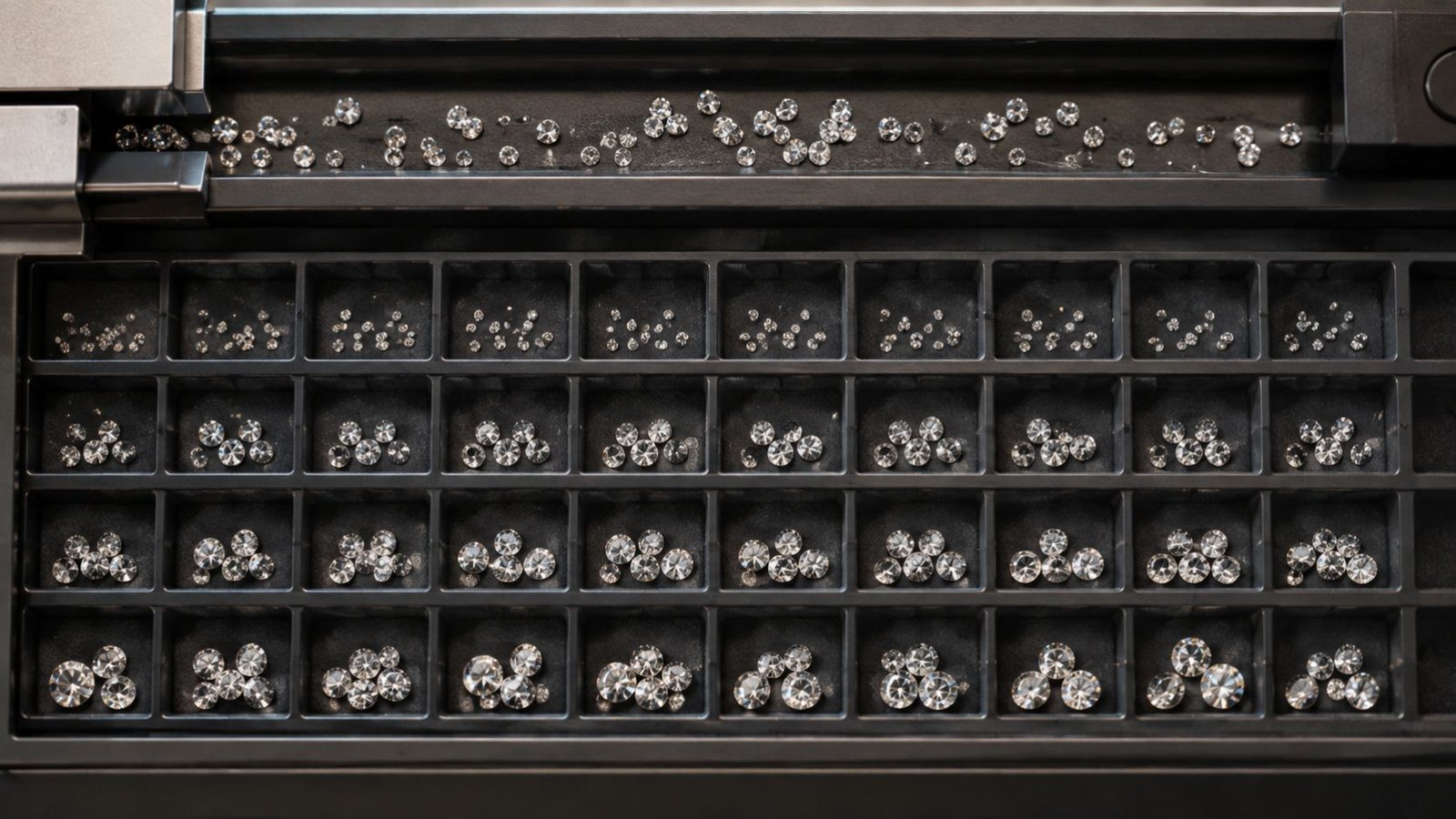
Beyond growth control and grading, automated sorting technology has become increasingly important for a category that matters enormously to manufacturers: matched melee for pavé, halo, and eternity band work. Automated sorting systems can sift through large parcels of small AI lab grown diamonds and group them by size, colour, and clarity far faster and more consistently than manual sorting ever achieved, which directly affects how quickly a supplier can assemble a genuinely well-matched batch rather than an approximately similar one.
This matters more than it might first appear, since a batch of melee that reads as visually mismatched under close inspection — even slightly — noticeably undermines a finished piece in a way that a single centre stone’s minor imperfection typically doesn’t. Faster, more consistent sorting technology is part of why well-matched melee has become more accessible and more affordable than it was even a few years ago.
The Business Case: Why Producers Are Actually Investing in This
It’s worth understanding the economic logic driving adoption, since it explains why this shift is happening now rather than remaining a future promise. Manual grading and sorting are genuinely labour-intensive processes, and as global lab grown diamond production volume has scaled up dramatically, the economics of pairing that volume with purely manual quality assessment have become increasingly strained. Automated systems that can process large volumes consistently, day after day, without the fatigue-related variability that affects human graders over long shifts, offer a genuinely compelling cost and consistency advantage at scale — which is the real driver behind investment in this technology, more than any abstract enthusiasm for artificial intelligence as a concept.
For AI lab grown diamonds specifically, this economic logic is particularly strong, since production volume has grown so quickly that manual-only quality assessment would struggle to keep pace without either slowing throughput or accepting more inconsistency than the market has shown itself willing to tolerate.
Common Misconceptions About AI in Diamond Production
AI has fully automated diamond grading — that’s a myth. Industry coverage consistently describes AI-assisted grading with human gemologist review and sign-off, not fully autonomous certification.
AI-optimised production being universal across the industry — also not accurate. Adoption varies significantly by facility and region — sensor-based process control and AI cut planning are genuinely established technologies, but not every producer has adopted them to the same degree.
The idea that faster, AI-driven production means lower quality gets this backwards. The documented purpose of these technologies is reducing defects and improving consistency, not cutting corners on quality.
AI grading and human grading don’t always land on the same answer, and that’s expected. They’re designed to converge, but the entire reason human review remains standard practice is that automated systems and trained gemologists don’t always reach identical conclusions on genuinely borderline stones.
A Practical Framework for Evaluating Supplier Claims
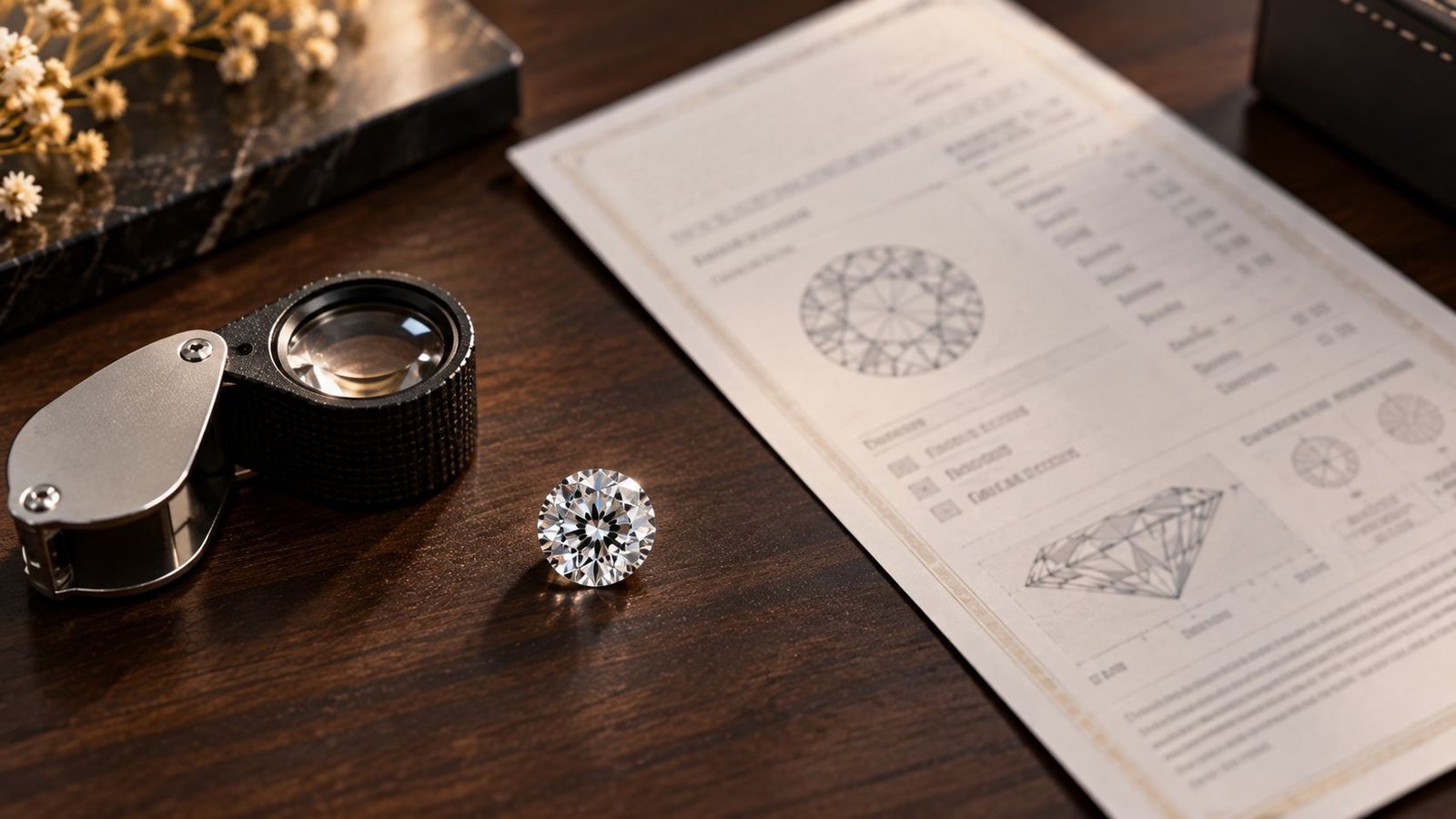
Given how much marketing language gets attached to “AI” as a term, it’s worth having a simple framework for evaluating any specific claim a supplier makes about AI lab grown diamonds and how they were produced or graded.
Ask for the specific technology or vendor name, not just the word “AI” in isolation. A supplier referencing Sarine’s eGrading or Galaxy systems by name is making a verifiable, specific claim; a supplier simply saying “AI-graded” without naming the underlying system is making a much vaguer one.
Ask whether human review still happens, and at what stage. A credible answer describes a hybrid process; an answer claiming fully autonomous grading with zero human oversight is worth treating with real scepticism, given how consistently industry coverage describes hybrid practice as the current standard.
Treat specific efficiency percentages with appropriate caution unless they come with a named, checkable source. General directional claims — faster, more consistent, more scalable — are well supported industry-wide; precise numbers attached to a single supplier’s marketing copy often aren’t independently verifiable.
Applying this kind of scrutiny doesn’t mean dismissing AI’s real role in producing and grading AI lab grown diamonds — it means being able to tell the difference between a supplier making a grounded, specific claim and one borrowing a buzzword for credibility it hasn’t actually earned.
Final Thoughts: Real Progress, Honestly Described
AI’s role in producing and grading AI lab grown diamonds is genuinely significant — real-time growth monitoring, computerised cut planning with a three-decade track record, and AI-assisted grading systems used by major industry players are all verifiable, established technologies, not vapourware. What’s overstated is the idea that any of this has replaced human expertise entirely. The most accurate way to think about where the industry actually stands in 2026 is a hybrid model: automation handling scale, consistency, and speed, with experienced human judgment still doing the work that genuinely needs it.