

How Custom Engraving Is Transforming Lab Grown Diamond Jewellery in 2026
A ring, pendant, or pair of earrings can carry more than a diamond’s sparkle. Somewhere on the metal, or occasionally on the stone itself, a handful of characters can turn a beautiful piece into an unmistakably personal one — a date, a name, a coordinate, a single word that means something only to the person wearing it. That’s the appeal behind custom diamond engraving, and heading into 2026, the options available for adding that personal layer have expanded well beyond the simple inside-band initials most buyers still picture first.
This guide walks through what custom diamond engraving actually involves in 2026 — the techniques available, where engraving can realistically be placed on a piece of lab grown diamond jewellery, what it costs, how durable it is over years of daily wear, and how to decide which approach fits a specific ring, pendant, or gift.
What Custom Diamond Engraving Actually Covers
Custom diamond engraving is a broad umbrella term, and it helps to separate it into two genuinely different categories before going further. The first is engraving on the metal itself — the inside of a ring band, the back of a pendant, the post of an earring — which is the more familiar and more widely available option. The second is engraving directly on the diamond, most often as a microscopic laser inscription along the stone’s girdle, invisible to the naked eye but visible under magnification.
Both fall under the same custom diamond engraving umbrella, but they involve completely different tools, different levels of precision, and different price points. Understanding which category a specific request falls into is usually the first practical step in planning any personalised piece.
Laser Inscription on the Diamond Girdle
Laser inscription is the more technically demanding form of custom diamond engraving, since it involves etching directly onto the diamond’s girdle — the thin band running around the stone’s widest point — using a focused laser rather than a physical tool.
How Girdle Inscription Works

A computer-guided laser burns microscopic characters into the girdle surface, small enough that they’re invisible without at least 10x magnification. This makes girdle inscription a popular choice for buyers who want a hidden, deeply personal message without it being visible in everyday wear — a proposal date, initials, or a short phrase that only the wearer knows is there. Many independent gem labs, including the GIA, offer a formal registry system for these inscriptions; the GIA’s laser inscription registry explains how a stone’s report number or a custom message can be permanently linked to its identity for insurance and identification purposes.
Why This Form of Custom Diamond Engraving Suits Lab Grown Stones Particularly Well
Lab grown diamonds are especially well suited to this kind of custom diamond engraving because their lower per-carat pricing means buyers are more comfortable requesting girdle inscription on a larger or higher-clarity centre stone than they might be with a natural diamond carrying a steeper price tag. The inscription itself doesn’t affect the diamond’s durability or its light performance in any measurable way, since it sits on the girdle rather than through any of the stone’s optically active facets.
Engraving on the Metal Band or Setting
The far more common and more affordable form of custom diamond engraving happens on the metal itself, and there are several distinct techniques available depending on the look and depth desired.
Hand Engraving

Hand engraving is done manually by a skilled engraver using small hand tools, and it remains the gold standard for anyone wanting genuinely fine, artistic detail — elaborate script, floral motifs, or a signature-style message that carries visible texture and depth. This is the slowest and typically most expensive form of custom diamond engraving, but it produces a result with a level of character that machine methods can’t fully replicate.
Laser Engraving
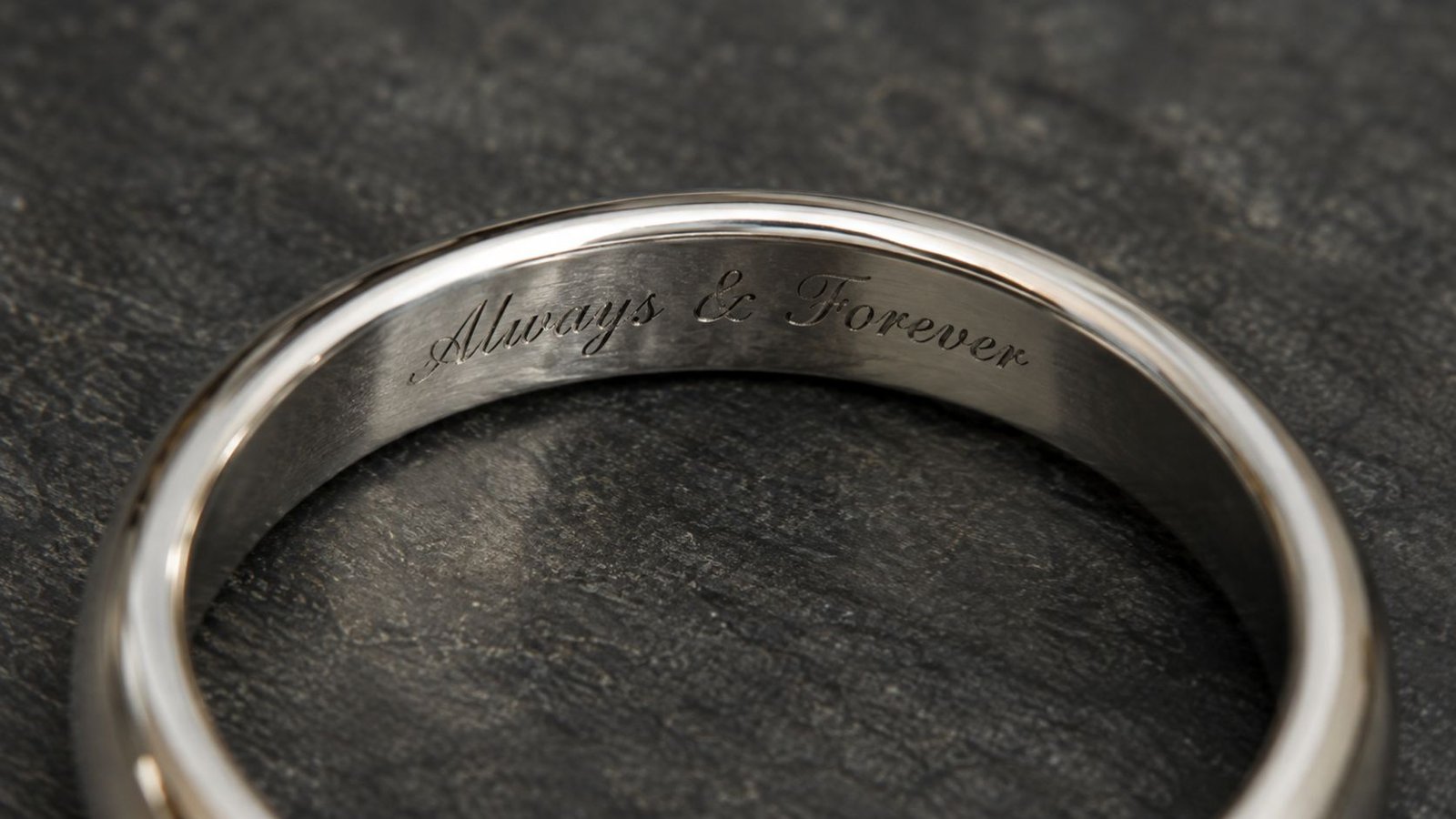
Laser engraving on metal uses the same underlying laser technology as girdle inscription but applied to a ring’s interior surface rather than the stone. It’s faster, more affordable, and highly consistent, which makes it the default choice for most standard text, dates, and short phrases. Because it’s computer-guided, laser engraving also handles small, precise fonts more reliably than hand tools can manage at the same scale.
Rotary or Machine Engraving
Rotary engraving uses a rotating cutting tool guided by a machine, sitting somewhere between hand engraving and laser engraving in both cost and character. It can achieve slightly deeper, more dimensional lettering than laser engraving while remaining faster and more affordable than fully manual hand work, making it a practical middle option for buyers who want more presence than a laser inscription but don’t need full hand-engraved artistry.
Where Custom Diamond Engraving Can Actually Be Placed
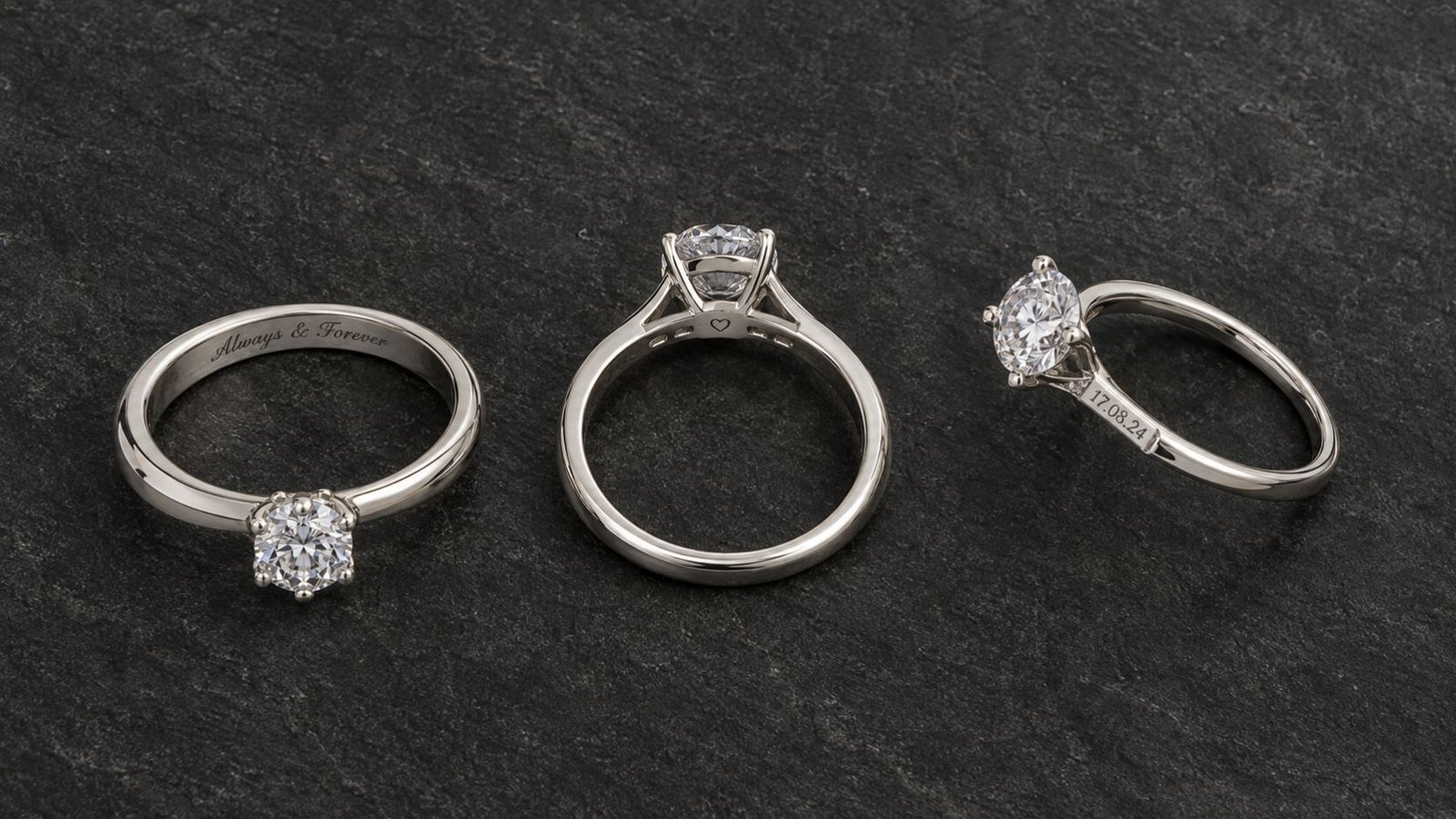
Beyond the technique itself, where the engraving physically sits on a piece changes both its visibility and its practicality.
Inside the band is the most traditional and most requested location for custom diamond engraving on rings, keeping the message private and against the skin rather than visible from the outside.
On the gallery or shoulders — the sides of the setting beneath the centre stone — offers a spot for slightly longer inscriptions or small symbols without interrupting the band’s outer surface.
On the diamond girdle itself, as covered above, is the most discreet option of all, invisible without magnification and reserved almost exclusively for laser inscription rather than any physical engraving tool.
On a pendant’s reverse side gives considerably more surface area to work with than a ring band, making it a popular choice for longer messages, small illustrations, or even a short handwritten phrase reproduced in engraved form.
Popular Custom Diamond Engraving Styles for 2026

A few specific styles of custom diamond engraving have become particularly popular heading into 2026, building on trends that have been building for a few years but are now more technically accessible than ever.
Handwriting reproduction — scanning an actual handwritten note or signature and reproducing it in laser-engraved form — has grown steadily as laser precision has improved enough to capture the individual character of real handwriting rather than a generic script font.
Coordinate engraving, marking the latitude and longitude of a meaningful location, remains a consistently requested style of custom diamond engraving for anniversary and proposal pieces specifically.
Sound-wave engraving, converting a short recorded phrase — “I do,” a voicemail, a laugh — into its visual waveform and engraving that pattern onto the band, is one of the more distinctly 2026 requests, made possible by more widely available waveform-conversion software feeding directly into laser engraving files.
Braille engraving has also become a more frequently requested and genuinely meaningful custom diamond engraving option, allowing a message to be felt as much as read.
How Much Custom Diamond Engraving Typically Costs
Pricing for custom diamond engraving varies significantly by technique, and it’s worth understanding roughly where each option sits before requesting a quote.
Laser engraving on metal is generally the most affordable option, since the process is fast and highly automated once the design file is set. Rotary engraving sits in the middle, reflecting the extra machine time and slightly more involved setup. Hand engraving is consistently the most expensive of the three, priced according to the engraver’s time and the complexity of the requested design rather than a flat per-character rate. Girdle inscription pricing depends heavily on the lab or jeweller performing it and whether formal registry documentation is included as part of the service.
Across all of these, custom diamond engraving on lab grown diamond jewellery specifically tends to represent a smaller proportion of the total piece cost than it would on an equivalent natural diamond piece, simply because the stone itself starts from a lower base price, leaving more comfortable room in the budget for a more elaborate engraving choice.
Custom Diamond Engraving Techniques Compared
| Technique | Best For | Relative Cost | Visibility | Typical Turnaround |
| Hand Engraving | Elaborate script, artistic detail | Highest | Fully visible | Longest |
| Laser Engraving (metal) | Dates, initials, short text | Low to moderate | Fully visible | Fastest |
| Rotary Engraving | Deeper lettering, symbols | Moderate | Fully visible | Moderate |
| Girdle Inscription | Hidden, deeply personal messages | Moderate to high | Invisible without magnification | Moderate |
Durability and Long-Term Care
One question that comes up often around custom diamond engraving is whether the inscription itself will hold up over years of daily wear. Metal engraving, whether hand-done, laser-cut, or rotary-cut, does gradually soften with decades of wear against skin, clothing, and everyday surfaces, similar to how any fine detail on a ring naturally wears with time. Deeper hand engraving and rotary engraving tend to remain legible longer than very fine laser text simply because there’s more material initially removed.
Girdle inscriptions, by contrast, are essentially permanent under normal wear, since the girdle itself isn’t a load-bearing or frequently contacted surface the way a ring’s interior band is. This is one of the practical reasons some buyers choose girdle inscription specifically for a message they want preserved indefinitely rather than one they’re comfortable seeing soften slightly with age.
Resizing a ring with interior custom diamond engraving is also worth planning around in advance, since resizing typically involves cutting and rejoining the band, which can shift or partially remove an inscription positioned too close to the join point. A jeweller experienced in personalised pieces will generally position the engraving away from the most likely resizing point specifically to avoid this.
Choosing Fonts, Symbols, and Languages
Font choice has a meaningful effect on how legible a piece of custom diamond engraving stays over time. Simple, evenly weighted fonts without very thin strokes tend to hold up better under laser and rotary engraving than delicate script fonts, which can lose definition faster as the metal wears. Hand engraving is generally more forgiving of script and calligraphic styles, since a skilled engraver can vary depth and pressure in ways a machine following a fixed file cannot.
Symbols and non-Latin scripts are increasingly common requests as well, and most experienced engravers can work from a wide range of alphabets and symbol sets, though it’s worth confirming this capability before finalising a design, since not every laser engraving setup is configured for every character set by default.
Custom Diamond Engraving and the Lab Grown Diamond Connection

Lab grown diamonds have played a genuine role in making custom diamond engraving feel like a more accessible, less precious-feeling decision than it might have a decade ago. Because lab grown pricing sits well below comparable natural diamond pricing for the same size and quality, buyers often have more flexibility to spend on personalisation without feeling like they’re compromising on the stone itself. For anyone comparing lab grown against natural stones as part of this decision, the GIA’s overview of laboratory-grown diamonds is a useful independent reference on how these stones are identified, graded, and documented.
That same budget flexibility often shows up in setting choice as well, since a more elaborate setting and a more detailed custom diamond engraving request tend to go hand in hand once the centre stone’s cost has already been accounted for. Our guide to choosing between solitaire, halo, and three-stone settings covers how setting style interacts with the overall design, which is worth reading alongside any engraving decision since the two choices affect each other.
Custom Diamond Engraving for Milestone Gifts
Beyond engagement and wedding jewellery, custom diamond engraving has become a popular way to mark broader milestone occasions — a graduation, a new baby, a significant anniversary, or a personal achievement worth commemorating in something permanent. A date, initials, or a short meaningful phrase engraved into a pendant or ring turns what might otherwise be a fairly generic gift into something that clearly couldn’t belong to anyone else. Our look at how lab grown diamonds mark life’s meaningful milestones covers this occasion-based gifting angle in more depth for anyone specifically shopping for a milestone piece.
Common Misconceptions About Custom Diamond Engraving
“Engraving on the diamond itself weakens the stone.” Girdle inscription is a microscopic laser process that doesn’t affect the diamond’s structural integrity or its durability in any measurable way, since it sits on a small portion of the girdle rather than through any load-bearing part of the stone.
“All custom diamond engraving looks the same regardless of technique.” Hand engraving, laser engraving, and rotary engraving produce visibly different results in depth, texture, and character, and choosing the wrong technique for a specific design can genuinely change how the finished piece looks and feels.
“Engraved jewellery can’t be resized without losing the inscription.” In most cases a skilled jeweller can resize a ring while preserving or only minimally affecting an interior inscription, particularly when the engraving was positioned with future resizing in mind from the start.
“Custom diamond engraving is only for engagement and wedding jewellery.” While engagement pieces remain the most common request, engraving is just as suited to milestone gifts, family jewellery, and pieces bought purely for personal meaning rather than any specific occasion.
Choosing the Right Approach: A Practical Framework
Deciding on the right form of custom diamond engraving comes down to a few practical questions rather than aesthetics alone. Is the message meant to be seen, or meant to be private and personal to the wearer? That distinction alone usually separates a metal engraving request from a girdle inscription request. How much detail and artistic character does the design actually need — simple text and dates suit laser engraving well, while elaborate script or illustrative detail leans toward hand or rotary work. And finally, how does the timeline and budget for the piece as a whole accommodate the chosen engraving method, since turnaround time and cost vary meaningfully across the available techniques.
Working through those three questions before finalising a design tends to make the eventual choice of custom diamond engraving feel obvious rather than overwhelming, and it gives the jeweller clear direction from the very first conversation about the piece.
Final Thoughts: A Small Detail With a Lasting Impact
Custom diamond engraving remains one of the most meaningful ways to make a piece of lab grown diamond jewellery unmistakably personal, and 2026’s expanded set of techniques — from handwriting reproduction to sound-wave patterns to discreet girdle inscription — means there’s genuinely more room to make that personalisation feel considered rather than generic. Choosing the right technique, placement, and level of detail comes down to understanding what the message is actually for, and matching that intent to a method built to preserve it well.
Frequently Asked Questions: Custom Diamond Engraving
No. Engraving on the metal setting doesn’t affect the diamond’s value at all, and a properly executed girdle inscription has no measurable effect on the stone’s clarity grade or durability either.
Laser engraving on metal can often be completed within a day or two, rotary engraving usually takes a few days longer, and hand engraving can take one to two weeks depending on design complexity.
Metal engraving can sometimes be polished away and re-engraved, though this does remove a small amount of metal each time. Girdle inscriptions can occasionally be re-lasered by a lab but are generally intended as permanent.
No. Girdle inscriptions are microscopic and require at least 10x magnification to read, making them effectively invisible during everyday wear.
Girdle inscription is the most permanent option since the girdle isn’t a frequently contacted surface, while among metal techniques, deeper hand or rotary engraving tends to outlast very fine laser text over decades of wear.
Yes, in most cases. Most experienced engravers can work with a wide range of alphabets, numerals, and symbols, though it’s worth confirming character support before finalising an unusual script.
It can, if the inscription sits directly at the point where the band is cut for resizing. Jewellers experienced with personalised pieces typically position engraving to minimise this risk from the outset.
The engraving cost itself is generally similar regardless of the diamond type, but because lab grown diamonds cost less overall, engraving typically represents a smaller share of the total piece price.
Laser engraving uses a computer-guided beam for fast, precise, generally shallower results, while rotary engraving uses a physical rotating tool that can achieve deeper, more dimensional lettering at a moderate cost and turnaround.
In most cases yes, provided there’s enough flat or gently curved surface area to render the pattern clearly — pendants tend to offer more usable space for this than a narrow ring band.
Disclaimer: This article is intended for informational and educational purposes only and reflects general jewellery engraving conventions as of 2026. Techniques, pricing, and turnaround times can vary by jeweller and by piece. Always consult a qualified jeweller or engraver before finalising a personalisation request.