

Asscher vs. Emerald: Choosing the Right Step-Cut Lab-Grown Diamond for You
Most diamond shapes are designed to do one thing: throw as much light back at the viewer as possible. Step-cut diamonds do something different. Instead of the scattered, fireworks-style sparkle of a round brilliant, they work in broad, mirrored flashes of light that move across the stone as it tilts. Asscher and emerald cuts are the two defining shapes in this category, and both have found a genuine second life in lab-grown diamonds, where the higher clarity these cuts demand is far more affordable to come by. This guide breaks down what actually separates the two shapes, what to prioritize when buying one, and how to make sure a step-cut lab-grown diamond looks its best once it’s set.
Why Step-Cut Diamonds Are Having a Moment
For a long time, step-cut shapes sat somewhat in the shadow of round and cushion cuts, popular with a specific, design-conscious buyer but rarely the default recommendation at a jewelry counter. That’s shifted meaningfully over the past several years, as more buyers have moved away from maximizing sparkle alone and started prioritizing a cleaner, more architectural look instead.
Lab-grown diamonds have played a direct role in that shift. Step-cut diamonds are notably less forgiving of inclusions than brilliant cuts, since their broad, open facets act almost like windows into the stone rather than hiding flaws behind scattered light patterns. That means a well-executed Asscher or emerald cut generally needs to start with a higher clarity grade than a round or cushion cut of similar size, which has historically made larger, high-clarity step-cut diamonds a genuinely expensive proposition in natural stones. Lab-grown diamonds remove much of that penalty, since the price gap between lab-grown and natural widens even further at higher clarity grades, making a large, eye-clean step-cut stone realistic for a far wider range of budgets.
Vintage and Art Deco-inspired engagement ring styles have also driven renewed interest in both shapes, particularly the Asscher cut, which carries genuine design history from exactly that period. Step-Cut Diamonds pair naturally with the clean geometric lines popular in current ring design, which has pulled both shapes further into mainstream demand rather than staying a niche choice for buyers already familiar with vintage jewelry.
What Makes a Step Cut Different

The defining feature of any step cut is its facet structure. Rather than the small triangular and kite-shaped facets arranged around a round brilliant to maximize fire and scintillation, step cuts use long, rectangular facets arranged in parallel rows that run around the stone like steps, which is exactly where the name comes from. This structure produces a distinctive optical effect often called the “hall of mirrors,” where light reflects in broad, flat planes rather than scattering into many small points of sparkle.
This isn’t simply a different style of brilliance; it’s a fundamentally different optical goal. A round brilliant is engineered to return as much light as possible in small, scattered flashes. A step cut is engineered to showcase the clarity and transparency of the stone itself, letting the viewer see further into the diamond rather than bouncing light back immediately at the surface. That’s precisely why clarity matters so much more in a step cut than almost any other shape; there’s simply nowhere for an inclusion to hide.
Because step cuts rely on fewer, larger facets, they’re also generally considered more technically demanding to cut well. Symmetry issues, such as a facet that doesn’t align precisely with its counterpart, are far more visible in a step cut than they would be in a brilliant cut, where dozens of smaller facets make minor misalignments much harder to spot with the naked eye.
The Asscher Cut Explained

The Asscher cut has a more specific origin story than most diamond shapes in circulation today. It was developed in 1902 by Joseph Asscher, a master diamond cutter working in Amsterdam, and became one of the first diamond cuts ever to be formally patented. The Asscher family’s reputation in diamond cutting was cemented further a few years later, when Joseph Asscher was entrusted with cleaving the Cullinan Diamond, the largest rough diamond ever discovered, guided by the inclusions visible within the stone itself.
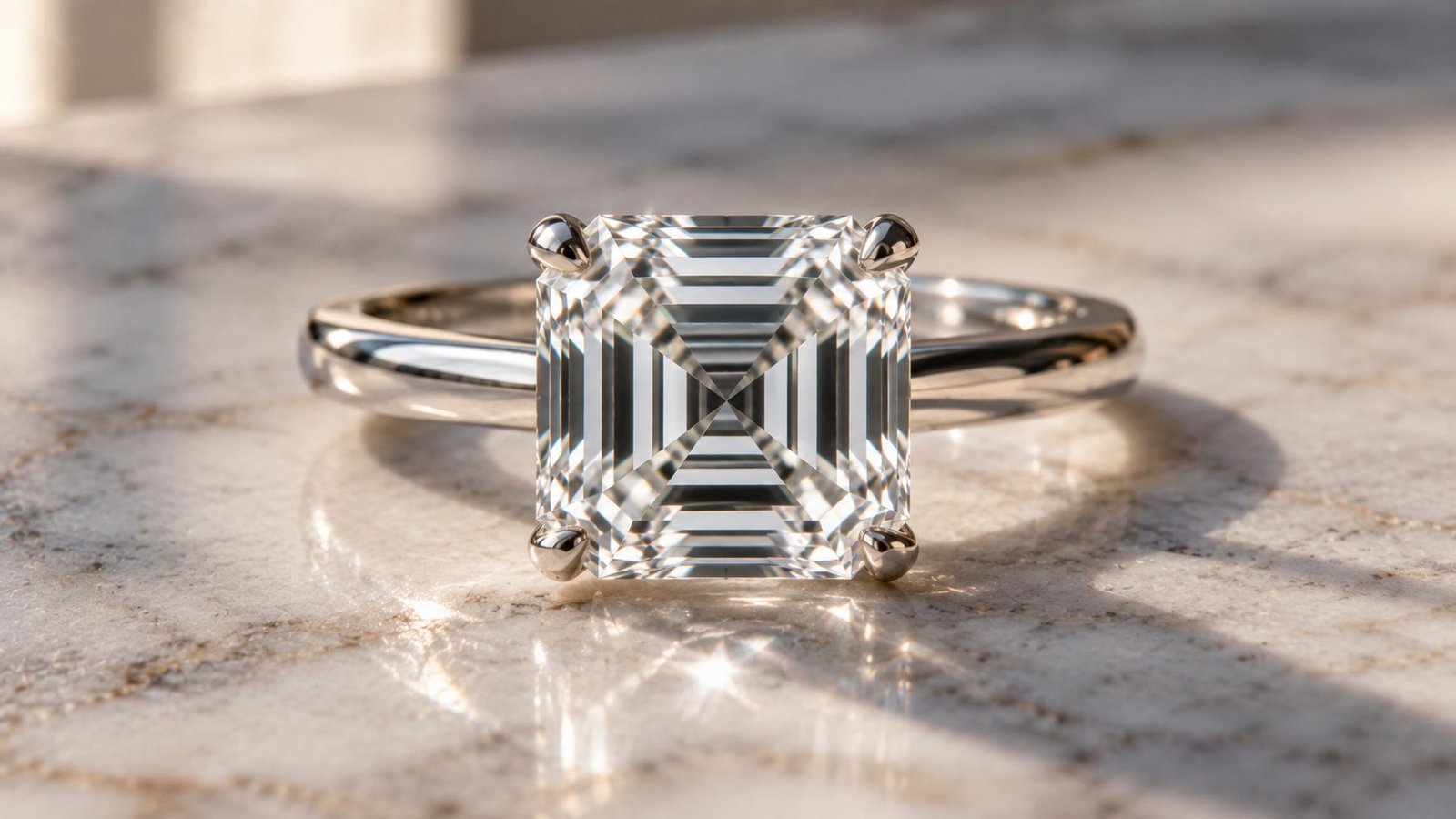
Structurally, an Asscher cut is a square shape with its corners cut away, which GIA’s grading terminology typically classifies as a cut-cornered square step cut. Depending on the specific cutting style used, an Asscher can carry anywhere from roughly 58 to as many as 74 facets, generally arranged in three to five concentric step rows per side. The cropped corners give the shape a nearly octagonal outline, and the high crown paired with a deep pavilion is part of what produces the Asscher’s particularly dramatic version of the hall-of-mirrors effect.
Because of this open facet structure, cutters traditionally start with a higher-clarity rough stone when creating an Asscher cut, and most guidance recommends buyers look for at least VS1 clarity to ensure an eye-clean appearance, since inclusions tend to be unusually visible through the wide, flat facets.
The Emerald Cut Explained
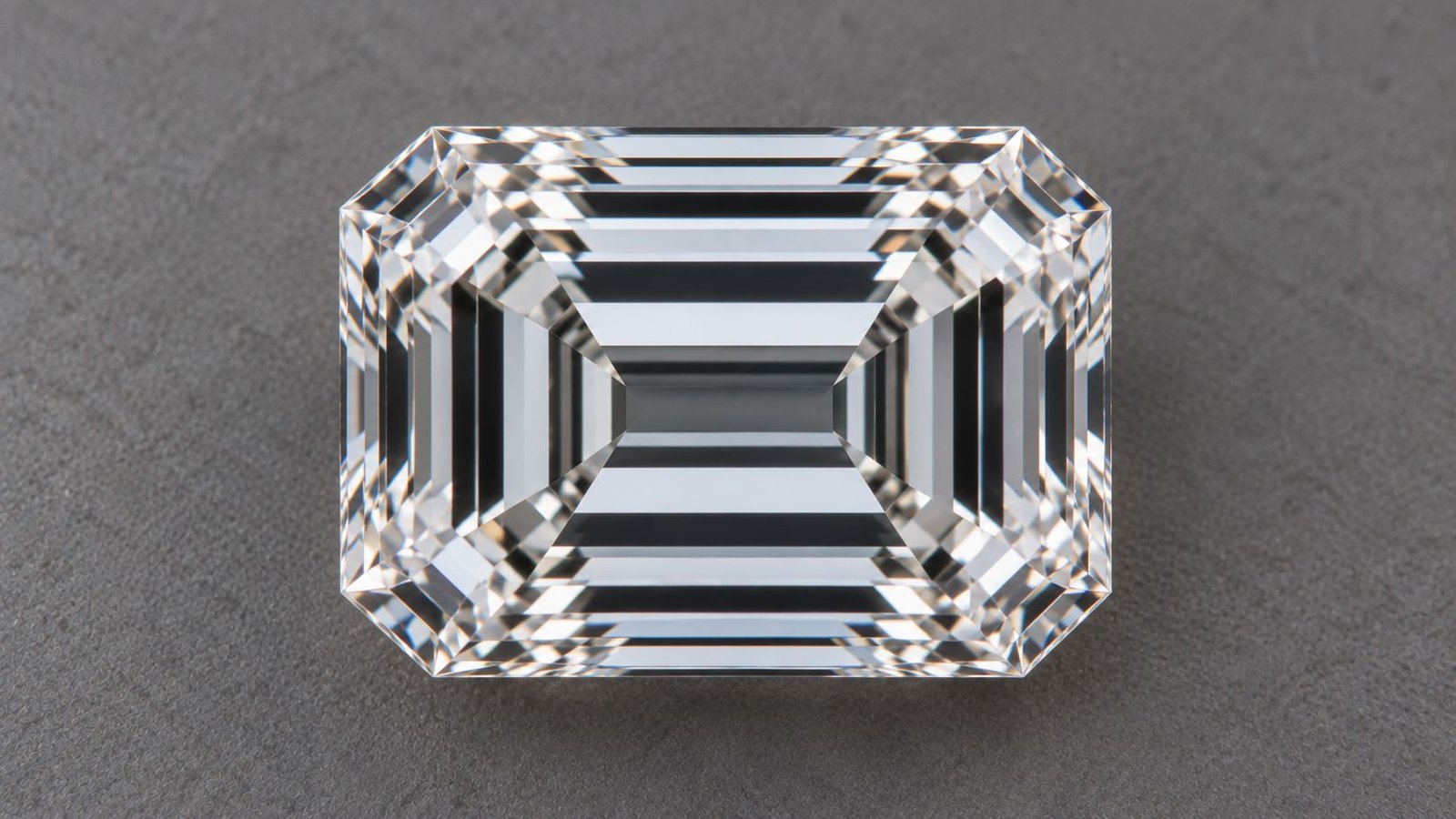
The emerald cut shares the same step-faceted structure as the Asscher but in a rectangular rather than square outline, typically with a length-to-width ratio somewhere between 1.3 and 1.5 for a classic proportion, though more elongated versions exist for buyers who want a more dramatic silhouette. Its corners are typically clipped at an angle rather than cut into the more octagonal shape seen on an Asscher.
The name itself comes from the cut’s original use on emerald gemstones rather than diamonds. Because emeralds are considerably more fragile and prone to internal stress fractures than diamonds, cutters developed this faceting style specifically to relieve pressure on the stone’s corners and reduce the risk of chipping during the cutting process. The technique was later adapted for diamonds, where it took on its own identity as one of the most recognizable fancy shapes available today.
Like the Asscher, the emerald cut’s open table and step facets mean clarity matters enormously, and color becomes more visible too, since there’s little scattered light to help mask any warmth in the stone. Buyers typically want a stone that reads as eye-clean, with minimal visible color, particularly toward the corners, where step-cut diamonds tend to show tint most noticeably if present.
Asscher vs Emerald: Key Differences
| Factor | Asscher Cut | Emerald Cut |
| Outline shape | Square with cropped corners | Rectangular with clipped corners |
| Typical facet count | 58 to 74, depending on style | Generally fewer, larger step facets |
| Visual effect | More concentrated, geometric hall-of-mirrors | Elongated, flowing hall-of-mirrors |
| Finger appearance | Reads more compact | Tends to elongate the finger visually |
| Origin | Patented in 1902 by Joseph Asscher | Adapted from historical emerald-cutting technique |
| Clarity recommendation | VS1 or higher generally recommended | VS1 to VS2 generally recommended |
Neither shape is objectively better than the other; the choice mostly comes down to silhouette preference. Buyers who want a more structured, symmetrical look tend to gravitate toward the Asscher, while buyers looking for a shape that visually lengthens the finger often prefer the emerald cut’s rectangular proportions.
Clarity and Color: What Actually Matters for Step Cuts

Because step-cut diamonds expose so much of their interior to view, clarity isn’t just a quality metric here; it’s a visible, practical factor in how the finished stone will actually look. Most guidance for both shapes converges around VS1 clarity as a reasonable starting point for an eye-clean appearance, with larger stones generally needing to go even higher, since inclusions become proportionally easier to spot as the open facet area increases with carat weight.
Color follows a similar logic. Because step cuts return less scattered light than brilliant cuts, any yellow or brown tint in the stone tends to pool visibly, particularly in the corners where facets angle more steeply. Buyers generally want to stay in the near-colorless range, typically G color or better, to avoid a visible warmth that would be far less noticeable in a round or cushion cut diamond of the same color grade.
This is one of the clearest places where lab-grown diamonds carry a genuinely practical advantage over natural stones rather than just a cost one. Because achieving high clarity and strong color simultaneously is significantly more expensive in natural diamonds, particularly at larger carat weights, many buyers shopping for a one-carat-plus natural step cut end up compromising on one or the other. Lab-grown diamonds make it realistic to get both the clarity and color grade a step cut actually needs without that same trade-off.
Lab-Grown Advantages for Step Cuts
Step-cut diamonds are arguably one of the shapes where lab-grown stones offer the clearest practical upgrade over natural diamonds, precisely because of how unforgiving the cut is of lower clarity and weaker color. A natural Asscher or emerald cut at VS1 clarity and G color or better, particularly above one carat, carries a significant price premium compared to a brilliant cut diamond of similar specifications, simply because achieving that combination in nature is comparatively rare.
Lab-grown diamonds, being chemically and physically identical to natural stones, display the exact same hall-of-mirrors effect, the same clarity requirements, and the same color behavior, just at a fraction of the cost for an equivalent grade. This makes it realistic for buyers to prioritize a larger stone, a higher clarity grade, or both, rather than needing to compromise on carat weight to stay within budget. Reputable lab-grown step cuts are graded by the same major labs used for natural diamonds, and a documented IGI-graded certificate is worth requesting specifically for a step-cut stone, since the certificate will typically confirm both clarity and color at the level of detail that actually matters for this particular shape.
Setting and Styling Step-Cut Lab-Grown Diamonds

Step-cut diamonds have a structural consideration that round and cushion cuts generally don’t share: their corners are more exposed and more prone to chipping if left unprotected, since there’s no rounded girdle to absorb an impact the way there is on a brilliant cut. Because of this, most jewelers recommend prong settings that specifically cover and protect each corner, rather than a bezel or setting style that leaves the corners exposed.
Baguette or trapezoid side stones are a particularly popular pairing for both Asscher and emerald center stones, since their own step-cut faceting echoes the center stone’s structure rather than competing with it visually. A simple, clean band tends to suit both shapes well, letting the step facets and the hall-of-mirrors effect remain the clear visual focus rather than competing with an elaborate setting.
Step cuts also tend to appear slightly smaller face-up than a round or cushion cut of the same carat weight, since more of their weight sits in the depth of the stone rather than spread across a wide table. This is worth factoring into sizing expectations, particularly for buyers comparing a step cut directly against a brilliant cut at the same carat weight.
Common Misconceptions
“Asscher and emerald cuts are the same shape.” They’re closely related step cuts, but the Asscher is square with cropped, nearly octagonal corners, while the emerald cut is rectangular with clipped corners and a more elongated profile.
“Step cuts don’t sparkle.” Step cuts don’t produce the same scattered sparkle as a round brilliant, but they create broad, mirrored flashes of light that read as a different, more understated kind of brilliance rather than an absence of it.
“Clarity doesn’t matter much if the diamond is well cut.” For step cuts specifically, clarity matters more than almost any other shape, since the open facet structure makes inclusions significantly more visible than in a brilliant cut.
“Lab-grown step cuts look different from natural ones.” Lab-grown and natural diamonds are chemically and optically identical, so a lab-grown Asscher or emerald cut displays the exact same hall-of-mirrors effect as a natural stone of the same clarity and color grade.
“Any setting works fine for a step cut.” Because the exposed corners of a step cut are more vulnerable to chipping, a setting style that specifically protects those corners is generally recommended over an open or unprotected style.
Buying Guide: Choosing a Step-Cut Lab-Grown Diamond
Start with clarity rather than carat weight when budgeting for a step cut. Since inclusions are so much more visible in this shape, it’s generally worth prioritizing at least VS1 clarity even if that means adjusting expectations on size, particularly for a natural stone; with lab-grown, this trade-off is far less necessary.
Next, decide on silhouette before comparing specific stones. If you want a more compact, geometric look, the Asscher cut is the better starting point; if you want a shape that visually elongates the finger, the emerald cut is generally the better fit. Comparing stones side by side in person, or through high-quality video, makes a meaningful difference for step cuts specifically, since photos don’t always capture how the hall-of-mirrors effect behaves in different lighting.
Always confirm the setting style will protect the stone’s corners, and ask your jeweler specifically about corner protection if you’re working from a custom design rather than a pre-made setting. Finally, request full certification for any step-cut diamond you’re considering, since clarity and color documentation matter more for evaluating this particular shape than almost any other.
Final Thoughts
Step-cut diamonds offer something genuinely different from the sparkle-first approach most other shapes are built around, trading scattered brilliance for a cleaner, more transparent kind of elegance. The Asscher and emerald cuts each bring their own silhouette to that same core idea, and choosing between them mostly comes down to whether a more geometric or more elongated look suits your taste. Because both shapes demand higher clarity and stronger color than most buyers realize going in, lab-grown diamonds have become a genuinely practical way to get a step-cut stone that actually lives up to what the cut is designed to show off.
Frequently Asked Questions
Disclaimer: Diamond grading terminology and cutting styles can vary slightly between gemological laboratories and individual cutters. This article is intended for general educational purposes and should not replace a professional evaluation from a certified gemologist for any specific stone.