

Clarity on a Fancy Colour Diamond: Where It Matters and Where It Doesn’t
Anyone who has shopped for a colourless diamond knows the drill: clarity is one of the four big levers, and the difference between a VS and an SI grade is something to weigh carefully. Fancy colour diamond clarity works differently, and applying colourless-diamond instincts to a Fancy Vivid pink, yellow, or blue can lead buyers to overpay for a clarity grade they’d never notice, or to overlook the one kind of inclusion that genuinely does matter. This guide walks through where clarity really sits in the value picture for fancy colours, and where it stops being a background detail.
The Core Principle: Colour Is the Dominant Value Factor
GIA states this plainly in its own guidance on fancy colour diamond quality factors: with fancy colour diamonds, colour is the dominant value factor. Even diamonds carrying numerous inclusions — enough to produce a low clarity grade — are prized by connoisseurs when they display an attractive face-up colour. That’s a genuinely different logic from colourless diamonds, where a stone’s value is built largely on how few flaws it has and how little colour it shows.
For fancy colour diamond clarity, this flips the priority order. Colour is the thing to judge before anything else — hue, tone, and saturation come first, and clarity works as a supporting consideration rather than a co-star.
Why Colour Masks Inclusions

The reason this works has a physical basis, not just a market preference. GIA’s guide to yellow diamonds explains that these stones naturally mask inclusions better than colourless diamonds do, because their rich body colour and light dispersion can disguise tiny internal features. A stone graded a notch or two lower in clarity can still look completely clean to the naked eye, since the colour itself does part of the hiding.
The same logic extends across other fancy hues. A saturated colour draws the eye to the overall effect of the stone rather than to individual internal details, so a small, pale feather or pinpoint that would be easy to spot in a colourless stone tends to disappear into the depth of a Fancy Intense or Fancy Vivid colour.
A Quick Refresher on the Clarity Scale
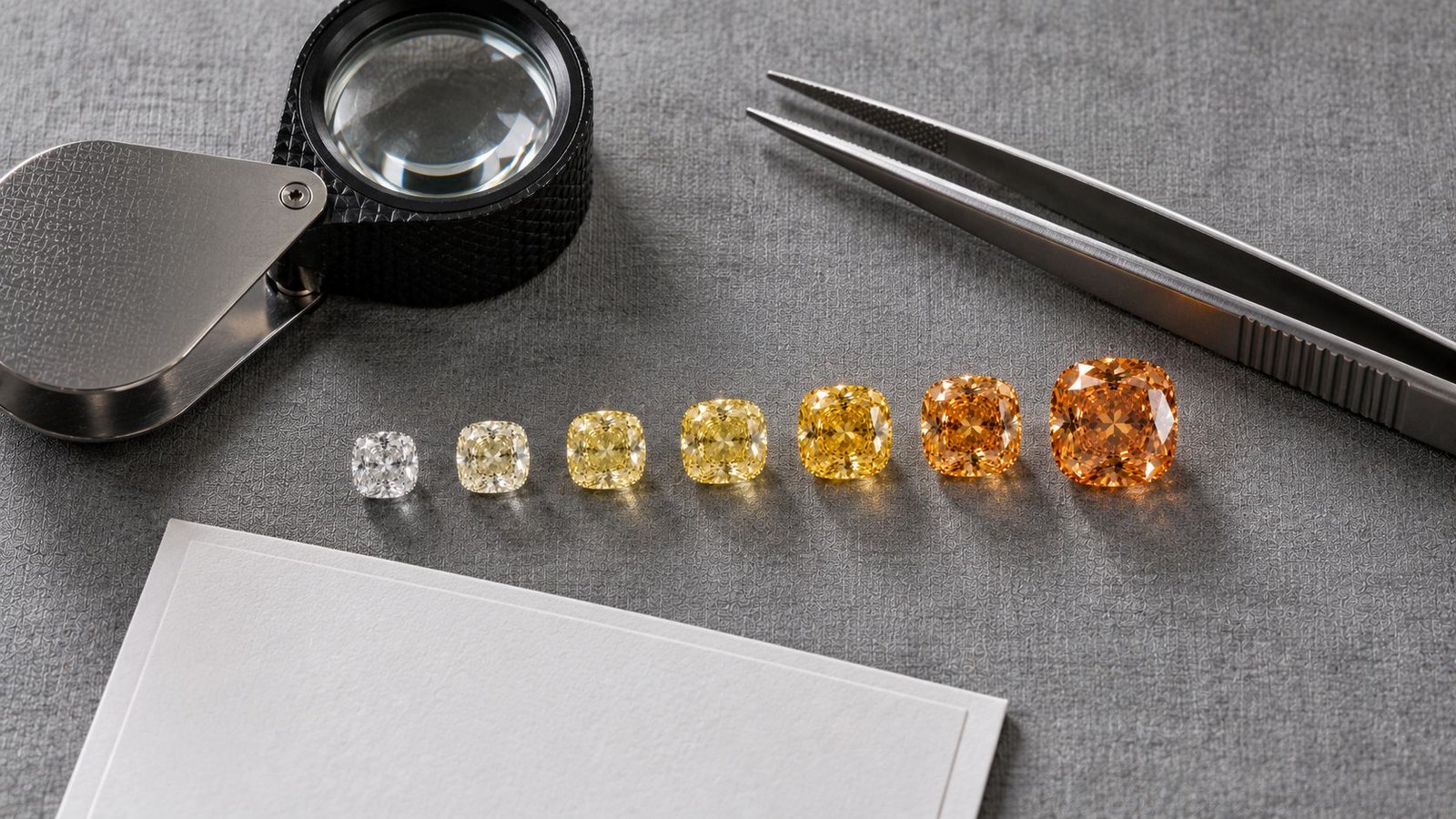
It helps to remember what the scale actually measures. GIA grades clarity under 10x magnification across eleven grades: Flawless (FL), Internally Flawless (IF), two Very, Very Slightly Included grades (VVS1 and VVS2), two Very Slightly Included grades (VS1 and VS2), two Slightly Included grades (SI1 and SI2), and three Included grades (I1, I2, and I3). Under that magnification, VS inclusions are observed with effort but considered minor, while SI inclusions are noticeable, and I-grade inclusions are obvious.
The key phrase is “under 10x magnification.” Clarity grading is about what a trained grader sees through a loupe, not what a buyer sees at arm’s length — and for fancy colours, the gap between those two views is wider than it is for colourless stones.
Where VS and SI Fit for Fancy Colours

Here’s the practical takeaway that gives this topic its value: for fancy colour diamond clarity, VS and SI grades are typically perfectly good choices, not compromises. GIA notes that most yellow diamonds on the market fall within the VS to SI range, where inclusions are often minor and difficult to see without magnification. And its own guidance goes further: a Fancy Intense or Fancy Vivid yellow with a VS2 or SI clarity grade can appear more stunning than a paler diamond with a higher clarity grade.
Put simply, chasing an extra clarity grade can mean paying more for something you can’t see, while stepping up a colour intensity level changes what the stone looks like from across the room. For most buyers, that makes saturation the smarter place to spend.
When Clarity Does Start to Matter
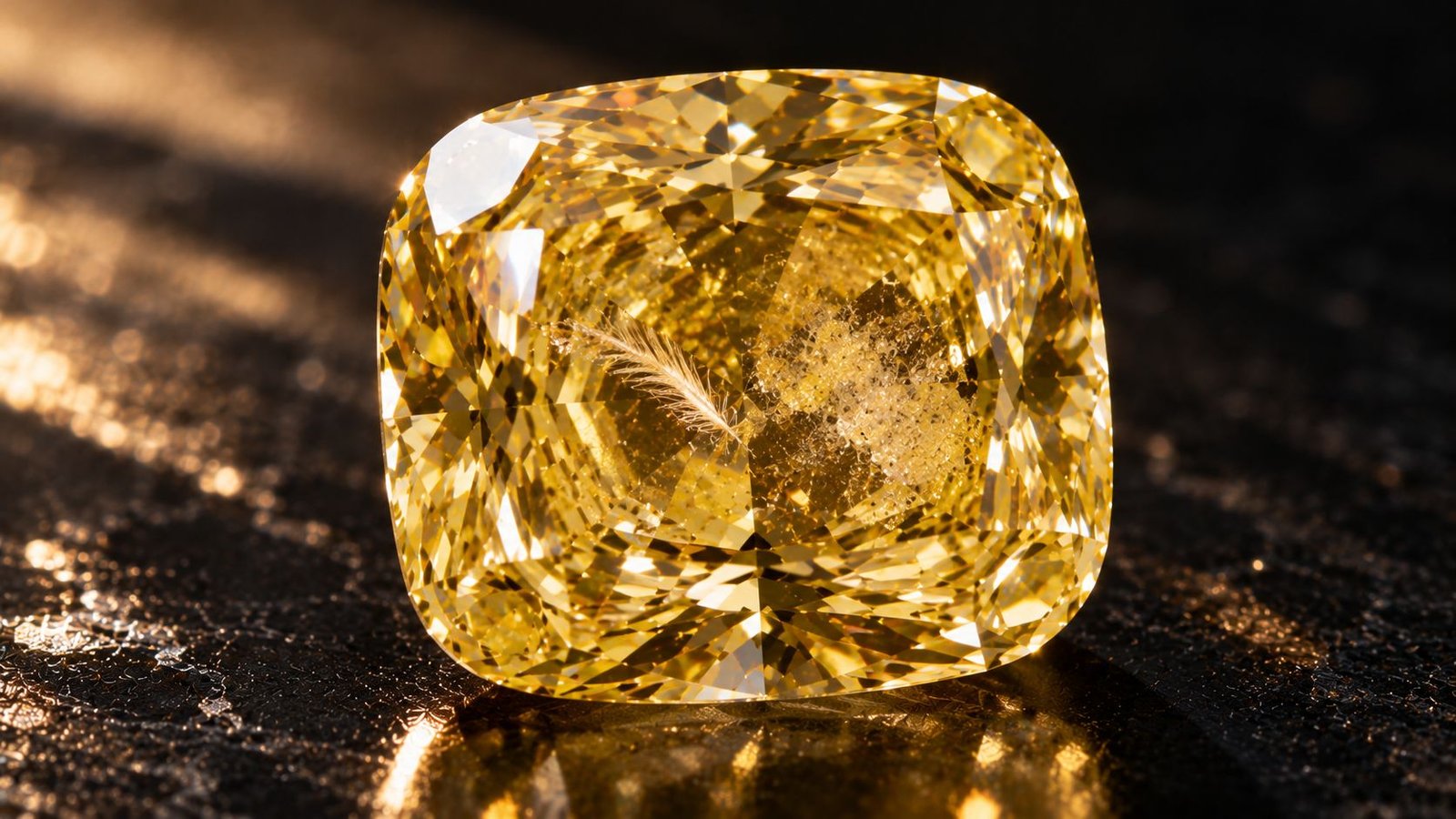
None of this means clarity is irrelevant. GIA is equally direct that clarity begins to noticeably affect a fancy colour stone’s appearance and value when inclusions become visible to the naked eye, or when they interfere with transparency and light return — typically in the I1, I2, and I3 grades. At that point inclusions can dull sparkle or create cloudy areas that detract from the stone’s brilliance, and no amount of rich colour fully hides that.
There’s a second, less obvious threshold too. GIA notes that inclusions threatening a gem’s durability can lower a fancy colour diamond’s value significantly. A large feather reaching the surface near a vulnerable edge, for instance, is a structural concern as much as a cosmetic one, regardless of how beautiful the colour is.
Colour Graining Counts as an Inclusion
One detail unique to this category: GIA states that fancy colour diamonds can exhibit colour graining, and that it is considered an inclusion. This links directly to the physical zoning phenomena covered in our guide to lab grown diamond colour zoning, where uneven distribution of colour-causing elements shows up as visible bands or patches within the stone.
The connection isn’t just theoretical. In one GIA-documented case, a CVD-grown diamond carried a single dark brown band roughly 2.2 millimetres long that resembled natural graining, and because that band was visible through multiple bezel facets and affected transparency at that spot, it directly determined the stone’s clarity grade. For buyers, the lesson is that a clarity grade on a fancy colour stone can reflect colour-related features, not only the classic crystals and feathers most people picture when they think of inclusions.
Cut and Clarity Work Together in Fancy Stones

Cut priorities differ for fancy colours in ways that also change how clarity reads. Rather than being optimised to maximise white brilliance, fancy colour diamonds are usually cut to present the best possible face-up colour, and GIA points out that size and shape both influence colour: a larger stone, or one with a deeper pavilion, lets light travel further inside and can produce a richer, more intense colour. Mixed cuts like the radiant are often favoured for exactly this reason.
This matters for clarity because the same cuts that concentrate colour can also make internal features easier or harder to spot. Broad, open step-cut facets tend to show what’s inside a stone more clearly than heavily faceted brilliant styles, which is worth keeping in mind when comparing two stones with similar clarity grades but different shapes. Our guide to yellow lab grown diamonds covers how shape choice affects colour and appearance in more detail for that specific hue.
What This Looks Like for Lab Grown Fancy Colours

Fancy coloured lab grown diamonds submitted to GIA are graded on a separate Laboratory-Grown Colored Diamond Report that includes a full clarity assessment, rather than the simplified Premium and Standard system used for typical colourless stones. That means the same clarity scale applies, and the same principle holds: colour leads, and a VS or SI grade on a saturated stone is a perfectly reasonable place to land.
Lab grown production adds a couple of stone-specific considerations worth knowing. GIA’s research documents metallic inclusions visible in HPHT-grown material under deep-UV imaging, and growth-related features that can appear in CVD-grown stones. Neither is a reason for concern by itself, but a proper certificate will reflect them in the clarity grade, and it’s another reason to read the full report rather than relying on a headline colour description alone. Our guide to GIA’s colour distribution assessment explains how the certificate’s other fancy-colour fields work alongside clarity.
A Budget Strategy: Where to Spend and Where to Save
Pulling these points together, a sensible approach to fancy colour diamond clarity looks like this:
Spend first on colour intensity and evenness. A step up in saturation is visible; a step up in clarity often isn’t, as long as the stone stays eye clean.
Accept VS and SI grades comfortably when the stone is eye clean. Given how much rich colour masks small inclusions, there’s little reason to pay a premium for higher clarity that can’t be seen.
Draw the line at I-grades with visible inclusions. Once inclusions are noticeable without magnification or affect transparency, they start to undermine the very colour you’re paying for.
Always check for durability-related inclusions. Ask about the position and size of any feathers or cavities, particularly near the girdle or other vulnerable areas.
Request a video under normal lighting for any stone you’re considering. Fancy colour is difficult to judge from a still image alone, and a video shows quickly whether a stone reads clean face-up.
Bringing It Together Across Colours
The principle covered here applies to fancy colours generally, though each hue has its own nuances. Our guides to green and orange lab grown diamonds and purple lab grown diamonds cover the colour-causing mechanisms specific to those categories, which can affect what kinds of features show up inside the stone.
Common Misconceptions About Fancy Colour Diamond Clarity
Fancy colour diamonds need the same high clarity as colourless stones — this is a myth. GIA states that colour is the dominant value factor, and stones with low clarity grades can still be prized for attractive face-up colour.
Any inclusion is a serious problem — not so. VS and SI inclusions are typically minor and difficult to see without magnification, and colour masks them further in fancy stones.
Clarity doesn’t matter at all for fancy colours — also incorrect. Visible inclusions, particularly in the I grades, can dull sparkle and cloud the stone, and durability-threatening inclusions can lower value significantly.
Clarity grades only reflect crystals and feathers — not always. Colour graining is considered an inclusion in fancy colour diamonds, and it can genuinely influence the clarity grade.
Final Thoughts: Let Colour Lead, Then Check for Problems
Fancy colour diamond clarity is best understood as a threshold rather than a race. Aim for a clean-looking stone with no durability concerns, then put your budget toward the colour intensity, evenness, and overall presence that actually define these diamonds. Buy the best colour you can afford, accept VS and SI grades without hesitation when the stone is eye clean, and treat visible inclusions or structural weaknesses as the real dealbreakers. Done that way, you end up with a stone that looks better, not just one that scores better on paper.
Frequently Asked Questions: Fancy Colour Diamond Clarity
Disclaimer: This article is intended for informational and educational purposes only. Grading standards and guidance referenced here reflect GIA’s published information available as of 2026, including its fancy colour diamond quality factors and yellow diamond guide. Always review the full grading report and request a video when evaluating a specific stone.