

Coloured Lab-Grown Diamonds vs Treated Natural Diamonds: Which Should You Buy in 2026?
Walk into any fine jewellery showroom today and the coloured diamond display looks genuinely different from how it did five years ago. Stones that once carried price tags reserved for ultra-luxury commissions — vivid pinks, electric blues, canary yellows — are now sitting beside significantly more accessible alternatives that look, to the naked eye, completely identical.
The reason is the rise of coloured lab-grown diamonds. And alongside them, a category that has existed for decades but rarely gets the clear explanation it deserves: treated natural diamonds — white mined diamonds that have been artificially enhanced through irradiation, coating, or HPHT processing to produce a colour that was never there naturally.
Anyone seriously considering whether to buy lab-grown coloured diamonds or invest in treated natural stones needs to look past the surface and understand how these two categories actually perform over time. Their visual similarities at the point of purchase can be misleading — the way they age, how their colours hold up under everyday conditions, and what they are actually worth on the secondary market tell a very different story than what most retail environments are designed to communicate.
Everything you need to make that call clearly is laid out below.
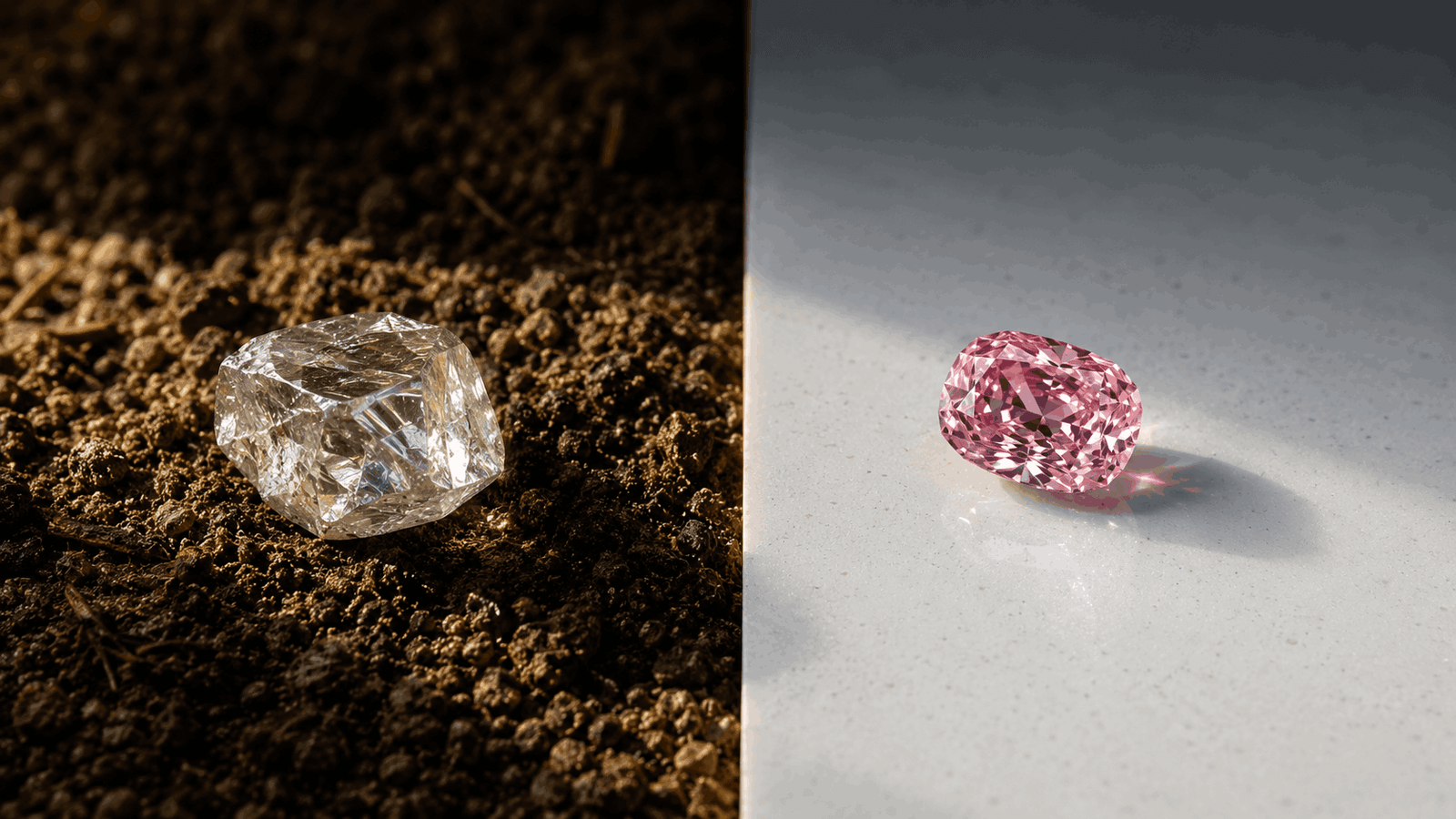
What Are Coloured Lab-Grown Diamonds and How Are They Made?
Coloured lab-grown diamonds are real diamonds — pure crystalline carbon — that achieve their colour through the controlled introduction of specific trace elements or post-growth treatments during or after the production process in a laboratory environment.
A reputable lab-grown diamond manufacturer uses one of two primary production methods:
High-Pressure High-Temperature (HPHT) replicates the intense pressure and heat found deep within the Earth, forcing carbon to crystallise around a seed crystal. This method is particularly well-suited to producing fancy yellow diamonds, as nitrogen — which produces yellow colour — can be precisely introduced into the growth environment during production.
Chemical Vapor Deposition (CVD) builds a diamond atom by atom inside a sealed chamber, where a carbon-rich gas mixture is converted to plasma and pure carbon molecules crystallise onto a seed plate. CVD produces exceptionally pure diamond rough that is then treated post-growth to achieve a range of colours.
Here is how each colour category is produced by leading manufacturers:
| Colour | Production Method | Process Detail |
| Fancy Yellow | HPHT growth | Controlled nitrogen introduction during crystal formation |
| Fancy Blue | HPHT or CVD + treatment | Boron introduction during growth creates permanent blue hue |
| Fancy Pink | CVD + post-growth treatment | Irradiation and annealing of high-purity colorless CVD rough |
| Fancy Green | CVD + post-growth irradiation | Controlled electron beam irradiation after growth |
| Fancy Black | CVD + graphite treatment | Graphite inclusion or targeted irradiation processes |
| Fancy Red | CVD + post-growth treatment | Extremely rare even in lab-grown; requires multiple treatment stages |

What distinguishes coloured lab-grown diamonds produced through these methods from surface-enhanced alternatives is where the colour actually lives inside the stone. When colour is built into the crystal’s atomic framework during growth or locked in through deep structural treatment, it runs through every layer of the diamond uniformly. There is no outer shell of colour sitting on top of a colourless interior — the stone reads the same hue whether you are looking at its table, its pavilion, or its girdle under magnification.
What Are Treated Natural Diamonds and How Do They Get Their Colour?
Treated natural diamonds begin as white or near-colourless mined stones, typically in lower-clarity or lower-colour grades that carry modest wholesale value in their unmodified state. What gets them onto the coloured diamond display shelf is one or more artificial enhancement processes applied after mining, designed to produce a colour the original crystal never possessed.
Understanding each treatment method in detail matters because the specific process applied to a stone is the single biggest determinant of how it will perform over years of wear, how stable its colour will remain, and what its long-term commercial value actually is.
Irradiation treatment exposes a colourless diamond to electron beams, neutron bombardment, or gamma radiation. This physically alters the crystalline lattice structure at a surface and near-surface level, producing colours including green, blue, yellow, and brown. Irradiation treatments are typically followed by annealing — a controlled heating process — to shift the colour toward a more commercially desirable hue.

HPHT treatment (applied to already-mined stones, not to be confused with HPHT production of lab-grown diamonds) uses extreme pressure and temperature to remove brownish tints from certain natural diamonds, effectively upgrading their colour grade. This is used most commonly to produce higher-colour whites from lower-grade rough, but can also be used to develop yellow or other colours in stones with specific nitrogen content.
Surface coating applies a thin layer of metallic oxide or chemical film directly to a diamond’s surface, creating a colour that is entirely superficial. While immediately effective, coated diamonds are the most fragile treatment category — the coating can be scratched off by abrasive cleaning methods or even by routine jewellery polishing, and the colour can fade, chip, or peel over time.
Fracture filling injects glass-like resin into surface-reaching cracks to improve apparent clarity. While this does not directly produce colour, it is often combined with tinted fillers to alter a stone’s overall visual impression.
The critical point for buyers is that not all treatments are equal. An irradiated blue diamond with post-treatment annealing has fundamentally different durability characteristics from a surface-coated yellow stone. Both are “treated natural diamonds” but they behave very differently over a decade of wear.
Colour Stability: The Most Important Comparison Point
For most buyers evaluating coloured lab-grown diamonds against treated natural stones, colour stability over time is the single most practically important factor — and it is the area where the two categories diverge most significantly.
Coloured Lab-Grown Diamonds: Permanent Colour
When a lab-grown diamond manufacturer introduces boron during CVD or HPHT growth to produce a blue diamond, that colour is part of the crystal’s atomic structure. It is not a coating, not a surface treatment, and not a temporary alteration. The colour is as permanent as the diamond itself — unaffected by heat, light exposure, ultrasonic cleaning, polishing, or routine wear.
The same applies to post-growth irradiation treatments on lab-grown rough when performed correctly by established manufacturers. The irradiation penetrates the entire stone uniformly rather than concentrating at the surface, and the subsequent annealing process locks in the colour at the atomic level. Major gemological laboratories including IGI and GIA certify these colours as stable under normal wear conditions.
Treated Natural Diamonds: Variable Stability Depending on Method
The stability picture for treated natural diamonds is considerably more variable and depends heavily on which treatment was applied:
Irradiation + annealing produces relatively stable colour that is generally considered permanent under normal conditions. However, prolonged exposure to very high heat (such as during jewellery repair involving torch soldering near the stone) can cause colour shift or fading in some irradiated stones.
HPHT-treated naturals also produce relatively stable results when performed by professional treatment facilities, though the process is not reversible and must be disclosed at the point of sale under FTC guidelines.
Surface-coated diamonds present the most significant durability concern. The coating adds no structural depth to the stone and can be compromised by ultrasonic cleaning, steam cleaning, abrasive polishing compounds, or even repeated exposure to harsh household cleaning chemicals. Jewellers who resize or repair coated diamond jewellery risk damaging the colour permanently during the repair process.
For wholesale buyers and retailers, this variability creates a real customer service risk. A client who purchases a surface-coated yellow diamond and returns six months later with a partially faded stone presents a problem that does not have a simple resolution.
Pricing: A Comparison Across the Colour Spectrum
The pricing difference between coloured lab-grown diamonds and treated natural diamonds has narrowed considerably since the wholesale market for lab-grown coloured stones matured, but meaningful differences remain across specific colour categories.
| Colour Category | Treated Natural Diamond (1ct retail) | Coloured Lab-Grown Diamond (1ct retail) |
| Fancy Yellow | $2,000 – $6,000 | $600 – $1,500 |
| Fancy Blue | $8,000 – $25,000+ | $1,200 – $3,500 |
| Fancy Pink | $15,000 – $80,000+ | $1,500 – $4,000 |
| Fancy Green | $10,000 – $40,000+ | $1,800 – $4,500 |
The price differential is particularly dramatic in the pink and blue categories because naturally occurring pink and blue diamonds are extraordinarily rare even in treated form — the starting rough itself commands a significant premium before any treatment costs are applied. Coloured lab-grown diamonds in these categories represent the most compelling value-for-visual-impact case in the entire fine jewellery market in 2026.
For anyone wanting to buy lab-grown coloured diamonds at wholesale, the pricing advantage translates directly into margin flexibility. A retailer sourcing fancy pink lab-grown stones at wholesale can build a competitive finished piece price point that simply does not exist in the treated natural diamond channel.
Disclosure Requirements: What the Industry Mandates
This is an area where many buyers — both individual and wholesale — are significantly under-informed, and the distinction between lab-grown and treated natural stones is critical.
Coloured lab-grown diamonds must be disclosed as laboratory-grown at the point of sale. In India specifically, the Bureau of Indian Standards’ IS 19469:2025 standard, enforced from January 2026, mandates explicit “laboratory-grown diamond” labelling. Internationally, the FTC requires clear disclosure of lab-grown origin on all grading reports and retail descriptions.
Treated natural diamonds also require disclosure of their treatment under FTC guidelines and most major gemological body standards. GIA grading reports for treated stones clearly note the treatment type. However, enforcement and compliance in the treated natural diamond market has historically been less consistent than in the lab-grown sector — particularly for surface-coated stones, which are sometimes sold without adequate disclosure at lower-tier retail levels.
For wholesale buyers, this disclosure landscape has a practical commercial implication: coloured lab-grown diamonds from a reputable lab-grown diamond manufacturer come with clear, consistent, internationally standardised certification from IGI or GIA that protects both the seller and buyer from downstream disputes. You can verify any coloured diamond’s treatment disclosure directly through the GIA report check portal before completing any purchase. The treated natural diamond market carries higher documentation variability and a corresponding higher due diligence burden.
Lab-Grown Coloured Diamonds in India: The Supply Advantage
For buyers sourcing lab-grown diamonds in India, the country’s manufacturing ecosystem has a particular advantage in the coloured stone category. Indian manufacturers — concentrated primarily in the Surat and Mumbai corridors — have developed deep expertise in producing consistent fancy colour lab-grown rough and finishing it to the precise colour intensity specifications that international retail markets demand.
Lab-grown diamonds in India are manufactured under rigorous quality controls and exported with full IGI and GIA certification, making the Indian supply chain one of the most reliable and cost-competitive sources for coloured lab-grown inventory globally. The combination of large-scale CVD production capacity, generational diamond finishing expertise, and competitive wholesale pricing makes India the primary sourcing destination for international retailers looking to build coloured diamond collections at viable commercial price points.
The demand growth for lab-grown diamonds in India domestically has also been significant — particularly among younger buyers in metropolitan markets who are driving the broader shift toward ethically sourced, design-forward fine jewellery that coloured lab-grown stones enable.
Ethical and Environmental Considerations
Both coloured lab-grown diamonds and treated natural diamonds involve different ethical and environmental profiles that buyers should understand clearly.
Natural diamonds — even treated ones — originate from mined rough. The environmental footprint of extraction remains the same regardless of whether the stone is subsequently treated. Mining involves significant land disturbance, water usage, and energy consumption. Treated natural diamonds do not represent a more sustainable option than any other mined stone simply because they underwent post-extraction treatment.
Coloured lab-grown diamonds produced by responsible manufacturers — particularly those lab-grown diamonds in India sourced from facilities using renewable energy — bypass the extraction footprint entirely. Leading Indian manufacturers now provide third-party carbon-neutral certifications and full supply chain documentation, making the ethical sourcing story completely verifiable for retail buyers who need to communicate provenance to their clients.

For retailers serving Millennial and Gen Z consumers — who in 2026 represent the majority of fine jewellery purchasing decisions — the ability to document where a stone came from and how it was produced has become a genuine commercial differentiator, not just a values statement.
How to Buy Lab-Grown Coloured Diamonds: A Practical Sourcing Guide
For anyone ready to buy lab-grown coloured diamonds at wholesale or retail, here is the practical framework that protects your purchase:
Always require IGI or GIA certification. Every coloured lab-grown stone should come with a grading certificate from one of these two internationally recognised bodies. The certificate documents the 4Cs, identifies the stone as laboratory-grown, and in most cases notes the production method (CVD or HPHT) and treatment applied. Never purchase uncertified coloured stones regardless of price or supplier reputation.
Verify the production method. For coloured stones specifically, the production method affects the nature of the colour. Ask your supplier whether the colour originates during growth (as with blue boron-doped stones) or through post-growth treatment (as with most pink and green lab-grown stones). Both are legitimate, but understanding the source of colour is part of informed purchasing.
Choose your supplier carefully. Work with an established lab-grown diamond manufacturer who can provide consistent specification matching across an order. Colour consistency across a batch of matched stones — for eternity bands, cluster settings, or collection production — is where manufacturer quality most visibly differentiates itself.
Request physical samples for colour evaluation. Colour grade descriptions on paper do not replace seeing the actual stones under different lighting conditions. For significant wholesale purchases, always request a sample parcel before committing to volume.
Understand the difference between Fancy, Fancy Intense, and Fancy Vivid. These are not marketing terms — they are standardised GIA colour intensity grades, and the price difference between Fancy and Fancy Vivid in categories like pink and blue is substantial. Ensure your certification documents the specific intensity grade you are paying for.
Final Verdict: Which Should You Choose?
The choice between coloured lab-grown diamonds and treated natural diamonds is ultimately a question of what you are optimising for.
If colour stability, supply consistency, ethical sourcing documentation, and maximum visual impact per dollar are your priorities — and for most buyers and retailers in 2026, they are — coloured lab-grown diamonds represent the clear, well-supported choice. The colour is permanent, the certification is rigorous, the supply chain is transparent, and the price point unlocks design possibilities that treated natural diamonds cannot match.
If geological origin, the rarity narrative, or the specific emotional value of owning a stone with a natural history is your priority — and for a genuine segment of the market, it legitimately is — then treated natural diamonds offer a middle path between the cost of truly rare natural fancy colours and the lab-grown alternative.
What neither option is: a simple, one-size-fits-all answer. Making an informed choice requires understanding exactly what you are buying, how the colour was achieved, what the long-term durability profile is, and how it aligns with what you or your clients actually value.
That understanding is what this guide was built to give you.
Frequently Asked Questions
Yes, completely. Coloured lab-grown diamonds are chemically and physically identical to natural diamonds — both are pure crystalline carbon scoring 10 on the Mohs hardness scale. The colour in a lab-grown diamond originates from the same mechanisms as in a natural coloured diamond: trace elements or structural modifications within the crystal lattice. They are graded by IGI and GIA using the same 4Cs criteria applied to natural stones.
When produced by a reputable lab-grown diamond manufacturer, coloured lab-grown diamonds do not fade under normal wear conditions. Colours produced through elemental introduction during growth (such as boron for blue) are permanent structural features. Post-growth treated colours, when performed correctly with full annealing, are also stable. This is a significant advantage over surface-coated treated natural diamonds, whose colour can degrade with routine cleaning or jewellery repair.
Yes, under GIA and IGI grading standards, treatment must be disclosed on the certificate. GIA reports for irradiated, HPHT-treated, or coated diamonds clearly note the treatment type. However, disclosure compliance in the broader retail market varies, particularly for surface-coated stones at lower price points. Always request a grading certificate before purchasing any coloured diamond regardless of origin.
The price gap reflects geological scarcity versus manufacturing scalability. Natural coloured diamonds — particularly pinks and blues — are extraordinarily rare in the rough and command significant premiums even before cutting and polishing costs. Lab-grown diamonds achieve their colour through controlled manufacturing processes that can be reliably repeated at scale, eliminating the scarcity premium entirely while producing visually identical results.
Lab-grown diamonds in India — particularly from established manufacturers in Surat and Mumbai — represent the strongest combination of quality, certification standards, colour consistency, and wholesale pricing available in the global market. Indian manufacturers have developed particular expertise in producing fancy colour rough and finishing it to precise intensity specifications, making them the preferred source for international retailers building coloured diamond collections.
Absolutely. One of the most compelling practical advantages of coloured lab-grown diamonds is their suitability for everyday wear pieces — earrings, stacking rings, tennis bracelets — where the lower price point makes colour-forward designs commercially viable in ways that natural coloured diamonds simply do not allow at accessible retail price points.
Always reference the IGI or GIA grading certificate accompanying the stone. Colour grades for fancy coloured diamonds use a specific intensity scale: Faint, Very Light, Light, Fancy Light, Fancy, Fancy Intense, Fancy Vivid, Fancy Deep, and Fancy Dark. The certificate will specify both the hue (pink, yellow, blue) and the intensity grade. Do not rely on verbal descriptions alone — the certificate is the authoritative document.
Yes. The market for lab-grown diamonds in India has grown rapidly, with both wholesale suppliers and retail jewellers now offering extensive coloured stone selections. Domestic demand — particularly among younger urban buyers — has driven significant investment in coloured lab-grown production capacity within India. IGI-certified coloured lab-grown stones are now widely available through established Indian jewellery retailers and direct manufacturer channels.
Both methods produce genuine diamonds, but they are better suited to different colour categories. HPHT is the preferred method for fancy yellow diamonds, as nitrogen — which produces yellow colour — can be precisely introduced during the high-pressure growth process. CVD produces exceptionally pure colorless rough that is then treated post-growth to achieve pinks, greens, and blues through irradiation and annealing. For blue stones specifically, boron-doped HPHT or CVD both produce excellent results.
For most retailers in 2026, yes. Coloured lab-grown diamonds open entire design categories — rainbow collections, fancy colour solitaires, coloured pavé work — that are simply not commercially viable with natural coloured stones at mainstream retail price points. Stocking both allows a retailer to serve the full spectrum of client values and budgets without losing sales either to buyers who want the rarity of natural colour or to those who want the visual impact of coloured diamonds at accessible prices.
Disclaimer: This article is intended for informational and educational purposes only. Diamond prices, availability, and market conditions vary and are subject to change. Always request grading certification and conduct due diligence before purchasing or sourcing coloured diamonds at any price point.