

Bigger Center Stones: 5 Reasons Buyers Are Upsizing in 2026
Walk through any bridal jewellery counter in 2026 and one thing becomes obvious almost immediately: average center stone size is climbing. Rings that would have been considered generously sized five years ago now sit comfortably in the middle of the range, while the pieces drawing the most attention on display are noticeably larger than what a typical buyer would have chosen in 2020.
This is not a marketing illusion or a handful of outlier purchases skewing perception. Center stone size has been climbing steadily as a genuine, measurable trend across engagement ring buying, and it is reshaping demand patterns all the way back through the wholesale supply chain. Retailers are stocking differently. Cutters are prioritising different rough. Wholesalers are recalibrating what “standard” inventory actually means.
Understanding why center stone size has shifted so decisively matters for anyone connected to the jewellery trade — not just for buyers deciding what to put on a finger, but for retailers planning inventory, wholesalers forecasting demand, and manufacturers deciding what to cut. This article walks through the five forces driving the upsizing trend and what they collectively signal for the diamond market going into the second half of the decade.
The Data Behind the Shift

Before getting into why buyers are choosing bigger stones, it is worth establishing that they genuinely are. Industry surveys and retailer reporting through 2024 and 2025 consistently pointed toward rising average carat weights for engagement ring center stones, particularly in markets where lab grown diamonds have achieved strong consumer acceptance. What had long been considered a “standard” center stone size in the 0.75 to 1 carat range has been steadily giving way to purchases clustering closer to 1.5 to 2 carats among a meaningful share of buyers, with a visible tail of purchases extending well beyond that.
This is not a universal shift — plenty of buyers still choose smaller, more understated stones, and personal taste remains the single biggest variable in any individual purchase. But in aggregate, average center stone size has moved upward enough that retailers and wholesalers can no longer plan inventory around the assumptions that held even a few years ago.
Reason 1: Lab Grown Diamonds Changed the Math Completely

The single biggest driver behind rising center stone size is straightforward: lab grown diamonds made bigger stones dramatically more affordable. Because lab grown diamond production costs have fallen sharply as manufacturing capacity has scaled, particularly out of India’s CVD and HPHT facilities, the price gap between a 1-carat stone and a 2-carat stone of comparable quality has compressed significantly compared to what that gap has traditionally looked like for natural diamonds.
For a buyer working within a fixed budget, this compression changes the decision entirely. Where a natural diamond budget might once have forced a choice between a smaller, higher-clarity stone and a larger stone with visible inclusions, a lab grown diamond budget increasingly allows a buyer to get both size and quality within the same price range that previously bought only one or the other. Once that trade-off disappears, most buyers naturally gravitate toward the larger stone — size has an emotional and visual impact that clarity grade differences rarely match for the average shopper.
This single economic shift explains a large share of the overall upsizing trend, and it is the reason wholesale demand patterns have moved so much faster in markets with high lab grown adoption than in markets still dominated by natural diamond purchases.
Reason 2: Social Media Has Changed What “Normal” Looks Like
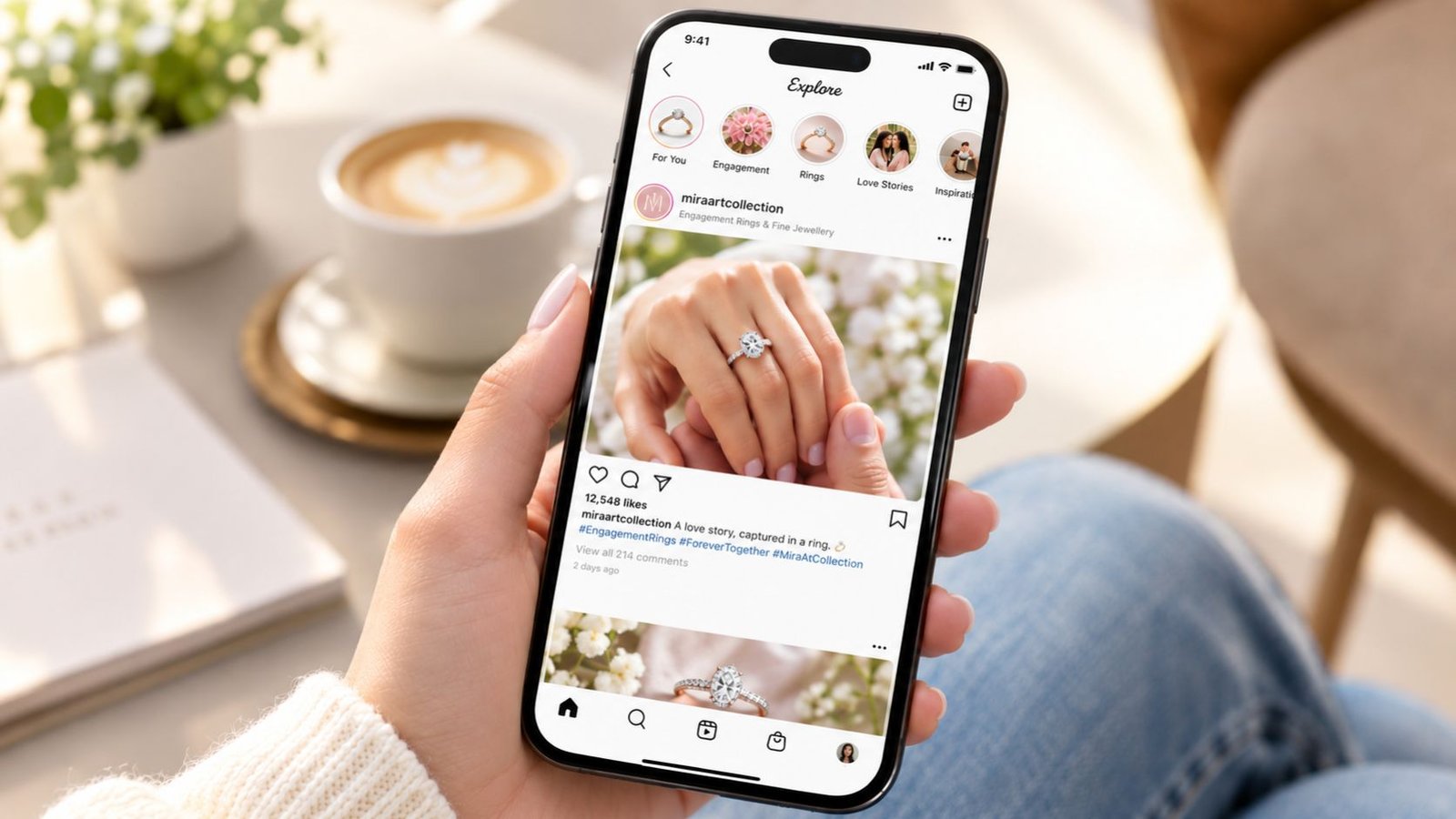
Engagement ring reveals have become one of the most consistently shared categories of content across visual social platforms, and that visibility has quietly recalibrated buyer expectations. When a buyer’s social feed is populated with ring photos, the stones that get the most engagement and comments tend to be on the larger, more visually striking end of the spectrum — simply because bigger stones photograph more dramatically and catch attention more easily while scrolling.
Over time, repeated exposure to this content shifts what buyers perceive as a typical or desirable center stone size, independent of any conscious decision to “keep up” with anyone else. Psychologists who study social comparison have long noted that repeated visual exposure recalibrates a person’s internal baseline for what looks normal, and engagement ring photography appears to be a clear example of that effect playing out in a purchasing category.
Retailers have noticed this shift directly at the counter, reporting that buyers increasingly arrive with a specific carat weight already in mind, often larger than what a similar buyer would have requested a few years earlier, having formed that expectation from social content rather than from in-store browsing alone.
Reason 3: Budgets Are Being Reallocated Toward the Stone Itself

Engagement ring spending has not necessarily increased overall, but how that spending gets allocated within the purchase has shifted. A growing number of buyers are choosing simpler settings — thinner bands, fewer accent stones, less intricate metalwork — specifically to free up more of the budget for the center stone itself.
This reallocation reflects a broader values shift among younger buyers, many of whom place less emphasis on ornate, traditional ring styling and more emphasis on a clean, modern aesthetic where center stone size does the visual work on its own. A larger stone in a minimalist setting has become a distinctly popular look, and it requires directing a higher proportion of total spend toward carat weight rather than toward setting complexity or accent diamonds.
Retailers who have adapted their showroom offerings to emphasise simpler setting options alongside larger stone choices have generally reported stronger alignment with what buyers are actually requesting compared to retailers still built primarily around traditional, setting-heavy inventory.
Reason 4: The Price-Per-Carat Curve Still Rewards Strategic Sizing
Diamond pricing has never scaled in a straight line with carat weight — prices increase disproportionately at certain size thresholds, historically around the 1-carat and 2-carat marks, because of how demand clusters around round numbers. What has changed in 2026 is that informed buyers increasingly understand this curve and shop around it deliberately.
A buyer aware that a 1.9-carat stone often carries a noticeably lower price-per-carat than a 2-carat stone of similar quality can choose the 1.9-carat option and capture most of the visual size benefit of hitting “two carats” without paying the premium attached to actually crossing that threshold. This kind of strategic sizing has become far more common as certification transparency and price comparison tools have made the underlying pricing curve visible to ordinary buyers rather than just industry insiders.
The net effect on wholesale demand is a noticeable clustering of demand just below major carat thresholds — a pattern wholesalers and cutters increasingly factor into planning, since it affects which rough sizes and cutting yields are most commercially valuable to prioritise.
Reason 5: Retailers and Marketing Have Leaned Into the Trend
Once a shift in buyer preference becomes visible, retail marketing tends to accelerate it. Retailers who noticed rising interest in larger center stones responded by featuring bigger stones more prominently in advertising, showroom displays, and online product imagery, which in turn reinforced the trend among buyers who had not yet formed a strong preference of their own.
This is a familiar retail dynamic — visible demand around center stone size shapes marketing, and marketing then reinforces and accelerates that demand. Several major online diamond retailers restructured their default search filters and featured collections during this period to foreground larger carat ranges, a merchandising choice that reflected the data they were seeing on buyer behaviour and simultaneously nudged undecided buyers further in that same direction.
What Rising Center Stone Size Means for Wholesale Demand

The upsizing trend is not just a retail curiosity — rising center stone size carries real consequences for wholesale demand and supply chain planning. Several shifts are already visible and are likely to intensify through the remainder of the decade.
Independent grading data from laboratories such as GIA confirms this shift toward larger, higher-value submissions, reinforcing what retailers are already seeing at the counter. For a closer look at how these pricing dynamics play out at the retail level, see our earlier breakdown of diamond markup and how retail pricing really works.
Carat mix in wholesale inventory is shifting upward. Wholesalers who historically stocked heavily in the sub-1-carat range are adjusting purchasing toward the 1.5 to 3 carat range to match retail demand, which changes both sourcing priorities and capital requirements, since larger stones represent more inventory value tied up per unit.
Cutting and manufacturing priorities are adapting. Rough diamond cutters, particularly in lab grown production facilities where growth parameters can be adjusted more directly than with natural rough, are increasingly optimising for larger finished carat weights rather than maximising the number of smaller stones from a given growth run.
Certification volume is climbing in larger size categories. Grading laboratories have reported rising submission volumes specifically in the 1.5-carat-and-above categories, reflecting the same upward shift and creating longer turnaround expectations that retailers now factor into inventory planning.
Price competition is intensifying in the upsized “sweet spot” ranges. As demand clusters around strategically sized stones just below major carat thresholds, wholesale competition in those specific size bands has increased, compressing margins in exactly the ranges seeing the fastest demand growth.
Retailer inventory financing needs are increasing. Because larger stones carry higher per-unit value, retailers carrying inventory weighted toward bigger center stones require more working capital to maintain equivalent unit counts, a shift that has pushed some smaller retailers toward more consignment-based and made-to-order inventory models rather than traditional showroom stock.
How Wholesalers and Retailers Can Respond
For businesses on the supply side of this trend, a few practical adjustments can help align inventory and sourcing strategy with where center stone size demand is actually heading. Tracking carat-weight purchase data closely rather than relying on historical assumptions helps identify exactly how fast the shift is moving in a specific market or customer segment. Building sourcing relationships that can flexibly supply larger lab grown rough, rather than assuming existing supplier relationships will automatically scale, helps avoid inventory gaps as demand grows.
Considering made-to-order and consignment models for higher-value larger stones reduces the working capital burden of holding expensive inventory that may take longer to sell. And training sales staff to understand and clearly explain the price-per-carat curve helps buyers make informed sizing decisions, which tends to build trust and improve conversion compared to a purely size-focused sales pitch.
Is the Upsizing Trend Likely to Continue?
Most signals point toward continued growth in average center stone size through the remainder of the decade, though likely at a more moderate pace than the sharp acceleration seen through the mid-2020s. Lab grown diamond prices are expected to continue softening as manufacturing capacity expands further, which would keep pushing the affordability threshold for larger stones lower. Social media’s influence on buyer expectations shows no sign of reversing. And as younger buyers who grew up with lab grown diamonds as a normalised, mainstream option reach peak engagement-ring-buying age, the preference for larger, more visually prominent center stones is likely to become even more deeply embedded rather than fading as a temporary trend.
The Bottom Line
Center stone size has moved from a matter of pure personal preference to a genuine market trend with measurable effects reaching back through the entire wholesale supply chain. Falling lab grown diamond prices, shifting social visibility, budget reallocation toward the stone itself, smarter price-per-carat shopping, and retail marketing that has leaned into the trend have together pushed average carat weights meaningfully higher.
For buyers, this means more genuine choice and better value at larger sizes than existed even a few years ago. For wholesalers and retailers, it means inventory planning, sourcing relationships, and financing strategies all need to account for a market that increasingly expects — and can increasingly afford — a bigger stone at the centre of the ring
Frequently Asked Questions
Changing attitudes toward men’s adornment, celebrity and athlete influence, evolving wedding band preferences, and falling lab grown diamond prices have together driven strong growth in the category.
Signet rings, tennis chains and bracelets, diamond pendants, wedding bands, diamond-set watches, and stud earrings are the strongest-performing categories.
Yes. Lab grown diamonds have made larger, more heavily set men’s designs far more affordable, which has been a major driver of category growth.
Bezel and channel settings are generally preferred over delicate prong settings, since they offer better durability for everyday wear.
Often, yes. Sourcing consistent melee diamonds at volume for men’s designs typically requires different supplier relationships than sourcing individually certified stones for engagement rings.
Individual grading isn’t practical for small melee stones, but batch-level documentation confirming origin and production method is increasingly expected by buyers.
Yes. Retailers report stronger engagement when men’s diamond jewelry is displayed and marketed as its own distinct category rather than folded into women’s displays.
Simple stud earrings or thin diamond wedding bands at accessible price points tend to perform well in attracting first-time male diamond buyers.
Yes. A growing number of retailers are seeking custom or semi-custom designs to differentiate their men’s offering from standard catalogue pieces.
Reliable lab grown melee sourcing, durable setting capabilities, clear origin documentation, and flexible minimum order quantities for custom designs are all key priorities.
Disclaimer: This article is intended for informational and educational purposes only. Market trends, sourcing practices, and pricing considerations discussed here are based on general industry reporting as of 2026 and can vary by supplier, region, and product category. Always verify certification, origin documentation, and pricing directly with a trusted supplier or gemological professional before making a sourcing decision.