
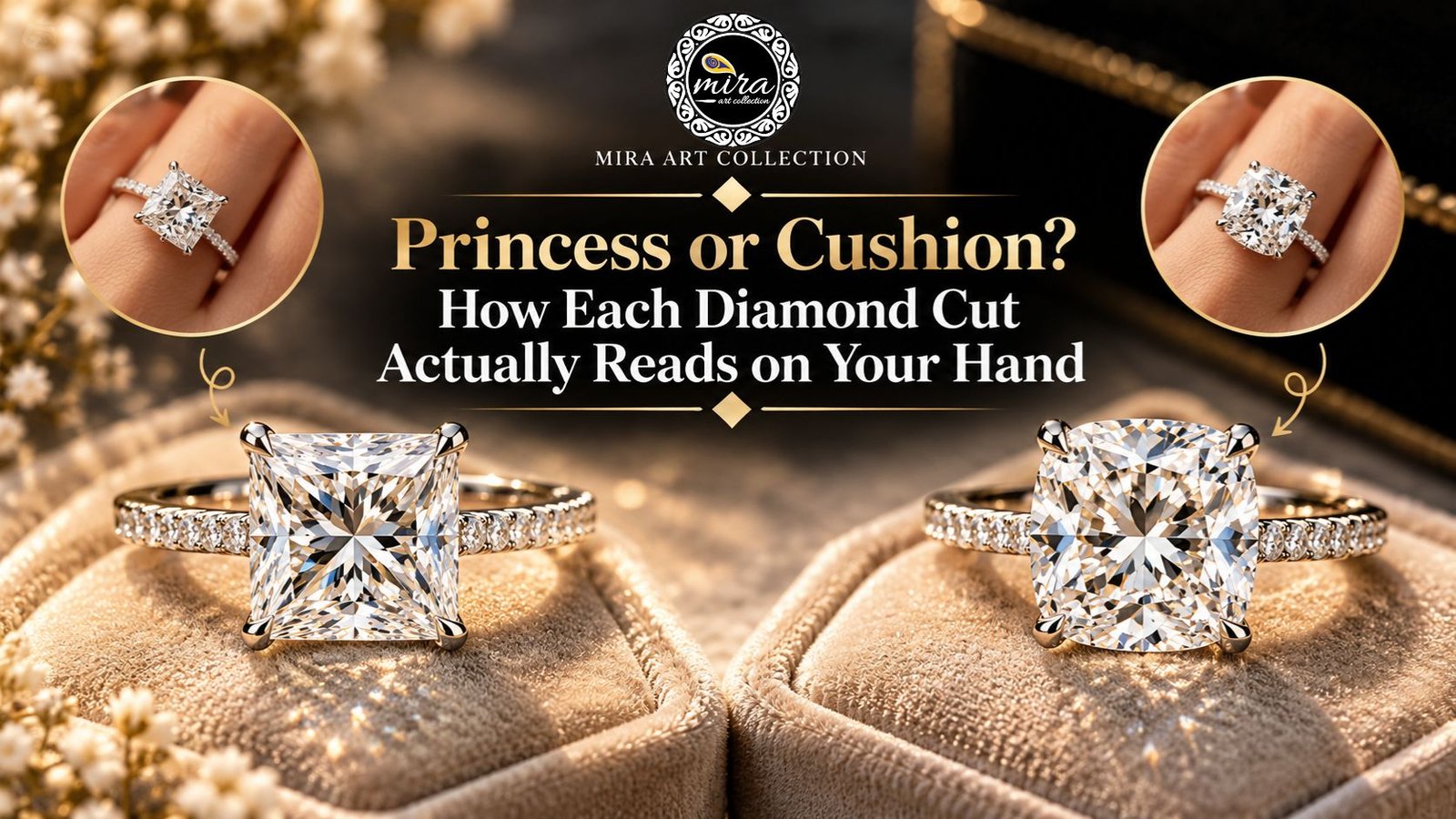
Princess or Cushion? How Each Diamond Cut Actually Reads on Your Hand
Shape is usually the first real decision a buyer makes after settling on a budget, and Princess vs Cushion Cut is one of the most common pairings buyers find themselves weighing against each other. Both are square-based shapes with genuine history behind them, both are widely available in lab-grown form, and both can look stunning, yet they behave very differently once they’re actually set on a finger. This guide breaks down what separates the two structurally, how each one tends to read on different hand and finger shapes, and what else is worth knowing before choosing between them.
Why This Comparison Isn’t Just About Looks
It’s tempting to treat a shape decision as purely aesthetic, a matter of which silhouette a buyer happens to prefer. In practice, Princess vs Cushion Cut involves several genuinely practical differences that go well beyond appearance alone: facet structure, corner vulnerability, how each cut distributes weight, and how light behaves differently across each shape’s distinct faceting pattern.
These structural differences are exactly why a side-by-side comparison matters more here than it might for two shapes that are optically closer together. A princess and a cushion cut diamond of the same carat weight can look, wear, and photograph quite differently, which makes understanding the underlying structure genuinely useful rather than a purely academic exercise.
The Princess Cut Explained

The princess cut is a relatively modern invention compared to most diamond shapes, developed in 1979 by a group of cutters working in Israel, drawing inspiration from the earlier radiant cut’s success at achieving brilliance in a square silhouette. The earliest version, sometimes called the Quadrillion, carried 49 facets; modern princess cuts generally range from around 40 to 58 facets, with 57 being the most common count used today.
Structurally, the princess cut is unusual in that it carries two full sets of main crown facets and two full sets of main pavilion facets, compared to a round brilliant’s single set of each. This doubled facet structure is part of what gives a well-cut princess diamond its notably sharp, geometric brilliance. GIA notes that symmetry matters significantly for this cut, checked by comparing the facets on either half of an imaginary line drawn down the stone’s length, since any asymmetry tends to be more visually obvious in a princess cut’s crisp, angular structure than it would be in a softer shape.
One genuinely useful practical advantage of the princess cut is its face-up size relative to carat weight; because less of the rough diamond is typically cut away during shaping compared to a round brilliant, a princess cut diamond tends to display a larger face-up appearance per carat than many other popular shapes.
The Cushion Cut Explained

The cushion cut carries considerably deeper historical roots, tracing back to the Old Mine cut style first used in the early 1700s, originating from Brazilian diamond mines of the period. Those early cuts prioritized retaining as much rough weight as possible given the limited cutting technology available at the time, producing a squarish outline with a high crown, small table, and deep pavilion that’s still recognizable in the cushion cut’s modern descendants.
Today’s cushion cut diamonds come in two main structural styles. A standard cushion brilliant typically carries around 58 facets, arranged with eight larger kite-shaped main facets producing bold, broad flashes of light often described as a “chunky” appearance. A cushion modified brilliant adds additional facets between those mains, often reaching 64 facets or more, breaking up the light into smaller, more numerous reflections commonly called the “crushed ice” look. Neither style is inherently superior; the choice between chunky and crushed ice comes down entirely to personal preference for how the light pattern actually reads.
The cushion cut’s historical pedigree includes some genuinely famous stones; both the Hope Diamond and the Regent Diamond, among the most celebrated diamonds in the world, are cut in cushion antique brilliant styles, underscoring just how long this shape has been associated with exceptional diamonds specifically.
Princess vs Cushion: Key Differences
| Factor | Princess Cut | Cushion Cut |
| Corner shape | Sharp, pointed corners | Soft, rounded corners |
| Typical facet count | 40 to 58 (commonly 57) | 58 to 64+ depending on style |
| Historical origin | Developed in 1979 | Traces back to the 1700s |
| Face-up size per carat | Generally larger | Generally appears somewhat smaller |
| Durability consideration | Corners need protective setting | Rounded corners naturally more durable |
| Visual character | Sharp, geometric brilliance | Soft, vintage-leaning brilliance or fire |
Neither shape outperforms the other across every category; the two are built around genuinely different design priorities, one favoring crisp geometry, the other favoring a softer, more historically rooted silhouette.
How Each Cut Actually Reads on Different Hand and Finger Shapes
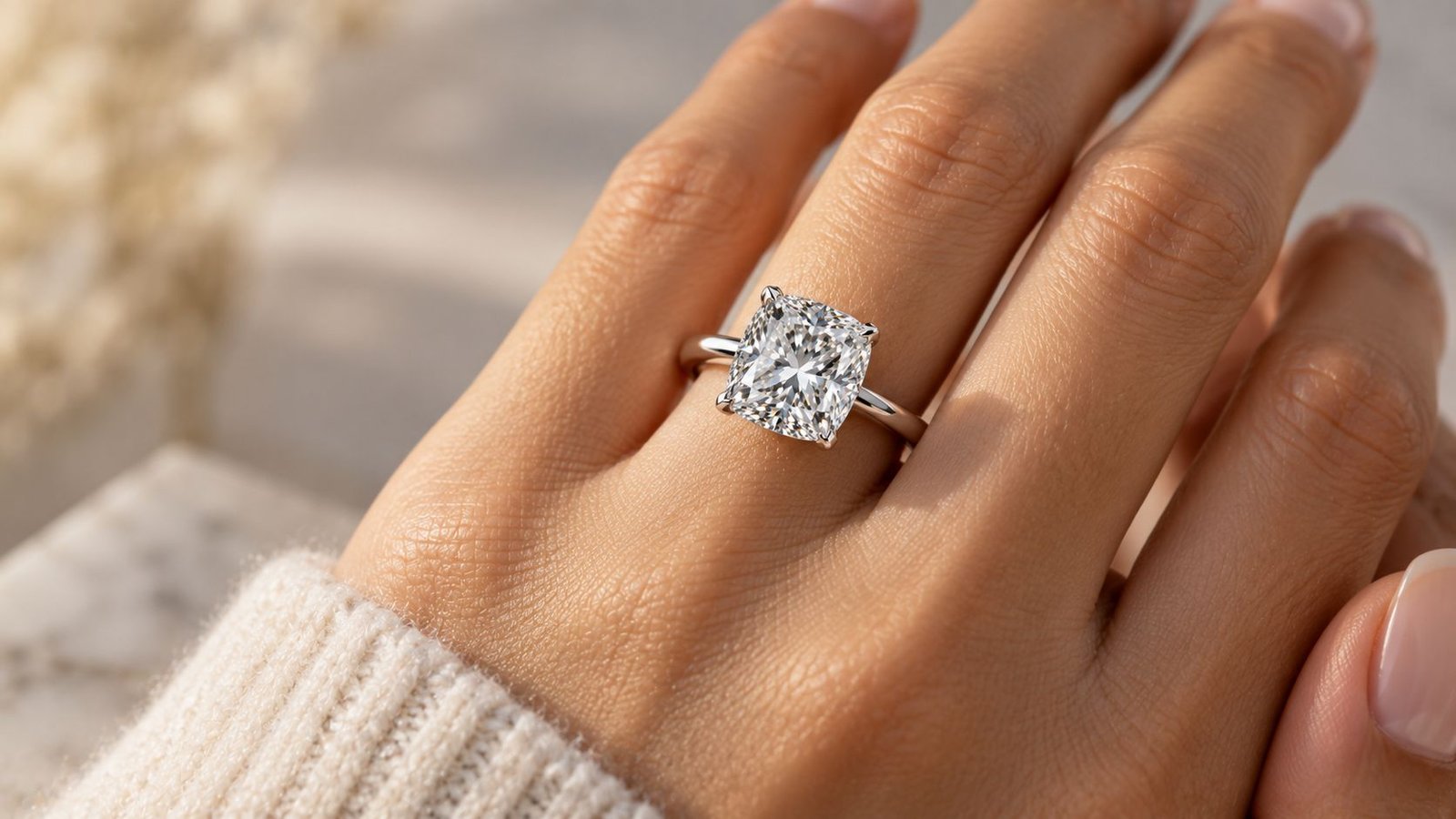
This is where the comparison becomes genuinely personal rather than purely technical, and it’s worth treating the following as general styling guidance rather than a strict rule, since personal taste ultimately matters more than any formula. The princess cut’s crisp, angular lines tend to complement longer, slender fingers particularly well, since the straight edges echo the finger’s own linear shape rather than contrasting against it. On a rectangular princess cut specifically, that elongated silhouette can visually lengthen a shorter finger in a way a perfectly square princess cut doesn’t achieve to the same degree.
The cushion cut’s rounded corners and softer overall silhouette tend to read as more universally flattering across a wider range of finger shapes and widths, since the absence of sharp angles avoids emphasizing a finger’s own proportions as directly as a geometric shape like the princess cut can. Buyers with shorter or wider fingers often find a cushion cut’s softer lines blend more naturally, while buyers specifically wanting an elongating, modern-reading effect often lean toward the princess cut instead.
Ring width and setting style factor into this as much as the diamond shape itself; a wider band paired with either cut shortens the visual effect on the finger, while a thinner, more delicate band tends to let whichever cut you choose have a more pronounced effect on how the finger reads overall.
Durability and Everyday Wear Considerations
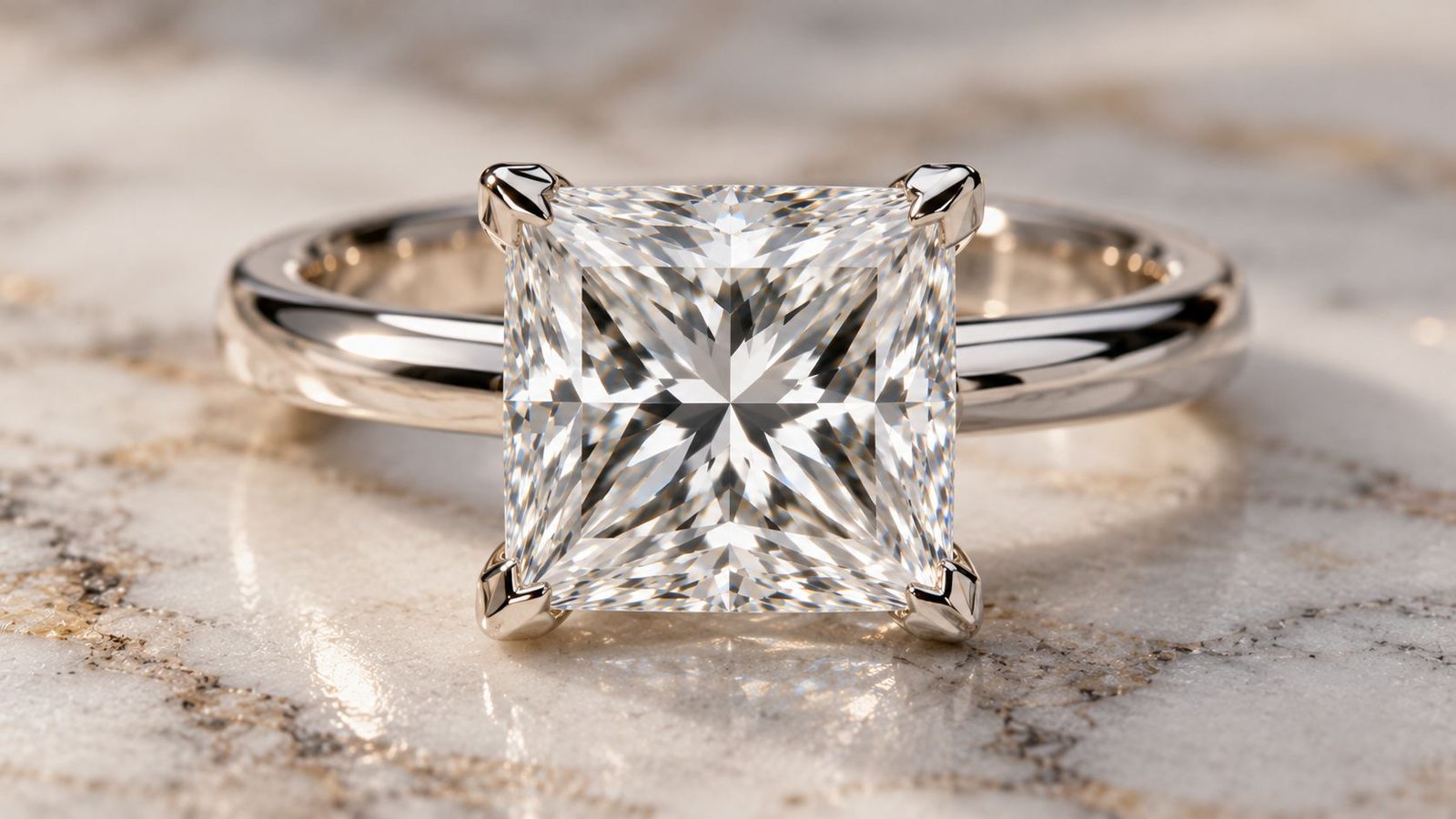
The princess cut’s sharp, pointed corners are its most notable practical vulnerability. Because these corners are genuinely more prone to chipping than a rounded shape, most princess cut diamonds are set using a V-shaped prong design specifically engineered to cover and protect each corner. Some cutters also use a technique called chamfering, cutting very small additional facets right at the corners themselves, specifically to reduce the risk of chipping during everyday wear.
The cushion cut’s rounded corners sidestep this particular vulnerability almost entirely, making it a somewhat lower-maintenance choice for buyers with genuinely active, hands-on lifestyles who want one less thing to think about when it comes to protecting the stone’s edges. This durability advantage is one of the more practical, non-aesthetic reasons some buyers choose cushion over princess specifically.
Clarity and Inclusions: What Each Cut Shows

Larger, open facets, like those found in a chunky-style cushion brilliant, tend to do a reasonably good job of masking minor inclusions, since the broad flashes of light draw the eye rather than letting it settle on any single point within the stone. A crushed-ice style cushion, with its smaller, more numerous facets, behaves somewhat differently, offering less of that masking effect but still generally performing well at hiding minor clarity characteristics compared to a step-cut shape.
The princess cut’s doubled facet structure produces a particularly brilliant, scattered light pattern that also tends to help disguise minor inclusions reasonably well, similar in principle to how a round brilliant’s many facets work, though the sharp, geometric pattern can sometimes make a poorly placed inclusion near the center more noticeable than it would be in a softer shape. For both cuts, a clarity grade in the VS range or better is generally a safe, practical choice for ensuring an eye-clean appearance without overpaying for a clarity level higher than what’s actually needed.
Lab-Grown Advantages for Both Cuts
Because princess and cushion cuts historically retain more of the original rough diamond’s weight than a round brilliant does, both shapes have traditionally offered somewhat better value per carat even in natural diamonds. Lab-grown diamonds extend that value advantage considerably further, since the baseline cost difference between lab-grown and natural stones applies on top of whatever efficiency advantage the shape itself already offers.
This combination makes it realistic for buyers to prioritize a larger stone, a higher clarity grade, or both, particularly for a cushion cut where larger facets genuinely benefit from strong clarity to look their best. Because lab-grown diamonds share identical hardness and optical properties with natural stones, a lab-grown princess or cushion cut displays the exact same brilliance, fire, and durability characteristics described throughout this guide, just at a meaningfully lower cost for an equivalent grade.
Common Misconceptions
“Princess cut diamonds are more fragile than other shapes.” The diamond itself isn’t fragile, but its pointed corners are more vulnerable than a rounded shape’s edges, which is why protective V-prong settings are standard practice for this cut.
“Cushion cut diamonds always have a vintage look.” While cushion cuts do carry genuine historical roots, modern cushion modified brilliants with a crushed-ice facet pattern can read as distinctly contemporary rather than strictly antique in style.
“A princess cut always looks the same regardless of length-to-width ratio.” A more rectangular princess cut produces a noticeably more elongated look than a perfectly square version, which matters for buyers specifically seeking a finger-lengthening effect.
“Cushion cuts hide inclusions better than any other shape.” Cushion cuts do a reasonably good job of masking minor inclusions, particularly in a chunky facet style, but this effect varies depending on the specific cutting style and inclusion placement.
“Lab-grown princess and cushion cuts look different from natural ones.” Lab-grown and natural diamonds are chemically and optically identical, so a lab-grown stone in either shape displays the exact same brilliance and fire as a natural diamond of equal clarity and cut quality.
Buying Guide: Choosing Between Princess and Cushion
Start by trying on both shapes in person if at all possible, since photographs rarely capture how differently these two cuts actually read against a specific hand. Pay attention not just to how each shape looks in isolation, but how it interacts with your particular finger length and width.
If durability and lower setting maintenance matter most to you, lean toward the cushion cut’s rounded corners; if you specifically want a sharp, elongating, modern silhouette and don’t mind the extra care a pointed corner requires, the princess cut is likely the better fit. For cushion cut buyers specifically, decide early whether you prefer a chunky or crushed-ice facet style, since the two produce genuinely different visual effects worth comparing side by side.
Finally, consider clarity grade carefully for either shape, generally aiming for VS1 or VS2 as a reliable baseline for an eye-clean appearance, and take advantage of the cost savings lab-grown diamonds offer to prioritize a larger stone or stronger clarity grade without exceeding your budget.
Final Thoughts
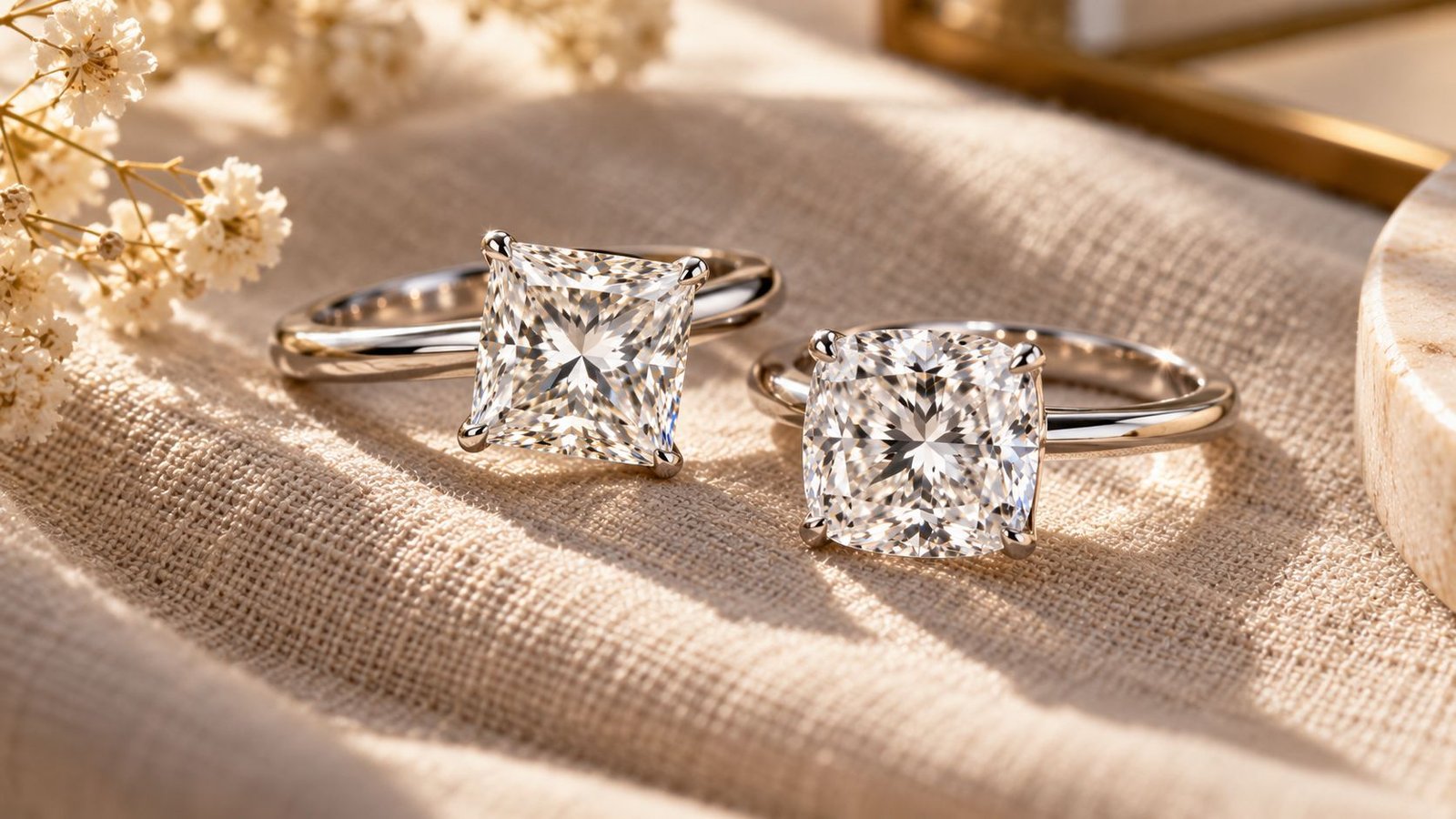
Princess vs Cushion Cut ultimately comes down to a genuine trade-off between sharp, modern geometry and softer, historically rooted elegance, with real practical differences in durability and finger suitability sitting underneath the aesthetic choice. Neither shape is the objectively correct pick; the better choice depends entirely on your specific hand, your lifestyle, and which visual character actually appeals to you once you see both in person. With lab-grown diamonds making both shapes more affordable at any given clarity and size, this decision can stay focused on what you genuinely love wearing rather than what fits a tight budget.
Frequently Asked Questions
Disclaimer: Styling guidance regarding how diamond shapes suit different hand and finger types reflects general industry observation rather than a strict rule, and personal preference should always take priority. Consult a jeweler in person for guidance specific to your hand.