

Loose Stones or Finished Pieces? A Wholesale Buyer’s Guide to Stocking Diamonds
Every new wholesale buyer eventually faces the same practical question: should your capital go into loose diamonds, finished jewellery, or some mix of both? It’s not a question with one universal right answer — the correct wholesale diamond inventory mix depends heavily on your customer base, your cash flow tolerance, and how much of the design and setting work you’re actually set up to handle yourself.
This guide walks through what each category of wholesale diamond inventory actually offers, where the real capital and cash flow differences show up, and how to think about the mix that fits your specific business rather than copying whatever a competitor happens to be doing.
What “Loose Diamonds” and “Finished Jewellery” Actually Mean as Inventory

Loose diamonds are individually graded stones — certified or non-certified — sold without being set into any piece. Buyers stocking loose stones are typically either setting them in-house, working with a manufacturing partner, or selling them onward to a designer or another retailer who will do the setting.
Finished jewellery refers to completed pieces — rings, pendants, earrings, bracelets — where the diamond is already mounted and the piece is ready to sell as-is. This category requires no in-house setting capability, but it also locks in a specific design, metal, and stone combination the moment you place the order.
Understanding which category a specific purchase falls into matters more than it might seem, since the two behave completely differently once they’re sitting in your wholesale diamond inventory.
The Case for Stocking Loose Diamonds
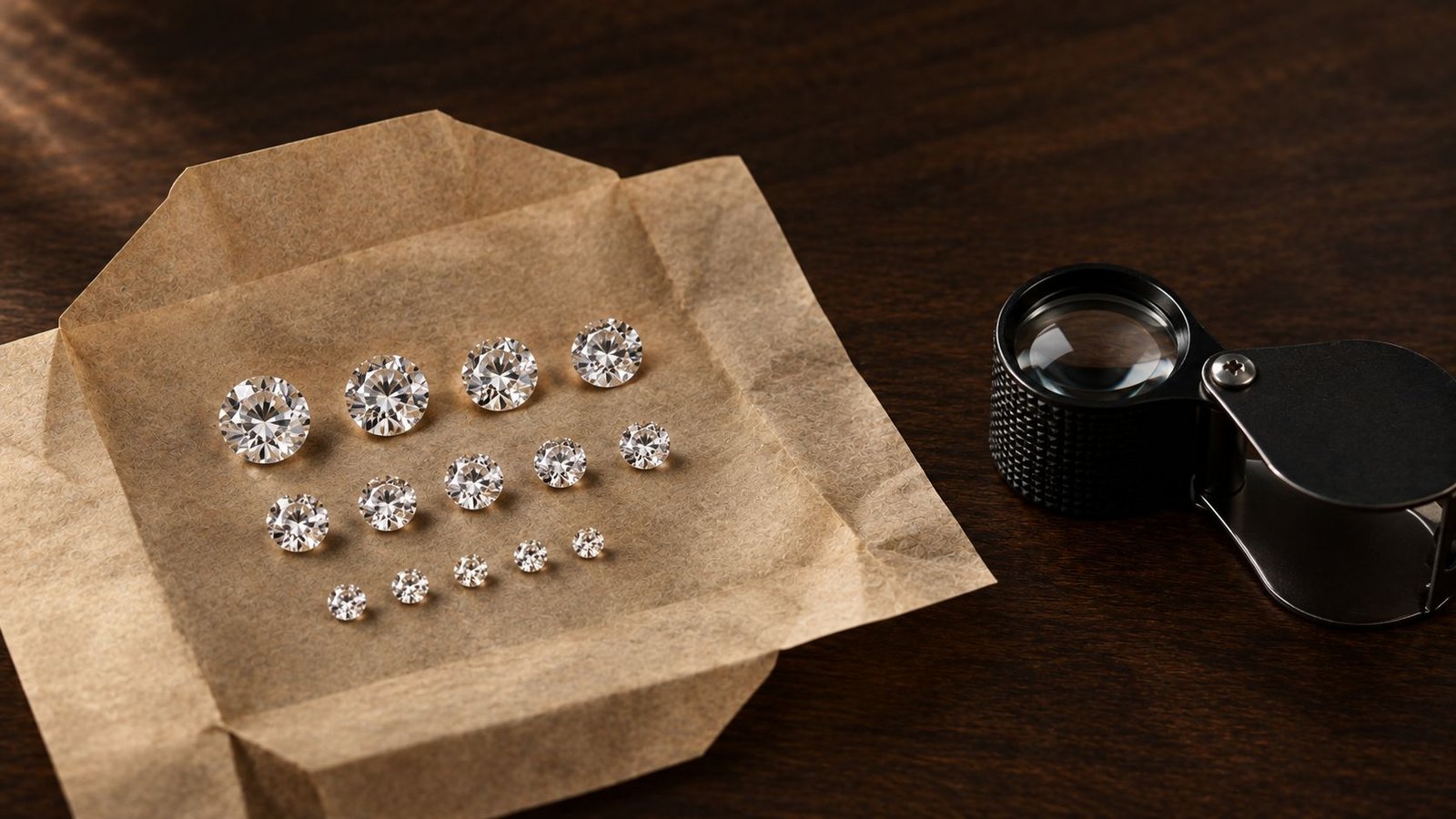
Flexibility is the biggest advantage. A loose stone can go into any design a customer wants, rather than being locked into whatever setting a finished piece happened to ship with. This matters enormously for buyers serving custom or bespoke clients, where the centre stone is chosen first and the design built around it afterward.
Capital efficiency tends to be stronger too. A parcel of loose stones typically ties up less capital per unit than an equivalent value of finished pieces, since there’s no additional labour, metal, and setting cost baked into the price yet — that cost only gets added once a specific piece is actually being made.
Certification transparency is easier to communicate. A loose stone’s certificate speaks entirely for itself, without any question about whether a setting is hiding an inclusion or affecting how a customer perceives the stone’s true colour and clarity.
The Case for Stocking Finished Jewellery

Faster sell-through for walk-in and e-commerce customers. A shopper browsing online or in a showroom generally wants to see and buy a complete piece, not commission a custom design — finished jewellery meets that expectation directly, without requiring a design consultation first.
No in-house setting capability required. Buyers without their own bench jewellers or manufacturing partnerships can still offer a complete, sellable product line by stocking finished pieces, which lowers the operational complexity of getting started.
Higher perceived value per transaction, in the right category. A well-designed finished piece can command a premium over the sum of its raw materials, particularly for design-forward or branded styles — though this cuts both ways, as covered in the risk section below.
The Real Risk With Finished Lab Grown Jewellery: Price Transparency

This is a risk specific to lab grown diamonds that’s worth naming directly, since it doesn’t apply the same way to natural stone inventory. Lab grown diamond pricing has been on a consistent downward trend as production efficiency improves, and buyers increasingly comparison-shop on their phones in real time. A finished piece purchased months ago at a certain cost basis can find itself competing against freshly priced inventory — your own or a competitor’s — at a lower price point, while your wholesale diamond inventory sits at the older, higher cost.
Industry inventory guidance increasingly points toward a just-in-time approach specifically for lab grown finished pieces — ordering closer to when a piece is actually needed rather than holding large finished inventory months in advance — while reserving deeper stock levels for loose stones used in custom work, where pricing can be set against current market rates at the point of sale rather than locked in at an earlier cost.
Capital and Cash Flow: Where the Real Differences Show Up

Jewellery inventory commonly represents a majority share of a retail jewellery business’s total assets, which makes the loose-versus-finished wholesale diamond inventory decision a genuine cash flow question, not just a product one.
Loose diamonds generally allow more precise capital allocation, since a buyer can purchase exactly the shapes, sizes, and grades their customer base actually needs without also committing to a specific design, metal weight, or labour cost upfront.
Finished jewellery ties up more capital per unit and turns over more slowly on average, particularly for larger or more distinctive statement pieces, though fast-moving, commodity-style categories like simple stud earrings or classic bands can turn nearly as quickly as loose stones in the right market.
A blended wholesale diamond inventory — a core of loose stones supporting custom and manufacturing work, alongside a smaller, carefully curated selection of fast-moving finished pieces — is how many established buyers balance flexibility against the convenience finished pieces offer walk-in and online customers.
Let Your Customer Base Decide the Mix
If you primarily serve independent designers, custom jewellers, or manufacturers, loose diamonds should make up the clear majority of your wholesale diamond inventory, since your customers are buying stones to build their own designs around, not finished concepts.
If you primarily serve retail or e-commerce end customers, finished jewellery — kept lean and fast-turning rather than deep and slow-moving — typically serves that audience better, since most retail buyers want to see and purchase a complete piece.
If you run a dropship or zero-inventory model, the calculation shifts again: you’re not holding either category as physical stock yourself, which changes the loose-versus-finished decision from a capital question into a catalogue and fulfilment-speed question instead.
Import Duties and International Sourcing Considerations
For buyers sourcing internationally, loose diamonds and finished jewellery — the two core halves of any wholesale diamond inventory — can face genuinely different duty treatment depending on the destination market, which is worth factoring into the stocking decision alongside the capital considerations above. Recent trade developments are directly relevant here — our look at India’s lab grown diamond market and the 2030 growth outlook covers how agreements like the 2025 India-UK trade deal and the US tariff framework have specifically affected duty treatment on plain diamond jewellery versus loose stones, which can meaningfully change the landed cost comparison between the two categories depending on where you’re importing to.
Sourcing Well for Either Category
Whichever direction your wholesale diamond inventory leans, sourcing quality matters just as much as the loose-versus-finished decision itself. If loose stones make up a significant part of your strategy, our guide to why calibrated lab grown diamonds matter for professional manufacturing covers exactly what separates a well-matched parcel from an inconsistent one, which affects how confidently you can commit capital to a given batch. And before committing to any new supplier relationship for either category, our warning guide on choosing a lab grown diamond wholesaler covers the due diligence worth doing regardless of which side of this inventory decision you land on.
Metal and Setting Costs: The Hidden Variable in Finished Jewellery
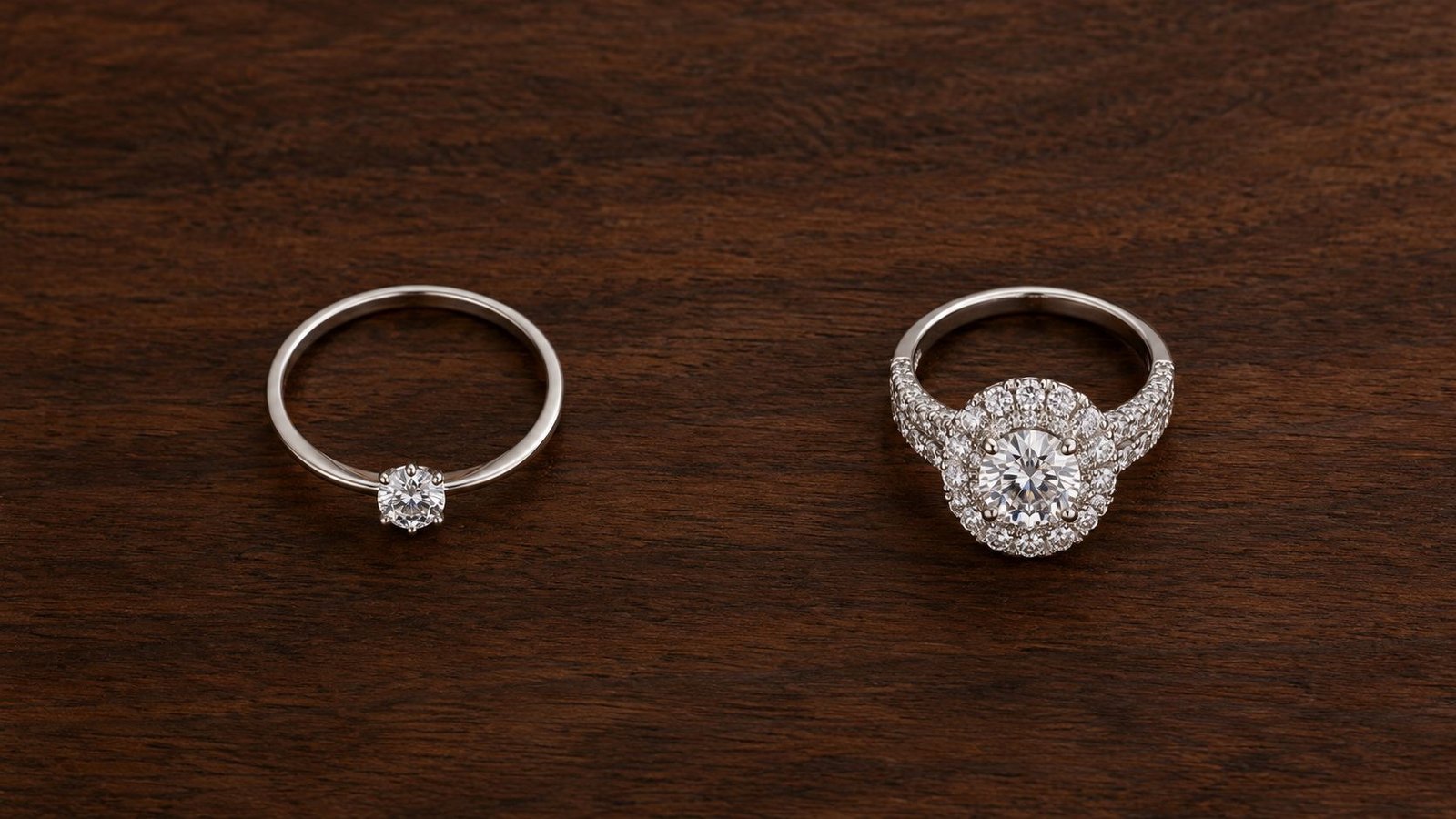
One factor that often gets underweighted when comparing loose diamonds against finished jewellery within a wholesale diamond inventory is how much metal and labour cost actually vary within the finished category itself, which changes the capital math meaningfully depending on what you’re stocking.
Simple, low-metal designs — thin bands, basic stud settings — carry a relatively small labour and material premium over the diamond’s own cost, making them closer in capital efficiency to loose stones than more elaborate pieces.
Detailed or heavier-metal designs — wide bands, elaborate halo settings, statement pieces — carry a much larger premium, since more skilled labour and more raw metal go into each unit regardless of the diamond’s own value.
Gold and precious metal price movements add a second layer of volatility on top of diamond pricing itself for finished jewellery specifically, since a finished piece’s total cost basis moves with both markets simultaneously, while loose diamond inventory is only exposed to diamond pricing alone.
Factoring this in changes how “loose versus finished” should really be evaluated — not as two uniform categories, but as a spectrum where simple finished designs sit much closer to loose-stone capital efficiency than elaborate ones do.
Building a Wholesale Diamond Inventory Plan That Actually Fits Your Business
Rather than defaulting to whatever wholesale diamond inventory mix feels intuitive, a more deliberate approach starts with a few honest questions about your own operation.
What does your actual sales data say, not your assumptions? Many buyers carry more of one category than their real sell-through numbers justify, simply because it’s what they started with rather than what current demand actually supports.
How much markdown risk can your cash flow genuinely absorb? A buyer with thin reserves should lean more conservative on finished lab grown inventory specifically, given the price-transparency risk covered above, regardless of how appealing a particular finished collection looks on paper.
Do you have a repeatable path from loose stone to finished piece? If loose diamonds are a growing share of your wholesale diamond inventory, having a dependable manufacturing relationship isn’t optional — it’s the difference between flexible inventory and stones that simply sit unsold.
Revisiting these questions on a regular cycle, rather than only when a problem forces the issue, is what separates buyers who adjust their mix proactively from those who end up reacting to cash flow strain after it’s already begun.
Common Mistakes When Deciding Your Inventory Mix
Overcommitting to finished lab grown pieces too far in advance. Given how quickly lab grown pricing can shift, holding large finished inventory for many months carries real markdown risk that loose stones, priced closer to point of sale, don’t carry to the same degree.
Ignoring your own operational capability. Stocking heavily in loose diamonds without an in-house setting capability or a reliable manufacturing partner just shifts the bottleneck rather than solving it — the stones still need somewhere to go.
Treating the mix as a one-time decision. The right balance between loose and finished inventory shifts as a business grows, as customer base changes, and as lab grown pricing trends evolve — revisiting the mix periodically matters more than getting it perfectly right once.
Underestimating how differently the two categories turn over. A buyer used to fast-moving finished jewellery can be caught off guard by how much longer certain loose stone specifications can sit before finding the right custom order, and vice versa.
Tracking Both Categories Properly
Whatever mix you land on, how well you actually track your wholesale diamond inventory matters almost as much as the mix itself. Jewellery inventory carries risks most retail categories don’t face at the same time — high per-unit cost, security and insurance overhead, and now a genuinely commoditising core product in lab grown diamonds — which makes loose tracking methods like spreadsheets increasingly risky as volume grows.
Loose diamonds need to be tracked individually by carat weight, shape, colour, clarity, and certificate number, since even a small mismatch between physical stock and recorded inventory can represent a meaningful dollar-value discrepancy at these per-unit values.
Finished jewellery needs tracking at both the component level (the stone and metal that went into it) and the finished-SKU level, so you know both what a piece is actually worth and what it cost to produce, not just what it’s listed to sell for.
A system that handles both loose and finished tracking together, rather than two disconnected processes, becomes genuinely necessary once a wholesale diamond inventory grows past a relatively small number of SKUs — trying to manage that complexity purely through manual spreadsheets is one of the more common points where inventory accuracy quietly starts to break down.
Final Thoughts: Build the Mix Around Your Actual Business
There’s no universally correct split between loose diamonds and finished jewellery — the right wholesale diamond inventory mix depends on who you’re actually selling to, how much capital you’re comfortable tying up in slower-turning stock, and whether you have the operational capability to work with loose stones directly. Buyers serving custom and manufacturing clients should lean loose; buyers serving retail and e-commerce end customers should lean finished, kept lean; and most established buyers land somewhere in between, adjusting the balance as their business and the market itself continue to evolve.
Frequently Asked Questions: Wholesale Diamond Inventory
It depends on the target customer. Buyers serving custom jewellers or manufacturers should lean toward loose diamonds from the start, while buyers targeting retail or e-commerce end customers often find finished jewellery easier to sell without additional design or setting capability.
Lab grown diamond pricing has trended downward as production efficiency improves, and finished pieces purchased at an earlier, higher cost basis can end up competing against newer, lower-priced inventory. Loose stones held for custom work can generally be priced against current market rates at the point of sale instead.
Generally yes, since a loose stone’s cost doesn’t yet include the metal, labour, and setting expense that gets added once it becomes part of a finished piece — that additional cost is deferred until a specific design is actually built.
Yes, and many established buyers do exactly this — a core of loose diamonds supporting custom work, alongside a smaller, fast-turning selection of finished pieces for customers who want something ready to buy immediately.
Often yes, and the difference can be significant depending on the destination market and current trade agreements, which is worth researching specifically for your sourcing and target markets before finalising an inventory strategy.
Significantly. A dropship or zero-inventory model shifts the loose-versus-finished decision away from a capital allocation question, since you’re not physically holding stock yourself, and toward a catalogue breadth and fulfilment-speed question instead.
Overcommitting to finished lab grown jewellery too far in advance of actual demand, which exposes a buyer to markdown risk if pricing shifts before the inventory sells through.
Regularly rather than once — customer base, cash flow tolerance, and lab grown pricing trends all shift over time, and a mix that made sense a year ago may no longer be optimal today.
For fast-moving, commodity-style categories like simple stud earrings or classic bands, finished jewellery can turn over nearly as quickly as loose stones, making the usual capital-efficiency advantage of loose diamonds less pronounced in those specific categories.
Not necessarily, but it does require either an in-house bench jeweller or a reliable manufacturing partner to actually turn stones into sellable finished pieces — stocking loose diamonds without either simply moves the bottleneck rather than eliminating it.
Disclaimer: This article is intended for informational and educational purposes only. Inventory strategies, trade policies, and market pricing trends referenced here reflect general industry practice and information available as of 2026. Always consult a qualified accountant or trade advisor for guidance specific to your business.