
Diamond Toughness: 5 Critical Facts About Why Lab Diamonds Chip
“Diamonds are forever” is one of the most successful marketing lines in the history of advertising, and it has quietly shaped how millions of buyers think about diamond durability and diamond toughness. If diamond is the hardest natural material on Earth, the logic goes, surely it must also be indestructible. Surely nothing short of catastrophe could ever damage it.
That logic, while understandable, is based on a genuine misunderstanding of what “hardest” actually means. Diamond toughness — the property that determines resistance to chipping, cracking, and fracture from impact — is a completely different characteristic from hardness, and diamonds, including lab grown diamonds, can absolutely chip under the wrong circumstances despite sitting at the very top of the hardness scale.
This is not a flaw specific to lab grown diamonds, nor is it a sign of lower quality. It is simply physics, and understanding it properly helps buyers make smarter decisions about settings, everyday wear, and realistic expectations for long-term care. This guide breaks down exactly what hardness and toughness actually mean, why they are not the same thing, and what that distinction means in practical terms for anyone wearing or selling diamond jewellery.
What Hardness Actually Measures

Hardness refers specifically to a material’s resistance to being scratched by another material. Diamond sits at 10 on the Mohs hardness scale, the highest possible rating, meaning that under normal circumstances, nothing except another diamond can scratch its surface. This is precisely why diamonds have historically been prized for industrial cutting and grinding applications, and it is also why a diamond, unlike a softer gemstone such as an opal or a pearl, will not develop surface scratches from everyday contact with dust, sand, or most other household materials.
Crucially, hardness says nothing about how a material responds to a sudden, sharp impact. A material can be extraordinarily scratch-resistant while still being vulnerable to cracking or chipping if struck at precisely the wrong angle with enough force — and diamond is a textbook example of exactly this combination.
What Toughness Actually Measures

Toughness refers to a material’s resistance to fracturing, chipping, or breaking under impact or sudden stress. This is a fundamentally different property from hardness, even though the two are commonly confused. A material can rank extremely high in hardness while ranking only moderately in toughness, and diamond falls into precisely this category — it is essentially unmatched in scratch resistance, but it is far from the toughest material when it comes to resisting a sharp, direct blow.
Understanding diamond toughness properly requires letting go of the assumption that “hardest” automatically means “most durable in every sense.” Durability is actually a combination of several distinct properties, and a diamond’s exceptional hardness only tells part of that story.
Fact 1: Hardness and Toughness Are Genuinely Different Properties
The confusion between hardness and diamond toughness is understandable, since everyday language tends to use words like “hard” and “tough” almost interchangeably. In materials science, however, they describe distinctly different behaviours. A ceramic tile, for example, can be quite hard and scratch-resistant while shattering easily if dropped — a clear illustration of high hardness paired with relatively low toughness. Diamond follows a somewhat similar, if less extreme, pattern: exceptional hardness combined with only moderate toughness relative to many other tough materials.
Fact 2: Diamonds Have Cleavage Planes That Create Vulnerability

The specific reason diamonds can chip despite their hardness lies in their atomic crystal structure. Diamond’s carbon atoms are arranged in a repeating lattice that includes four distinct directions, known as cleavage planes, along which the atomic bonds are comparatively weaker than in other directions through the crystal. A sharp, well-aimed blow along one of these cleavage planes can cause a piece of the diamond to separate cleanly, producing a chip, even though the same diamond would resist scratching from nearly any other material in the world.
This is actually the same underlying property that allows skilled diamond cutters to cleave rough diamond material deliberately during the shaping process, using controlled force along a cleavage plane to divide a stone precisely. The very property that makes diamond workable during cutting is the same property that creates vulnerability to accidental chipping if the stone receives an unlucky, sharply angled impact after it has already been cut and set.
Fact 3: Cut and Setting Significantly Affect Chip Risk

Not all diamond shapes and settings carry equal chip risk when it comes to diamond toughness, and this is one of the more practically useful facts for buyers to understand. Diamond shapes with sharp, exposed corners — princess cuts and other angular fancy shapes in particular — carry meaningfully higher chip risk than rounded shapes like the round brilliant cut, simply because sharp corners present more vulnerable points of contact during everyday impact.
Setting style also plays a significant role. A thin, unprotected girdle — the narrow edge running around a diamond’s widest point — is more vulnerable to chipping than a girdle protected by a well-designed setting that shields the stone’s most exposed edges from direct contact. Prong settings that leave sharp corners exposed carry higher risk than settings, such as a well-designed bezel, that fully enclose and protect vulnerable edges.
Fact 4: Lab Grown Diamonds Have Identical Toughness to Natural Diamonds
Because lab grown diamonds share the exact same atomic crystal structure as natural diamonds, their diamond toughness — and their vulnerability to chipping along cleavage planes — is genuinely identical. There is no meaningful physical difference in how a lab grown diamond responds to impact compared to a natural diamond of the same cut and shape. Any claim suggesting lab grown diamonds are more or less prone to chipping than natural diamonds is simply inaccurate; the underlying physics governing hardness and toughness applies identically to both categories, since both are chemically pure carbon arranged in the same crystal lattice.
This is a useful fact for both buyers and retailers to communicate clearly, since misconceptions about lab grown diamond durability occasionally circulate without any basis in the actual material science involved.
Fact 5: Everyday Situations Cause Most Chips, Not Dramatic Accidents
Diamond chipping in real-world settings, when tested against actual diamond toughness limits, is rarely the result of a dramatic accident. Far more commonly, it results from small, repeated moments of everyday contact — a ring catching sharply against a hard countertop edge, an accidental knock against a doorframe, or contact with tools or equipment during manual activity. Because these everyday impacts often happen at unpredictable angles, they occasionally strike a stone precisely along a vulnerable cleavage plane, even though the vast majority of similar impacts cause no damage at all.
This helps explain why chipping, while uncommon, is not entirely rare either. It is less about diamonds being fragile in general and more about the simple statistical reality that enough small, everyday impacts occurring over years of daily wear will eventually include a small percentage that happen to strike at exactly the wrong angle.
How Diamond Toughness Compares to Other Gemstones
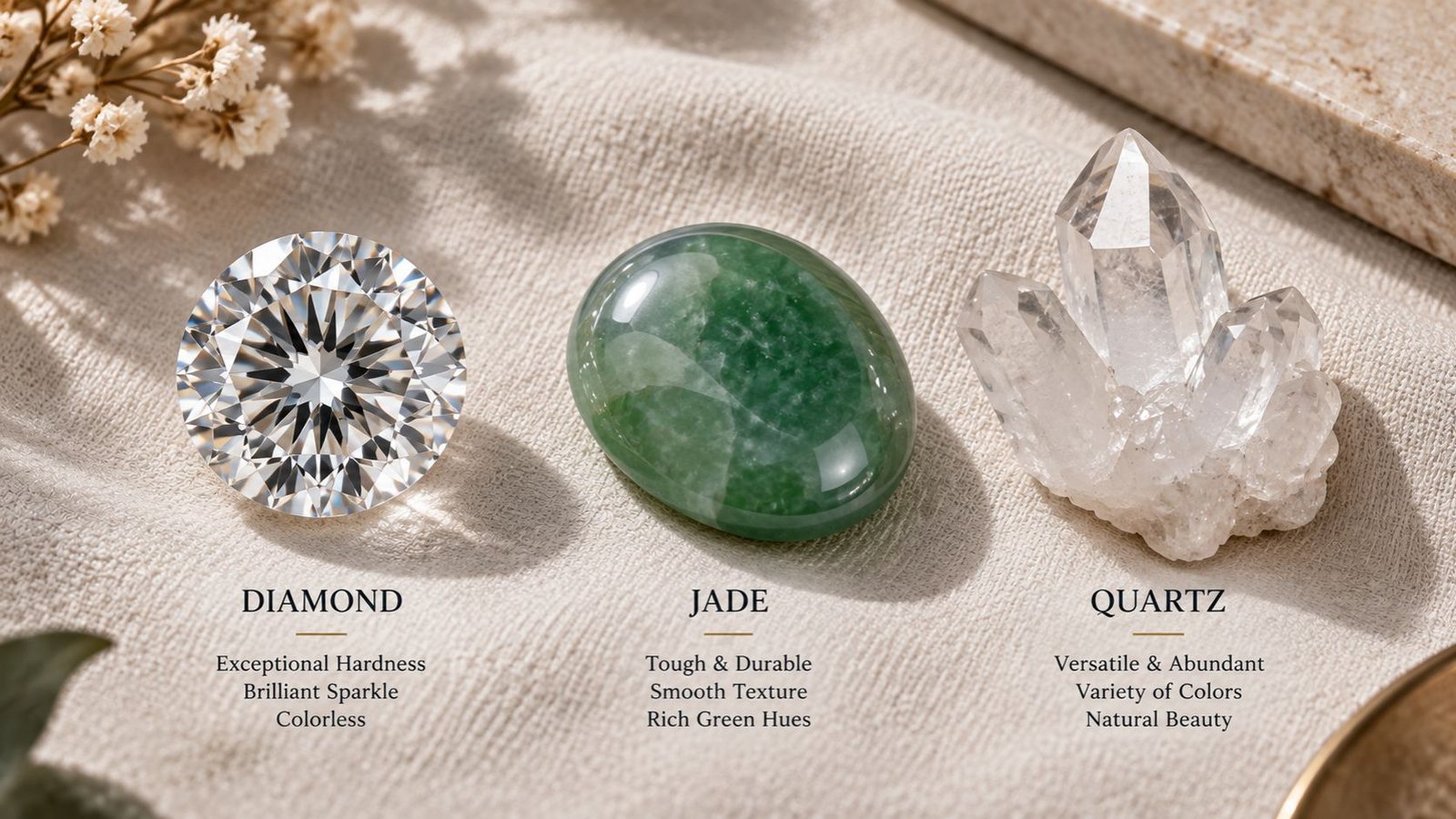
Diamond’s position on the toughness scale is genuinely interesting once separated from its position on the hardness scale, and comparing diamond toughness to other materials helps put this in context. While diamond ranks unmatched in hardness, several other gemstones, including jade and certain varieties of quartz, actually rank higher in pure toughness despite being considerably softer and more prone to scratching. This is precisely why some traditional cultures have historically favoured jade for items subject to significant physical impact, even in eras when diamond was available as an alternative.
This comparison is not meant to suggest diamond is a poor choice for jewellery — its combination of exceptional hardness, respectable toughness, and unmatched brilliance remains genuinely excellent overall for everyday wear. It simply illustrates that “hardest” and “most durable in every situation” are not the same claim, and understanding that distinction leads to more realistic expectations and better care decisions.
Practical Steps to Reduce Chip Risk

A handful of practical choices meaningfully reduce the already-low risk of diamond chipping in everyday wear. Reference material from the Gemological Institute of America on gemstone durability confirms this same distinction between hardness and toughness across other gem types as well. Choosing rounded shapes, such as round brilliant or oval cuts, over sharply angular shapes reduces the number of vulnerable exposed corners on a stone. Selecting settings that protect the girdle and any exposed corners, such as a well-designed bezel or protective prong arrangement, provides meaningful physical protection without requiring any change to the stone itself. For more on how setting choice affects everyday care, see our guide on cleaning diamond jewelry safely at home.
Removing rings before manual labour, heavy cleaning, sports, or any activity involving repeated hard contact significantly reduces cumulative impact exposure over time. And having a jeweller periodically inspect a ring’s setting, particularly for pieces worn daily over many years, helps catch any small existing chips early, before they have a chance to worsen through continued wear.
What to Do If a Diamond Does Chip
A small chip, while disappointing, is rarely a catastrophic problem for a stone with reasonable diamond toughness and does not typically mean the stone needs to be replaced entirely. Depending on the chip’s size and location, a skilled diamond cutter can sometimes recut and repolish the stone to remove the damaged area, resulting in a slightly smaller but fully restored diamond. For very small chips located near the girdle, a jeweller may also be able to adjust the setting to conceal the affected area without requiring any recutting at all.
Consulting a qualified jeweller promptly after noticing a chip, rather than continuing to wear the piece as-is, helps prevent a small chip from gradually worsening through continued everyday impact and gives the best chance of a straightforward, minimally invasive repair.
The Bottom Line
Diamond toughness and diamond hardness are genuinely different properties, and understanding that distinction resolves what initially seems like a contradiction: how can the hardest material on Earth still chip? The answer lies in diamond’s crystal structure, specifically its cleavage planes, which create directional vulnerability to sharp impact even in a material that resists scratching from virtually everything else.
This applies equally to lab grown and natural diamonds, since both share identical atomic structure and therefore identical toughness characteristics. Understanding cut, setting, and everyday care choices — rather than assuming hardness alone guarantees complete durability — gives buyers a genuinely more accurate and more useful picture of how to protect a diamond for decades of confident, everyday wear.
Frequently Asked Questions
Hardness measures resistance to scratching, while toughness measures resistance to chipping or fracturing from impact. They’re separate properties, and diamond ranks highest in hardness but only moderate in toughness.
Diamonds have cleavage planes in their crystal structure where atomic bonds are weaker, making them vulnerable to chipping from a sharp impact at the right angle.
No. Lab grown and natural diamonds share identical atomic structure, so their toughness and chip vulnerability are genuinely the same.
Shapes with sharp, exposed corners, like princess cuts, carry higher chip risk than rounded shapes such as round brilliant or oval cuts.
Yes. Settings that protect the girdle and exposed corners, like a well-designed bezel, reduce chip risk compared to settings that leave edges exposed.
Small, everyday impacts, like catching a ring on a hard surface, are far more common causes than dramatic accidents.
It’s respectable but not the highest. Some softer gemstones, like jade, actually rank higher in pure toughness despite being easier to scratch.
Often, yes. A jeweller may be able to recut and repolish the stone, or adjust the setting to conceal a small chip near the girdle.
Choose rounded shapes, protective settings, remove rings during manual activity, and have your setting periodically inspected by a jeweller.
No. A small chip may reduce value somewhat and can often be repaired, but it doesn’t make the diamond worthless.
Disclaimer: This article is intended for general informational purposes only and does not replace professional gemological advice. Individual diamonds may respond differently to impact depending on cut, setting, and condition. Always consult a qualified jeweller or gemologist for guidance specific to your piece.