

Old-World Elegance or Contemporary Design? Choosing a Setting Style for Lab Grown Diamonds
Every buyer eventually faces the same fork in the road once shape and carat weight are settled: does the setting lean into ornate, old-world detail, or does it stay clean and contemporary? Choosing between vintage-inspired and modern lab grown diamond settings is a genuinely different design decision from choosing a shape, and it changes far more about how a finished piece actually looks and wears than most buyers expect going in.
Lab grown diamond settings today span both directions further than they ever have, largely because lab grown pricing has made the kind of detailed metalwork and matched melee that ornate vintage styles require far more financially realistic than it was even a few years ago. This guide breaks down what actually separates vintage-inspired lab grown diamond settings from modern ones, what each style demands from a lifestyle and maintenance standpoint, and how to choose between them with more than just a photo to go on.
What “Vintage-Inspired” Actually Means in Setting Design

Vintage-inspired lab grown diamond settings borrow their design language from specific historical periods — Victorian, Edwardian, and Art Deco most commonly — and the details that define them are genuinely specific, not just a general impression of “old.”
Milgrain refers to a row of tiny beaded texture along a metal edge, originally created by hand and now achieved through precise casting, that softens a hard edge and catches light in a fine, subtle sparkle.
Filigree describes delicate, open lacework metal patterns, typically found beneath the centre stone in a ring’s gallery, that let light pass through the shoulders rather than presenting a solid wall of metal.
Hand engraving and scrollwork add flowing, ornate patterns directly onto the band or setting surface, often used to complete a period-accurate look alongside milgrain and filigree.
Cathedral shanks, where the band arches upward to support the centre stone like the ceiling of a cathedral, are another common vintage-leaning element, frequently paired with the detailing above.
What “Modern” Actually Means in Setting Design
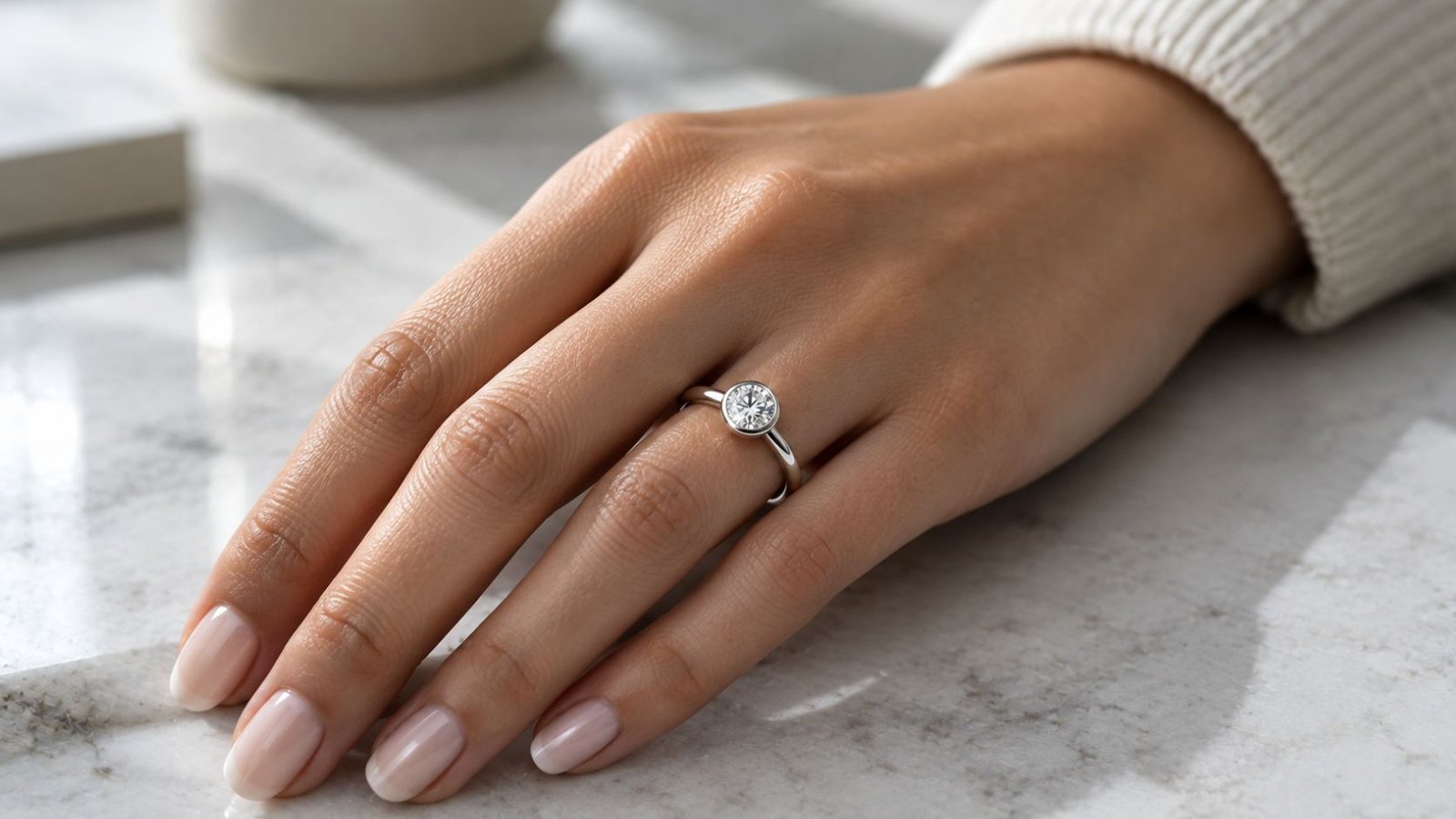
Modern lab grown diamond settings are defined less by a specific era and more by a shared design philosophy: clean lines, minimal visible metal, and an emphasis on the stone itself over surrounding ornamentation.
Bezel settings wrap a smooth, continuous rim of metal around the stone’s edge — GIA’s own guide to engagement ring settings describes this as one of the most protective mounting styles available, and it’s become one of the most requested modern lab grown diamond settings for exactly that reason, alongside its streamlined, contemporary look.
Tension settings use the metal band’s own structural tension to hold the stone in place, appearing to almost float without visible prongs — a distinctly architectural look, though one of the least secure setting types available.
Hidden halo settings tuck a ring of smaller accent diamonds beneath the centre stone rather than fully visible around it, adding extra sparkle without disrupting a clean, minimal silhouette from above.
East-west settings, where the centre stone sits horizontally rather than vertically, represent one of the more distinctly current departures from traditional solitaire orientation.
Why Lab Grown Diamonds Suit Both Styles Equally Well
This is where lab grown pricing genuinely changes the calculation. Ornate vintage settings depend heavily on well-matched melee for their filigree accents and milgrain-adjacent pavé work, and sourcing consistent small stones in quantity has historically added real cost to natural-diamond vintage pieces. Lab grown pricing makes that same level of detail achievable at a price point that puts genuinely intricate vintage-inspired lab grown diamond settings within reach of a much wider range of buyers than before.
Modern settings benefit differently. Because styles like bezel and tension settings put the centre stone on full, unobstructed display with minimal surrounding metal, they demand a genuinely well-cut stone with strong light performance — and lab grown pricing means buyers can often afford a meaningfully higher cut grade for the same budget than they could with a comparable natural diamond, which matters more in a modern setting than almost any other style.
Vintage-Inspired Setting Styles Worth Knowing
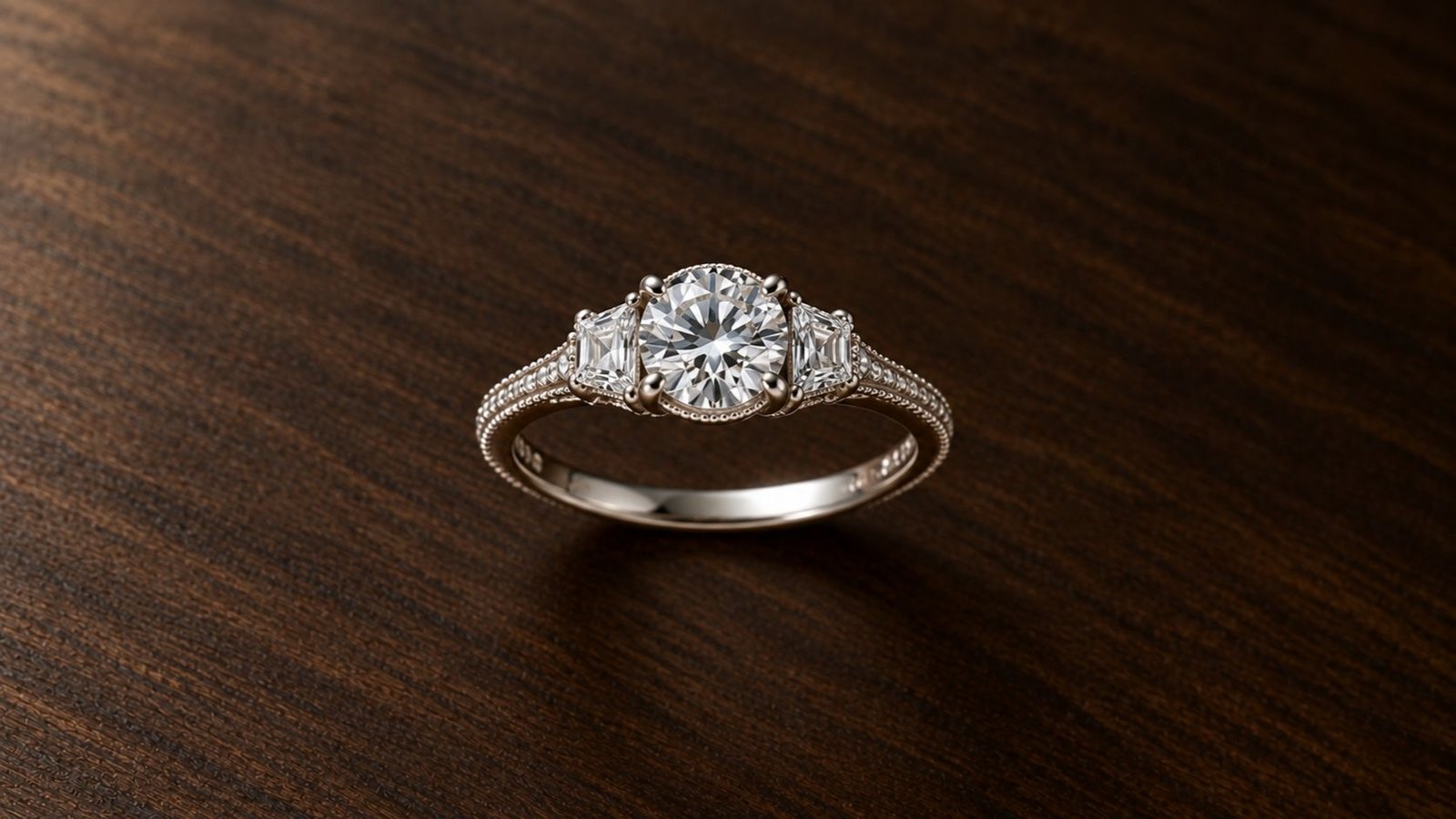
Among vintage-inspired lab grown diamond settings, halo settings surround the centre stone with a ring of smaller diamonds, and while modern minimalist versions exist, ornate vintage halos typically combine the ring of accent stones with milgrain edging and a more detailed gallery beneath.
Three-stone settings — symbolising past, present, and future in traditional bridal symbolism — pair naturally with vintage detailing, particularly when the side stones are geometric shapes like baguettes or trapezoids set against milgrain-edged prongs.
Filigree and milgrain combinations represent the most explicitly vintage of all lab grown diamond settings, and they pair especially well with cushion and Asscher-shaped centre stones, whose own softly geometric outlines echo the ornamentation around them.
Art Deco-influenced settings lean into bold geometric patterns and symmetry rather than the softer, more floral detailing of Victorian and Edwardian styles, offering a distinctly different vintage character within the same broader category.
Modern Setting Styles Worth Knowing

Among modern lab grown diamond settings, bezel solitaires remain the most requested overall, valued for combining a clean, contemporary look with genuinely strong everyday durability, since there’s no prong edge to catch or bend.
Six-prong solitaires, sometimes called the Tiffany-style setting, sit at an interesting middle point — modern enough in overall silhouette while offering meaningfully more security than a standard four-prong design, since losing one of six prongs is a far less serious issue than losing one of four.
Split-shank and sculptural settings divide the band into two or more separate strands as it approaches the centre stone, creating visual interest and additional light exposure without adding traditional ornamentation.
Pavé bands, when paired with a clean, low-profile centre setting rather than ornate detailing, read as distinctly modern despite using the same small-stone technique found in vintage filigree work.
Durability and Maintenance Differences Worth Understanding
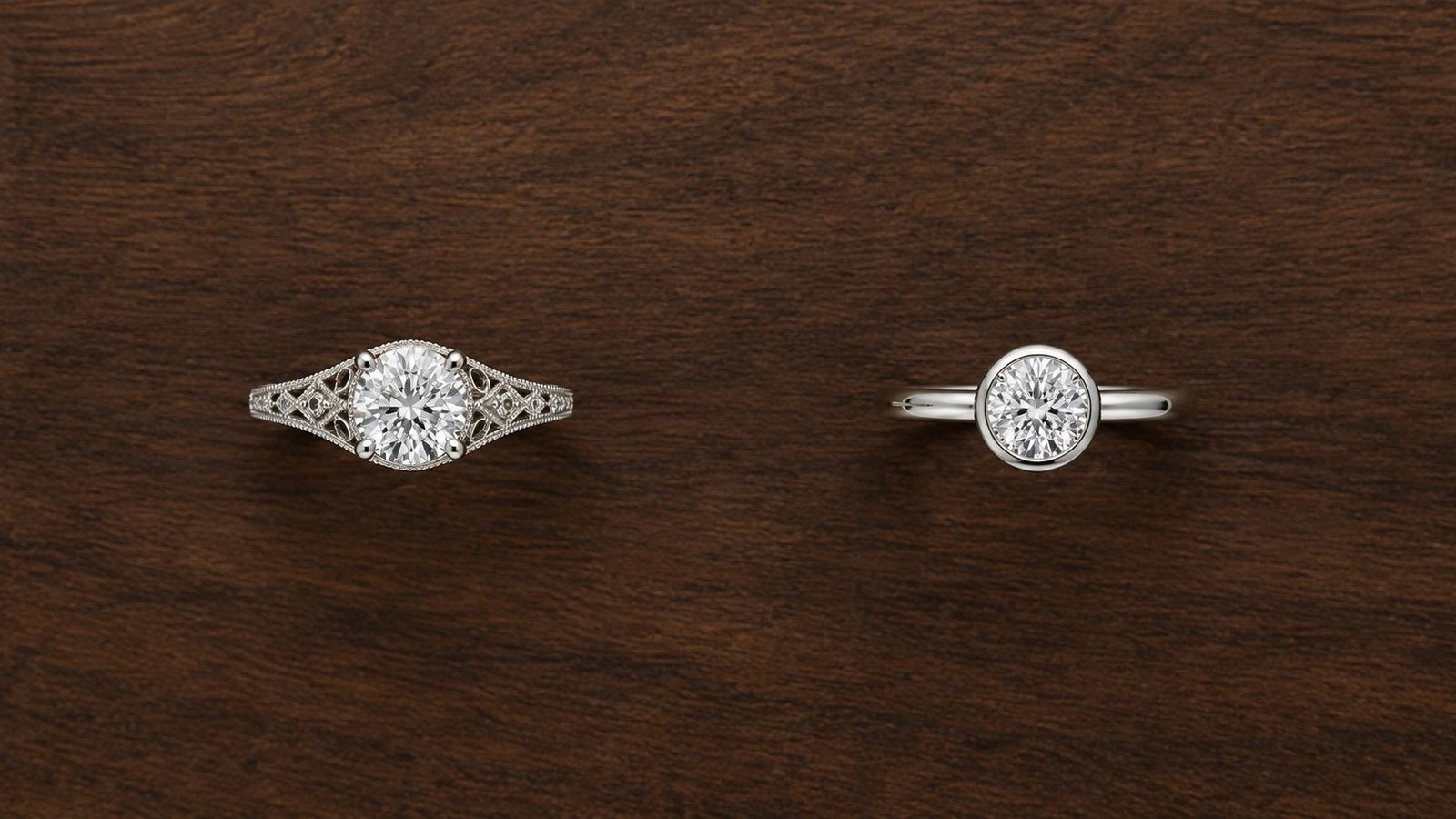
The lab grown diamond itself performs identically across every one of these lab grown diamond settings — at a 10 on the Mohs hardness scale, the stone is never the fragile part of the equation regardless of setting choice. The real durability differences come down to metalwork, not the diamond.
Bezel settings are generally the most durable option of any style covered here, since the metal rim shields the stone’s most vulnerable edge and there are no prongs to bend or catch on daily activity.
Vintage filigree and very high-profile settings require the most ongoing care, since the same intricate detail that makes them beautiful also creates more surface area to catch dust, lotion, and daily grime, along with more delicate metalwork that benefits from periodic professional inspection.
Halo, pavé, and three-stone settings sit in the middle — the small accent stones involved can loosen gradually over years of wear, which isn’t a dramatic risk but does call for the occasional jeweller check-up regardless of which broader style they belong to.
None of this makes any particular style a wrong choice; it simply means understanding what level of upkeep you’re signing up for alongside the aesthetic you actually want.
Choosing Based on Shape and Personal Style
Certain shapes lean naturally toward one direction of lab grown diamond settings over the other, though nothing here is a hard rule.
Cushion and Asscher shapes, with their romantic, softly geometric outlines, pair especially well with vintage filigree and milgrain detailing, letting the setting echo the shape’s own character.
Oval, pear, and marquise shapes tend to suit modern settings particularly well, since their elongated silhouettes already read as contemporary, and a clean bezel or minimal prong setting lets that shape speak for itself without competing ornamentation.
Round and princess shapes genuinely work with either direction convincingly, which is part of why they remain the most consistently popular choices regardless of which broader style a buyer ultimately prefers.
Shape and lab grown diamond settings are best decided together rather than separately. If you haven’t finalised a shape yet, our guide to choosing a lab grown diamond shape for your engagement ring covers how different shapes perform and pair with settings in more depth.
The Hybrid Trend: Blending Both Directions

A genuinely current middle path has emerged among lab grown diamond settings that borrows from both categories rather than committing fully to either — a clean, modern bezel setting finished with a single row of subtle milgrain along its edge, for instance, or a minimalist solitaire mounted on a delicately engraved band. This hybrid approach has grown alongside the broader shift toward personalised, story-driven jewellery design covered in our look at 2026 US jewelry trends, where buyers increasingly want a piece that reflects individual taste rather than committing fully to one historical category or design movement.
For anyone considering how a coloured centre stone or accent might factor into either a vintage or modern setting choice, our guide to pairing lab grown diamonds with coloured gemstones covers how colour theory interacts with setting style specifically.
How Metal Choice Interacts With Either Style
Metal tone changes how convincingly lab grown diamond settings read as vintage or modern, sometimes more than the structural style itself.
Yellow and rose gold naturally reinforce a vintage character, since these warmer tones historically dominated the Victorian and Edwardian periods that vintage-inspired lab grown diamond settings draw from. Milgrain and filigree work also tends to photograph with more visible texture and warmth against gold than against cooler white metals.
White gold and platinum are the default choice for most modern settings, since these cooler tones let the diamond itself read as the clear focal point rather than competing visually with a warmer-toned band. Bezel and tension settings in particular are almost always shown in white metal for this reason.
Mixed-metal designs have become a genuine crossover point between the two categories — a modern bezel setting finished in rose gold, for instance, borrows warmth from the vintage side of the spectrum without adopting any of its structural detailing, which is part of why mixed-metal pieces have grown so popular alongside the broader hybrid trend covered above.
Budgeting for Either Direction
Cost differences between vintage-inspired and modern lab grown diamond settings come down more to labour and detail than to any inherent price difference between the two categories.
Ornate vintage detailing — hand-finished milgrain, filigree galleries, and engraved scrollwork — generally requires more skilled labour hours than a comparable modern setting, which can make a highly detailed vintage piece cost more in setting fees alone than an equivalent modern solitaire, even when using centre stones of identical size and grade.
Simpler modern styles, particularly clean bezel and solitaire settings, typically carry lower labour costs, which can free up more of an overall budget for a larger or higher-grade centre stone instead.
Matched melee for either style — small accent stones needed for vintage pavé work or a modern hidden halo alike — benefits from the same lab grown pricing advantages covered throughout this guide, making detailed work in either direction more accessible than it would be with natural stones of comparable consistency.
Common Mistakes When Choosing Between Styles
Choosing purely from a product photo. Vintage detailing in particular can photograph as either delicate or busy depending on lighting and angle — seeing a setting in person, or at minimum requesting a close-up video, matters more here than for a simpler modern style.
Underestimating maintenance commitment. A stunning filigree setting that never gets cleaned properly will lose its crispness faster than a comparable bezel setting, and that upkeep gap is worth being honest with yourself about before committing.
Assuming modern always means more durable. While bezel settings genuinely are the most durable option, other modern styles like tension settings are actually among the least secure of any category — “modern” and “durable” aren’t automatically the same thing.
Ignoring how the setting will pair with a wedding band. Vintage settings with milgrain or filigree detailing generally want a complementary band with matching or contrasting detail worked in, while very high-profile settings of either style can leave an awkward gap beneath a flush wedding band if this isn’t considered early.
Final Thoughts: Let Lifestyle Guide Aesthetic
Vintage-inspired and modern lab grown diamond settings both deliver on their own terms — one leans into detail, history, and character; the other into clarity, durability, and restraint. Neither is objectively better, and the hybrid middle ground is proof that the two aren’t even mutually exclusive anymore. What matters more than which category you’re drawn to is being honest about maintenance tolerance, daily lifestyle, and how the setting will actually be worn — because a piece chosen for those reasons tends to stay genuinely loved far longer than one chosen from a single flattering photo.
Frequently Asked Questions: Lab Grown Diamond Settings
Milgrain is a row of tiny beaded texture along a metal edge, while filigree refers to delicate, open lacework metal patterns typically found beneath the centre stone. They’re frequently used together but are technically distinct techniques.
Bezel settings are generally considered the most durable, since the metal rim protects the stone’s edge and there are no prongs to bend or catch. Six-prong solitaires follow closely behind for the same reason — more prongs means more redundancy if one is damaged.
Generally yes, particularly for ornate filigree and very high-profile designs, since the same intricate detail that makes them beautiful also creates more surface area for dust and grime to collect, along with more delicate metalwork worth having periodically inspected.
Absolutely — the stone’s origin has no bearing on setting style. Lab grown pricing actually makes ornate vintage detailing, which depends on well-matched melee, more financially accessible than it’s historically been with natural stones.
Cushion shapes pair especially well with vintage filigree and milgrain detailing, since the shape’s own softly geometric, romantic outline complements that style of ornamentation naturally.
Not typically. Despite their striking, architectural look, tension settings are among the least secure setting styles available, relying entirely on the band’s structural tension to hold the stone rather than prongs or a bezel rim.
A hidden halo tucks a ring of smaller accent diamonds beneath the centre stone rather than fully visible around it, adding extra sparkle and apparent size without disrupting a clean, minimal look from directly above.
Yes, and this hybrid approach has become genuinely popular — a clean modern bezel finished with subtle milgrain edging, or a minimalist solitaire on a delicately engraved band, are both common ways buyers blend the two directions.
Yes. Halo settings can make a centre stone appear noticeably larger than its actual carat weight, while bezel settings can make a stone look slightly smaller, since the metal rim covers part of the stone’s visible edge.
Simpler modern styles like solitaires and bezels are generally easier and less expensive to resize than heavily detailed vintage settings, where milgrain and filigree work can require more careful, specialised handling during resizing to avoid damaging the metalwork.
Disclaimer: This article is intended for informational and educational purposes only. Design terminology, durability characteristics, and style trends referenced here reflect general jewellery industry knowledge and information available as of 2026. Always consult a qualified jeweller for guidance specific to an individual piece.