
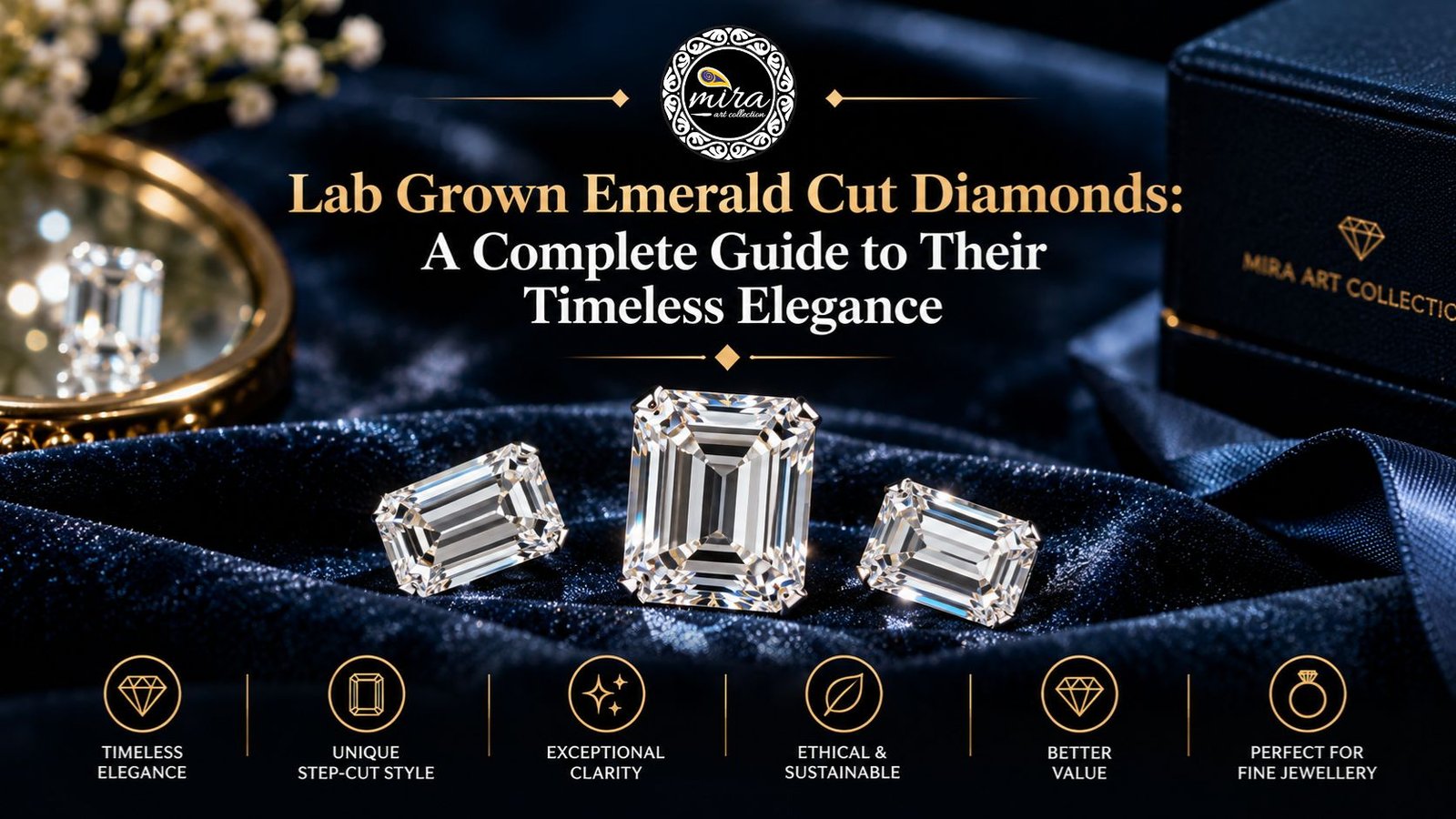
Lab Grown Emerald Cut Diamonds: A Complete Guide to Their Timeless Elegance
There’s a reason the emerald cut has stayed in constant rotation through nearly five centuries of jewellery history, from Renaissance-era gemstones to Angelina Jolie’s engagement ring to the growing wave of couples choosing it today. Lab grown emerald cut diamonds bring that same architectural elegance into a category that’s more accessible, more customisable, and better suited to this particular shape than most buyers realise.
This guide covers everything worth knowing before choosing one — what actually makes an emerald cut different from every other diamond shape, why lab grown emerald cut diamonds pair so naturally with lab-grown production, and the specific quality factors that matter more here than they do for a standard round brilliant.
What Makes an Emerald Cut Genuinely Different
Most diamond shapes you’ll encounter — round, oval, cushion, princess — are brilliant cuts, faceted specifically to scatter light in every direction and produce maximum sparkle. The emerald cut belongs to an entirely different family: step cuts, which GIA’s own guide to diamond shapes groups alongside the Asscher cut as the two defining examples of this style.
Instead of dozens of small triangular facets designed to catch and scatter light, an emerald cut features long, rectangular facets arranged in parallel rows, stepping down from the table toward the pavilion. This produces something different from sparkle entirely — broad, clean flashes of light known as the “hall of mirrors” effect, where light seems to bounce in wide, dramatic sheets rather than a thousand tiny points. It’s a quieter, more architectural kind of beauty, and it’s exactly why lab grown emerald cut diamonds have such a devoted following among buyers who find round brilliant sparkle a little too busy for their taste.
The shape’s distinctive cropped corners aren’t just a styling choice either — they’re a practical inheritance from the emerald cut’s original purpose. Cutters first worked out this faceting style in the 1500s, applying it to actual emerald gemstones, a material that chips and cracks far more readily than diamond ever does. Bevelling the corners reduced stress points that would otherwise make the stone prone to chipping during cutting, and the technique carried over beautifully once diamond cutters began applying the same faceting style to diamond centuries later, with the style reaching particular popularity during the Art Deco era of the 1920s and 30s.
Why Lab Grown Emerald Cut Diamonds Suit Production So Well
Here’s a detail most buyers never think about, but it genuinely affects both availability and value: the growth method behind a lab-grown diamond actually influences how well-suited the rough is to becoming an emerald cut in the first place.
CVD-grown rough tends to form in flatter, more tabular crystal shapes, which lines up naturally with the rectangular, elongated planning an emerald cut requires. This means cutters working with CVD rough often achieve better yield — less wasted material — when planning a step cut like an emerald compared to shapes that suit a more cuboctahedral rough shape better. If you want the fuller technical picture of how CVD and HPHT rough actually differ, our CVD vs HPHT comparison guide breaks down exactly why this matters at the production stage, and our deep dive into the polishing process covers how cutters translate that rough shape into a finished stone.
Buyers tend to see this play out directly at checkout: lab grown emerald cut diamonds frequently carry stronger relative value than shapes whose rough geometry forces a cutter to sacrifice more material along the way. It’s one more reason this particular shape keeps showing up as the smart pick among buyers who’ve actually looked into how lab-grown pricing works under the hood.
The Clarity Consideration That Matters More Here Than Anywhere Else
If there’s one thing worth understanding before choosing lab grown emerald cut diamonds over any other shape, it’s this: clarity matters more here than it does almost anywhere else in diamond shopping.
A round brilliant’s dozens of small, angled facets do a remarkably good job of hiding minor inclusions — light bounces around so much that small internal characteristics simply get lost in the sparkle. An emerald cut has the opposite problem. Its large, open, flat facets act almost like a window into the stone, meaning inclusions that would be completely invisible in a round brilliant can be genuinely noticeable in lab grown emerald cut diamonds of the same clarity grade.
For this reason, most experienced buyers and gemologists recommend starting your clarity search at VS2 or better for lab grown emerald cut diamonds, and moving up to VS1 or even VVS territory for larger stones above roughly two carats, where the bigger, more open table makes any inclusion considerably easier to spot. If you want the fuller framework for balancing clarity against budget across different shapes, our detailed guide to cut and clarity specifications covers exactly how to think about this trade-off.
Colour Matters More Too — Here’s Why
The same open-facet transparency that makes clarity more important also applies to colour. Round brilliants disperse light so actively that faint colour tints often go unnoticed, but lab grown emerald cut diamonds with broad, flat facets can let a warmer body colour show through more visibly, especially in larger stones.
The practical guidance here: aim for G colour or better if you want a stone that reads as bright white face-up. Push toward D-F territory once you’re shopping for a genuinely large lab grown emerald cut diamond centre stone, since a bigger table simply gives any hint of warmth more room to show. Buyers working with a tighter budget can still make an H or I colour grade work beautifully in lab grown emerald cut diamonds, particularly in warmer metal settings like yellow or rose gold, which naturally complement a touch of warmth in the stone rather than fighting against it.
Getting the Length-to-Width Ratio Right
Because the emerald cut is elongated by nature, the relationship between its length and width dramatically affects its overall look, and this is a specification worth paying deliberate attention to rather than leaving to chance.
A classic, balanced lab grown emerald cut diamond typically sits in a length-to-width ratio of around 1.30 to 1.50 — proportions that read as elegant and traditional without looking unusually stretched. Buyers drawn to a more dramatic, elongated silhouette often push toward a higher ratio, sometimes above 1.60, for a longer, more slender look that can make a stone appear larger and more striking on the hand. There’s no objectively correct ratio here — it comes down entirely to personal style preference, though it’s worth viewing a few different ratios side by side before deciding, since the visual difference between a 1.35 and a 1.55 ratio is more noticeable in person than most buyers expect from photos alone.
Setting Styles That Complement Lab Grown Emerald Cut Diamonds
The emerald cut’s clean geometric lines pair beautifully with several classic setting styles, each emphasising a different aspect of the shape’s character.
Solitaire settings let the emerald cut’s architectural lines speak entirely for themselves, emphasising the hall-of-mirrors effect without any visual competition from surrounding stones.
Three-stone settings, with smaller side stones flanking the centre emerald cut, echo the shape’s elongated symmetry and have become an especially popular choice for buyers drawn to a more vintage-inspired aesthetic.
Hidden halo settings add a discreet ring of smaller diamonds beneath the centre stone, boosting perceived size and adding extra sparkle from below without disrupting the clean lines visible from a standard viewing angle.
East-west settings, where the stone is oriented horizontally rather than vertically along the finger, have grown considerably in popularity recently, offering a distinctive, modern take on a genuinely historic shape.
Why Lab Grown Emerald Cut Diamonds Often Look Larger Per Carat
One detail that surprises a lot of first-time buyers: lab grown emerald cut diamonds typically appear larger, face-up, than a round brilliant of the same carat weight. This comes down to how the two shapes distribute their mass. A round brilliant carries a good portion of its weight in depth, below the girdle, where it contributes to carat weight but not to visible surface area. Lab grown emerald cut diamonds, by contrast, spread their weight across a broader, flatter table, meaning more of every carat translates directly into visible spread across the finger.
This is one of the more practical, budget-friendly advantages of choosing this shape. A 1.5-carat lab grown emerald cut diamond can genuinely look larger than a 1.5-carat round brilliant, giving buyers working within a fixed budget a way to maximise visual size without necessarily needing to size up in carat weight. It’s worth keeping this in mind if you’re comparing a specific carat target across different shapes, since a straightforward like-for-like carat comparison can understate how differently these shapes actually wear on the hand.
How Emerald Cuts Compare to Other Popular Shapes
| Factor | Emerald Cut | Round Brilliant | Cushion Cut |
| Cut family | Step cut | Brilliant cut | Modified brilliant |
| Visual effect | Hall-of-mirrors, broad flashes | Maximum sparkle and fire | Soft, romantic sparkle |
| Clarity sensitivity | High — inclusions more visible | Lower — facets help hide inclusions | Moderate |
| Colour sensitivity | High — body colour more visible | Lower | Moderate |
| Official GIA cut grade | Not available (fancy shape) | Yes, Excellent to Poor | Not available (fancy shape) |
| Well-suited lab-grown rough | CVD (tabular growth shape) | HPHT (cuboctahedral shape) | Either method |
| Best recommended clarity | VS2 or better | SI1 often eye-clean | SI1–VS2 |
Worth noting: unlike the round brilliant, which receives an official GIA cut grade, lab grown emerald cut diamonds — like all fancy shapes — don’t have a standardised cut grading scale. This makes proportion, polish, and symmetry assessment even more important to evaluate directly, ideally with visual references or video, rather than relying on a single cut grade number the way you might with a round stone.
Emerald Cut vs. Asscher Cut: Choosing Between the Two Step Cuts
Buyers drawn to the hall-of-mirrors effect often find themselves comparing lab grown emerald cut diamonds against their closest relative, the Asscher cut, and understanding the distinction helps clarify which one actually suits your taste.
Both are step cuts sharing the same broad, architectural light pattern, but the shape itself differs meaningfully. Lab grown emerald cut diamonds are rectangular, with a length-to-width ratio typically above 1.10, giving them an elongated, slimming silhouette on the finger. An Asscher cut is essentially a square emerald cut, with a length-to-width ratio close to 1.00, producing a more compact, symmetrical look with the same signature step facets and cropped corners.
Neither is objectively better — the choice comes down entirely to whether you prefer an elongated or squared silhouette. Buyers who like lab grown emerald cut diamonds’ stretched, finger-flattering proportions but want something slightly less traditional sometimes land on the Asscher as a genuinely distinct alternative that still delivers the same broad, dramatic light performance both shapes are known for.
Caring for Your Lab Grown Emerald Cut Diamond
The emerald cut’s bevelled corners, while historically designed to reduce chipping risk, still benefit from thoughtful everyday care, particularly in a prong or solitaire setting where the corners have less metal protection than the flat sides. If you want the full routine for keeping any lab-grown stone looking its best, our complete lab grown diamond care guide covers cleaning, storage, and professional check-up schedules in detail — all of which apply directly to an emerald cut, with slightly extra attention worth paying to the corner areas during your regular cleaning routine.
Common Misconceptions About Lab Grown Emerald Cut Diamonds
“Emerald cuts don’t sparkle.” They don’t sparkle in the traditional brilliant-cut sense, but the hall-of-mirrors effect is its own distinct kind of beauty — broad, dramatic flashes rather than scattered fire. Calling it “less sparkly” misses what the shape is actually designed to do.
“A lower clarity grade will look fine regardless of shape.” This is one of the most common and costly mistakes buyers make with this particular shape. The open facets genuinely do reveal more, so the clarity guidance for emerald cuts is meaningfully different from what you’d choose for a round brilliant of the same visual budget.
“Lab-grown emerald cuts are harder to find than natural ones.” If anything, the opposite is increasingly true. CVD rough’s naturally tabular growth shape suits step-cut planning well, and lab-grown production has scaled to the point where emerald cut availability across a wide range of sizes and grades is genuinely strong.
“All emerald cuts look basically the same.” Length-to-width ratio alone creates meaningfully different looks, from a classic, balanced proportion to a dramatically elongated silhouette — this shape offers more personalisation through proportion choice than many buyers realise going in.
“Emerald cuts are only for very formal, traditional styles.” While the shape has deep art deco roots, modern settings — east-west orientations, minimalist bezels, mixed-metal designs — have given the emerald cut a genuinely contemporary range that goes well beyond its vintage reputation.
Final Thoughts: The Enduring Appeal of Lab Grown Emerald Cut Diamonds
What makes lab grown emerald cut diamonds genuinely special isn’t just their history, though five centuries of continuous popularity is no small thing. It’s the specific, considered kind of beauty the hall-of-mirrors effect delivers — understated, architectural, and unmistakably elegant in a way that stands apart from every brilliant-cut shape on the market.
Choosing well simply means paying attention to the details that matter more here than elsewhere: a clean clarity grade, a colour that reads bright in the open facets, and a length-to-width ratio that matches your personal sense of style. Get those right, and lab grown emerald cut diamonds deliver a piece that looks every bit as considered and timeless as the shape’s long history suggests it should.
Final Thoughts: The Enduring Appeal of Lab Grown Emerald Cut Diamonds
An emerald cut is a step-cut shape, featuring long, rectangular parallel facets rather than the small triangular facets found in brilliant cuts like round or princess. This produces a distinctive “hall of mirrors” effect — broad, clean flashes of light rather than scattered sparkle.
Most experienced buyers recommend VS2 or better, since the emerald cut’s large, open facets reveal inclusions more readily than a brilliant cut would. Larger stones above roughly two carats often benefit from stepping up to VS1 or higher for a genuinely eye-clean appearance.
The emerald cut’s broad, flat facets allow more of the stone’s body colour to show through compared to a brilliant cut, where active light dispersion tends to mask faint colour tints. This makes colour grade a more important consideration for this shape specifically.
A classic, balanced emerald cut typically falls between 1.30 and 1.50. Buyers wanting a more dramatic, elongated look often choose a higher ratio, sometimes above 1.60, though the right choice ultimately comes down to personal style preference.
Yes. Lab grown emerald cut diamonds are chemically, physically, and optically identical to mined diamonds, graded using the same clarity, colour, and carat standards, with the only difference being where and how the crystal was formed.
No. Only round brilliant diamonds receive an official GIA cut grade. Emerald cuts, like all fancy shapes, require direct evaluation of proportion, polish, and symmetry rather than relying on a single standardised grade.
CVD-grown rough tends to form in a flatter, tabular shape that naturally suits emerald cut planning, often resulting in better material yield during cutting compared to shapes requiring different rough geometry, which can translate into stronger relative value.
Solitaire settings highlight the shape’s clean lines, three-stone settings echo its elongated symmetry, hidden halo settings boost perceived size and added sparkle, and east-west settings offer a modern, horizontal take on the classic shape.
The style’s signature bevelled corners were specifically designed to reduce chipping risk, a feature inherited from the shape’s original use on emerald gemstones. With reasonable everyday care, an emerald cut diamond is just as durable as any other diamond shape.
Absolutely — its architectural elegance and centuries-long popularity make it a genuinely timeless choice, particularly for buyers who prefer a more understated, sophisticated look over the scattered brilliance of a round cut.
Disclaimer: This article is intended for informational and educational purposes only. Grading recommendations and historical details reflect general gemological guidance available as of 2026. Always consult a certified gemologist or your supplier for advice specific to an individual stone.