

Why Wholesale Lab Created Diamonds Are the Best Choice for Custom Jewellery Design in 2026
Custom jewellery design has always been about one thing: bringing a client’s exact vision to life without compromise. For decades, that vision was limited by one unavoidable constraint — the cost and inconsistency of sourcing natural diamonds at scale.
That constraint no longer exists. Today, wholesale lab created diamonds have made that constraint completely irrelevant for modern jewellery studios.
Wholesale lab created diamonds have fundamentally shifted the economics of the custom jewellery business. Designers who once had to talk clients down from their dream stone size are now delivering exactly what was asked for — and then some. Studios that used to carry thin margins on bespoke pieces are now operating with genuine financial flexibility. And buyers who assumed a truly customised diamond piece was beyond their budget are finding themselves pleasantly wrong.
This guide is written specifically for jewellery designers, studio owners, and B2B buyers who want a clear, data-backed understanding of why wholesale lab created diamonds have become the dominant sourcing choice for custom jewellery work in 2026 — and how to use that shift to your competitive advantage.
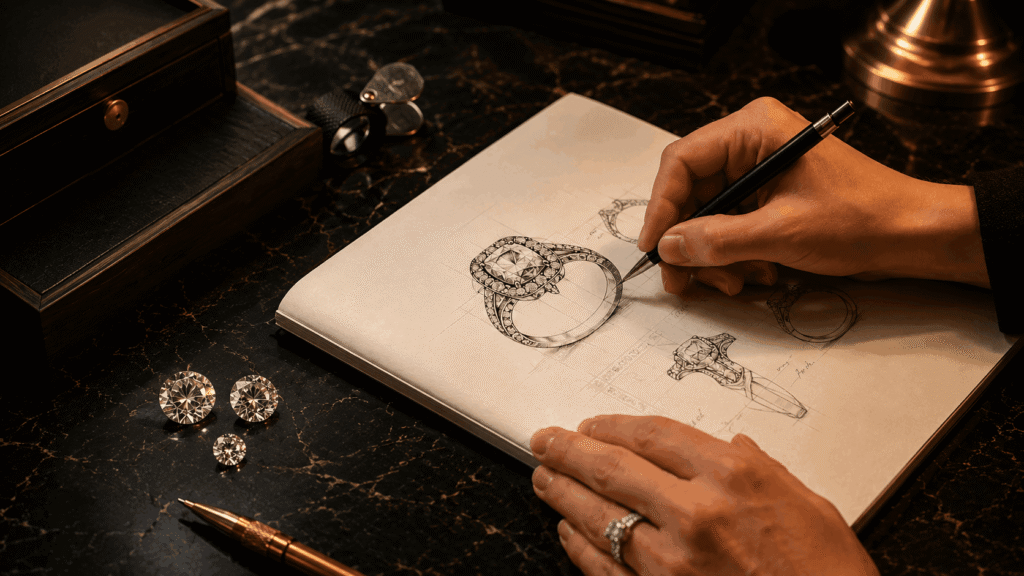
What Exactly Are Wholesale Lab Created Diamonds?
Before we explore the business case, it is worth grounding this conversation in science — because the most common misconception in the market still trips up buyers and designers alike.
Lab grown diamonds are real diamonds. They are not simulants, not look-alikes, and not a cheaper substitute material. They share the same chemical composition (pure crystalline carbon), the same hardness (10 on the Mohs scale), the same refractive index (2.417), and the same optical fire and brilliance as any diamond pulled from the Earth’s crust.
The difference is purely one of origin. A mined diamond formed over billions of years under intense geological pressure deep within the Earth. A lab grown diamond replicates that exact process — either through High-Pressure High-Temperature (HPHT) technology or Chemical Vapor Deposition (CVD) — inside a controlled laboratory environment, completing in weeks what nature took billions of years to achieve.
When purchased at wholesale volume directly from a lab grown diamond manufacturer or certified supplier, these stones become one of the most powerful tools available to the modern custom jewellery studio.
The Financial Case: Why Wholesale Pricing Changes Everything for Designers
The single most transformative aspect of sourcing wholesale lab created diamonds is the pricing structure — and what that pricing unlocks for your design business.
The Raw Price Advantage
As of 2026, a high-quality 1-carat lab grown diamond in the G/VS2 range is available at wholesale for well under $500 from established suppliers. A comparable natural diamond at wholesale sits between $3,500 and $5,000 for the same grade. That is a cost differential of roughly 85–90% in the designer’s favour.
For a custom jewellery studio, this gap translates directly into three business benefits:
Higher margins on custom work. When your primary stone cost drops by 85%, your margin on the finished piece improves dramatically — even if you pass some of the saving onto the client to stay competitive.
Larger design ambitions per budget. Clients who walk in with a $3,000 budget for a custom ring can now receive a 2-carat centre stone where before they might have been offered a 0.7-carat stone. That is a completely different product conversation.
Lower risk on experimental designs. When trying a new cut geometry, an unusual setting style, or a prototype piece, sourcing from lab grown diamonds wholesale in India or certified international suppliers means the cost of experimentation does not eat into your operating capital.
The Wholesale Volume Advantage
Purchasing wholesale lab created diamonds is not just about price per stone. It is about the consistency of supply and the ability to plan your design pipeline with confidence.
A reliable lab grown diamond manufacturer can fulfill precise specifications across an entire order — same colour grade, same clarity range, same cut parameters — across dozens or hundreds of stones simultaneously. For designers building collections, filling large bridal orders, or supplying retail partners, that consistency is operationally invaluable and virtually impossible to achieve with mined stones at the same price point.
CVD Diamonds Wholesale: Understanding the Technology Behind the Stone
For designers serious about sourcing intelligently, understanding the production method matters — because it affects both availability and the specific quality characteristics of the stone.
CVD diamonds wholesale refers to stones produced through the Chemical Vapor Deposition process. In a CVD reactor, a thin diamond seed plate is placed inside a sealed chamber filled with a carbon-rich gas mixture — typically methane. The gas is then ionised into plasma using microwave energy, causing individual carbon atoms to break free and deposit themselves onto the seed plate, layer by atomic layer, building a diamond crystal from the ground up.
CVD production has become the dominant method for high-quality wholesale supply for several reasons:
- Precise control over crystal growth means consistently higher clarity grades with fewer inclusions
- Scalable production means large orders can be filled to exact specifications
- Thinner reactor footprint allows manufacturers to expand capacity rapidly as demand grows
- Post-growth treatment options allow fine-tuning of colour grade after production
For studios sourcing wholesale lab created diamonds, CVD production offers something that was simply not possible in the mined diamond market: the ability to request a specific grade profile and reliably receive it across your entire order.
Lab Grown Diamonds Wholesale in India: The Global Supply Hub
India has long been the world’s dominant centre for diamond cutting and polishing — responsible for processing over 90% of the world’s rough diamonds at its peak. That same expertise and infrastructure has now positioned the country as the leading hub for lab grown diamonds wholesale in India supply chains.
Cities like Surat and Mumbai house hundreds of certified lab diamond manufacturers and wholesale suppliers, operating state-of-the-art CVD and HPHT facilities alongside expert cutting houses that finish the rough stones to internationally certified standards.
For international custom jewellery designers and studios, sourcing through lab grown diamonds wholesale in India channels offers several specific advantages:
| Advantage | What It Means for Your Studio |
| Competitive wholesale pricing | Lower stone cost = better margins or better client value |
| IGI and GIA certified stones | Every stone comes with internationally recognised documentation |
| Wide specification range | Round, fancy shapes, custom cuts available to exact spec |
| Fast turnaround on bulk orders | Established supply chains move quickly on volume orders |
| Ethical supply chain transparency | Full provenance documentation available on request |
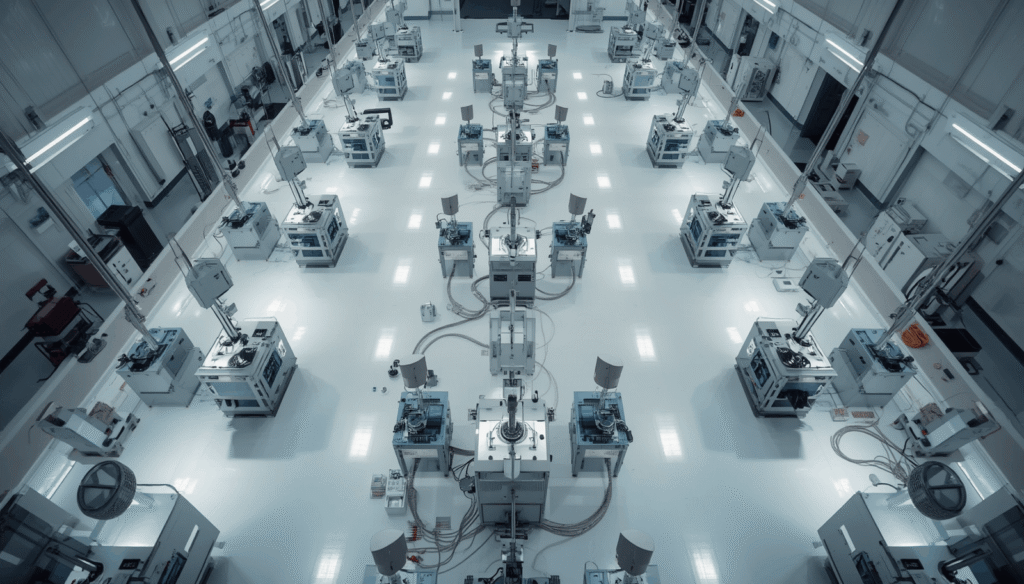
When evaluating suppliers of wholesale lab created diamonds in India, always request IGI or GIA certification on every stone, verify the supplier’s manufacturing registration, and request sample stones before committing to a volume order.
Working with a Lab Grown Diamond Manufacturer: The Creative Advantage
One of the most underappreciated advantages of working directly with a lab grown diamond manufacturer — rather than through a retail or secondary channel — is the creative latitude it opens up for bespoke design work.
Unlike mined diamonds, where a designer is limited to whatever rough the Earth happened to produce and what the cutting houses chose to do with it, working directly with a manufacturer means you can specify:
Shape and cut profile. Need a specific length-to-width ratio on an elongated oval? A custom rose cut depth? A proprietary faceting pattern exclusive to your studio? A manufacturer can work to your exact blueprint.
Colour grade targeting. For designers working with colored settings or specific metal tones, being able to target a precise colour grade — say, a consistent H/I for a yellow gold pavé band — ensures every stone in the design reads identically under the same lighting conditions.
Clarity range consistency. For high-transparency designs where the stone’s interior is visible from multiple angles — cathedral settings, bezel-free tension mounts, or open-gallery designs — specifying a minimum clarity floor ensures your finished piece performs exactly as designed.
Carat weight precision. For matching sets, eternity bands, or multi-stone designs where visual uniformity is critical, manufacturers can calibrate growth batches to deliver stones within an extremely narrow carat window.
This level of specification control is simply not available in the mined diamond market at any reasonable price point. It is one of the primary reasons bespoke jewellery studios have shifted their sourcing toward direct manufacturer relationships.
Colored Lab Grown Diamonds: Unlocking a Previously Exclusive Market
Perhaps the most exciting creative frontier that wholesale lab created diamonds have opened up is the world of colored lab grown diamonds.
In the natural diamond market, fancy colored diamonds — particularly vivid pinks, blues, greens, and canary yellows — are extraordinarily rare and correspondingly expensive. A natural vivid pink diamond of even modest size can command prices that put it entirely out of reach for all but the most exclusive custom commissions.
Colored lab grown diamonds have changed that equation entirely.
Through precise control of the growth environment, manufacturers can introduce specific trace elements or apply post-growth treatment processes to produce consistent, vivid color saturation across a range of hues:
- Fancy Yellow — produced by introducing nitrogen during CVD growth
- Fancy Blue — produced by introducing boron during the growth process
- Fancy Pink — achieved through post-growth treatment of colorless CVD rough
- Fancy Green — produced through controlled irradiation treatment after growth
- Fancy Black — produced through graphite inclusion or irradiation processes
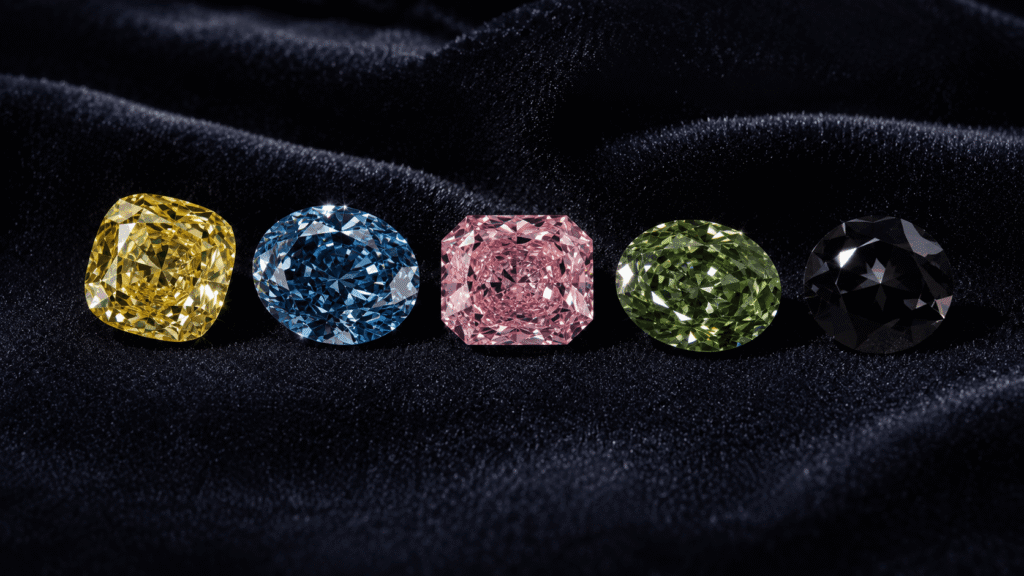
For a custom jewellery designer, the ability to source colored lab grown diamonds at wholesale pricing means that color-forward bespoke designs — rainbow eternity bands, colored solitaires, multi-hue cluster pieces — are now commercially viable for a much broader range of client budgets.
A vivid fancy yellow lab grown diamond of 1.5 carats, for example, is available at wholesale for a fraction of what even a faint natural fancy yellow would cost at retail. That opens up design territory that was previously reserved for ultra-luxury commissions to a far wider client base.
Choosing the Right Lab Grown Diamond Suppliers: What to Evaluate
Not all lab grown diamond suppliers operate to the same standard. For a custom jewellery studio building a reliable sourcing relationship, here is the evaluation framework that matters:
Certification Standards
Every stone you purchase wholesale should carry an IGI or GIA grading report. You can verify any stone’s grading report directly on the GIA official report check page before finalising any wholesale purchase. These are the two most widely accepted international certification bodies for lab grown diamonds and provide documented verification of the stone’s 4Cs grades. Avoid suppliers who offer uncertified stones or proprietary in-house grading only.
Production Method Transparency
Reputable suppliers will clearly disclose whether their stones are HPHT or CVD grown. This is relevant because each method can produce slightly different internal growth characteristics, and some retail markets and clients may have a preference.
Post-Sale Support and Returns Policy
In a custom design environment, occasionally a stone arrives outside the specified parameters. A quality supplier will have a clear, fair process for returns, exchanges, or re-specification on out-of-spec stones. This is non-negotiable for any studio doing volume business.
Ethical and Sustainability Documentation
Modern clients increasingly request documentation of ethical sourcing. Reputable lab grown diamond suppliers will provide documentation of their energy sourcing practices, manufacturing facility certifications, and supply chain transparency reports.
Sample Order Policy
Before committing to any significant wholesale relationship, always request a sample order of 3–5 stones across your most common specification range. Evaluate cut quality, grading accuracy, and surface finish before scaling up.
The Sustainability Argument: What Your Clients Actually Want to Hear
In 2026, sustainability is no longer a niche concern for a small segment of eco-conscious buyers. It has become a mainstream purchasing consideration — particularly among the Millennial and Gen Z buyers who now represent the largest segment of the custom jewellery market.
Lab grown diamonds address the most significant ethical concerns associated with the traditional mined diamond industry: conflict sourcing, unsafe mining conditions, environmental land disruption, and lack of supply chain transparency.
When a client asks where their diamond came from, a custom jewellery studio sourcing from certified lab grown diamond suppliers can answer that question with complete precision and documented evidence. That transparency is a genuine competitive differentiator in a market where many clients are actively choosing jewellers based on their sourcing practices.
It is worth noting the energy consideration honestly: growing diamonds in a laboratory does require significant electrical power. However, leading manufacturers — particularly those operating through India’s growing renewable energy infrastructure — are increasingly sourcing their reactor power from solar and hydroelectric grids and providing third-party verified carbon-neutral certifications to their wholesale clients.
How to Build a Wholesale Lab Created Diamond Sourcing Strategy for Your Studio
Transitioning your studio’s sourcing toward wholesale lab created diamonds is not simply a matter of switching suppliers. It requires a deliberate strategy that aligns your stone sourcing with your design pipeline, client profile, and business model.
Step 1: Audit your current stone usage. Before approaching suppliers, document your most common specification requirements — your typical carat ranges, shape preferences, colour and clarity grades, and volume per month. This data drives a better supplier conversation.
Step 2: Identify 2–3 candidate suppliers. Do not commit to a single supplier relationship immediately. Identify 2–3 reputable manufacturers or wholesale distributors and run sample orders through each before choosing a primary partner.
Step 3: Negotiate volume pricing tiers. Wholesale pricing improves significantly with volume commitment. Once you have validated a supplier through sample orders, negotiate a tiered pricing agreement based on your projected monthly volume.
Step 4: Update your client-facing communication. Prepare a clear, confident explanation of lab grown diamonds for client conversations — covering quality parity with mined stones, ethical sourcing advantages, and the design benefits of lab-grown availability. Most clients respond positively once the science is clearly explained.
Step 5: Build the sustainability story into your brand. Use your switch to lab grown sourcing as a brand narrative, not just an operational decision. Studios that position themselves as leaders in ethical, sustainable fine jewellery are capturing significant market share from clients who are actively seeking that positioning.
Final Thoughts: The Studio That Sources Smarter Designs Better
The custom jewellery industry is in the middle of a genuine structural shift. The designers and studios that are thriving in 2026 are not the ones clinging to traditional sourcing models out of habit — they are the ones who recognised early that wholesale lab created diamonds represent a fundamentally better tool for delivering exceptional bespoke work.
Better pricing means more ambitious designs per budget. Better specification control means more precise execution. Better supply consistency means more reliable production timelines. And better sourcing transparency means a stronger ethical brand story that resonates with today’s most valuable clients.
Lab grown diamonds are not a compromise. They are not the budget option. They are the professional’s choice for any studio that takes its design output — and its business model — seriously.
The question is no longer whether wholesale lab created diamonds belong in your sourcing strategy. The question is how quickly you can build the supplier relationships that will power your next level of creative and commercial growth.
Frequently Asked Questions
Yes, completely. Lab grown diamonds are physically, chemically, and optically identical to mined diamonds. They consist of pure carbon in the same crystalline structure, score 10 on the Mohs hardness scale, and are graded by the same institutions — IGI and GIA — using the same 4Cs criteria. No gemologist using standard tools can tell them apart.
Most reputable wholesale suppliers and manufacturers work with orders starting from 10 to 20 stones per specification. Larger studios placing regular monthly orders can often negotiate no minimum quantity agreements once a supplier relationship is established and trust is built over time.
Both methods produce real diamonds of equivalent quality. CVD diamonds tend to offer slightly better consistency in clarity grades and are more commonly available at high-specification wholesale levels. HPHT stones can show slightly different fluorescence characteristics. For most custom jewellery applications both are excellent — the more important factor is cut quality and certification on each individual stone.
Yes. Working directly with a lab grown diamond manufacturer you can specify the desired colour family — yellow, blue, pink, green — and receive stones produced to that colour profile. Very specific colour intensity targets may require a small batch production run and slightly longer lead times of 4 to 6 weeks, but they are absolutely achievable for bespoke commissions.
Yes. Indian wholesale suppliers operating through established manufacturing hubs in Surat and Mumbai routinely produce IGI and GIA certified stones that meet international retail standards. Always request full certification documentation before completing any wholesale purchase to ensure every stone is properly verified.
No — not visually and not with standard jewellery testing equipment. The two stones are indistinguishable to the naked eye, under a loupe, and under a standard gemological microscope. Only specialised equipment specifically designed to detect CVD or HPHT growth patterns can differentiate them, and most retail jewellers do not own this equipment.
It is important to be transparent with clients on this point. Lab grown diamonds currently have a very limited secondary resale market due to ongoing price decreases driven by expanding manufacturing capacity. They should be purchased for the joy and utility of wearing them, not as financial investments. Natural diamonds retain better secondary market value for clients with long-term asset preservation goals.
Request the supplier’s facility certification documentation, energy sourcing disclosure, and any third-party sustainability audit reports. Reputable lab grown diamond suppliers will have these materials readily available. Look for suppliers who are members of the Responsible Jewellery Council (RJC) or who hold recognised environmental certifications for their manufacturing operations.
Yes, this is a major advantage of working directly with manufacturers. Custom cutting instructions including proprietary faceting patterns exclusive to your studio can be provided and the manufacturer will produce the rough and cut to your exact specification. Lead times for custom cuts are typically 4 to 8 weeks depending on volume and complexity of the design.
Start with a clearly defined specification list based on your studio’s most common requirements. Contact 2 to 3 established wholesale suppliers or manufacturers, request sample stones at your standard specification before committing to volume, verify IGI or GIA certification on every sample, and assess cut quality and grading accuracy against the certificate before scaling the relationship.
Disclaimer: This article is intended for informational and educational purposes only. Diamond prices, supplier terms, and market conditions vary and are subject to change. Always conduct due diligence and consult certified gemological professionals before entering wholesale purchasing agreements.